

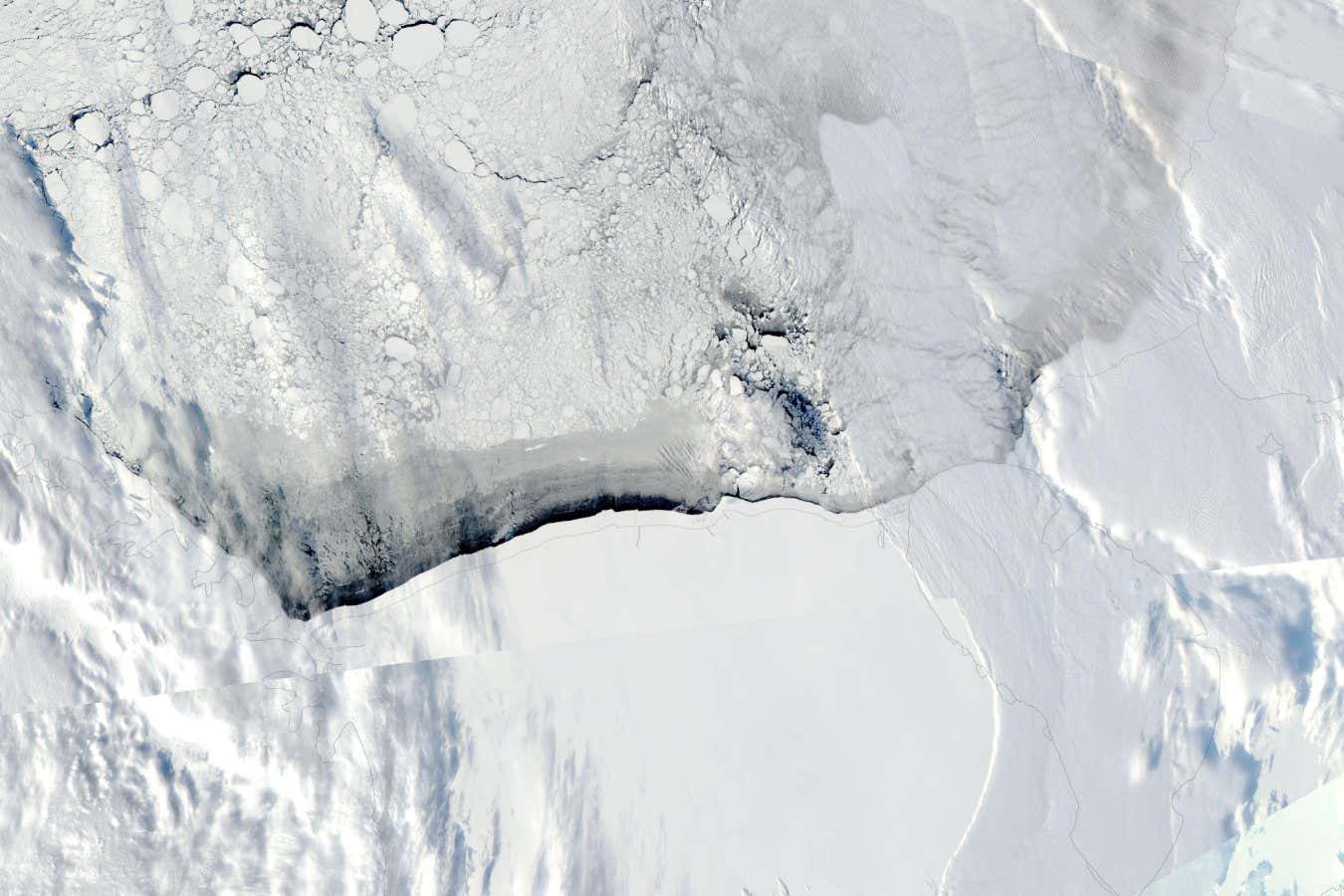
The Ronne ice shelf in West Antarctica survived a warm period long ago
MODIS/ZUMA Wire/Shutterstock
A major ice shelf in Antarctica appears to have survived a period of hot temperatures more than 120,000 years ago, indicating that the West Antarctic ice sheet may not be as vulnerable as we thought to complete collapse caused by climate change – a worst-case situation that could raise sea levels by metres. But large uncertainties remain.
“It’s good news and it’s bad news,” says Eric Wolff at the University of Cambridge, UK. “We didn’t get the worst-case scenario. But I can’t put my hand on my heart and say this wouldn’t happen in the next century or two.”
Human-caused climate change has made the future of the West Antarctic ice sheet uncertain. If we continue emitting high levels of greenhouse gases, some models project the ice sheet will completely disappear over the next few centuries. In the most extreme scenario projected by the Intergovernmental Panel on Climate Change in 2023, this could raise sea levels by as much as 2 metres by 2100.
Wolff and his colleagues looked at the Ronne ice shelf, a large section of the ice sheet that extends into the ocean, to see how it behaved between 117,000 and 126,000 years ago. During that time, which was part of the last interglacial period, changes in Earth’s orbit raised Antarctic temperatures even higher than they are today.
To determine the extent of the Ronne ice shelf during that warm period, the researchers measured concentrations of sea salt in an ice core drilled about 650 kilometres away from the shelf’s edge. If the ice shelf had melted during the last interglacial, its edge would have drawn closer to the core’s location. As a result, the researchers expected salt concentrations in the core would rise eightfold during those years, because the core’s location would have been much closer to the open ocean. “It would have been a seaside resort,” says Wolff.
Instead, they found salt concentrations during the last interglacial were similar or even lower than those of today, indicating that the edge of the ice sheet remained far away. Other measurements of water isotopes in the core, which preserve evidence of weather patterns influenced by changing ice sheets, also suggest the Ronne ice shelf persisted during the last interglacial.
The ice’s stability in this previous warm period suggests a lower likelihood that the West Antarctic ice sheet will totally collapse as climate change drives up global temperatures, says Wolff. However, he and other researchers say sea level rise due to melting ice still poses a major risk.
“It implies there was not a complete deglaciation of western Antarctica, but it doesn’t give us enough information to relax,” says Timothy Naish at Victoria University of Wellington in New Zealand.
For one, the survival of the Ronne ice shelf doesn’t mean that other areas of ice, like the Thwaites or Pine Island glaciers, didn’t melt. In fact, the water isotope record in the core suggests they did, says Wolff. The ice core the researchers used also didn’t cover the warmest period of the last interglacial.
The dynamics of warming in the last interglacial, which varied by region, are also different from global warming today, when temperatures are rising across the whole planet. For example, warmer ocean waters reaching Antarctica could accelerate melt by intruding under the ice, says Wolff.
“This is a really important observation, but I think it’s going to take us longer to figure out what it means,” says Andrea Dutton at the University of Wisconsin-Madison. She stresses that researchers have spent 50 years trying to work out what happened to the West Antarctic ice sheet during the last interglacial.
Topics:
