

Did Homo sapiens (left) and Neanderthals have shared culture?
S.PLAILLY/E.DAYNES/SCIENCE PHOTO LIBRARY
About 59,000 years ago, Homo sapiens moved into a coastal cave in Turkey that was previously home to Neanderthals. Yet the tools and trinkets found in the cave remained remarkably consistent, hinting that these ancient hominin species had a shared material culture.
Situated on Turkey’s Mediterranean coast, Üçağızlı II cave is a 56-square-metre space, about the size of a city studio apartment.
Naoki Morimoto at Kyoto University, Japan, and his colleagues carried out the first full archaeological dig at the site in 2020. Teeth and jaw remains revealed that Neanderthals inhabited the cave from 77,000 to 59,000 years ago and our species, Homo sapiens, from 59,000 to 47,000 years ago.
Altogether, nearly 20,000 stone artefacts were also recovered from the cave. But, surprisingly, the stone-tool technology used by the two human species and the objects they collected remained extraordinarily consistent throughout the entire period. This raises the possibility that Neanderthals and Homo sapiens co-existed for a while.
“We cannot definitively prove a temporal or physical overlap between the two hominin species in the region of the site or the site itself,” says Morimoto. “However, this is indeed a central hypothesis that we are exploring.”
Across every layer of human occupation in the cave, the foundational toolkit was exactly the same, says Morimoto. More remarkably, the Neanderthals and Homo sapiens collected a shell that seemed to have no useful purpose as a tool or as a food but was, for some reason, desirable to both species.
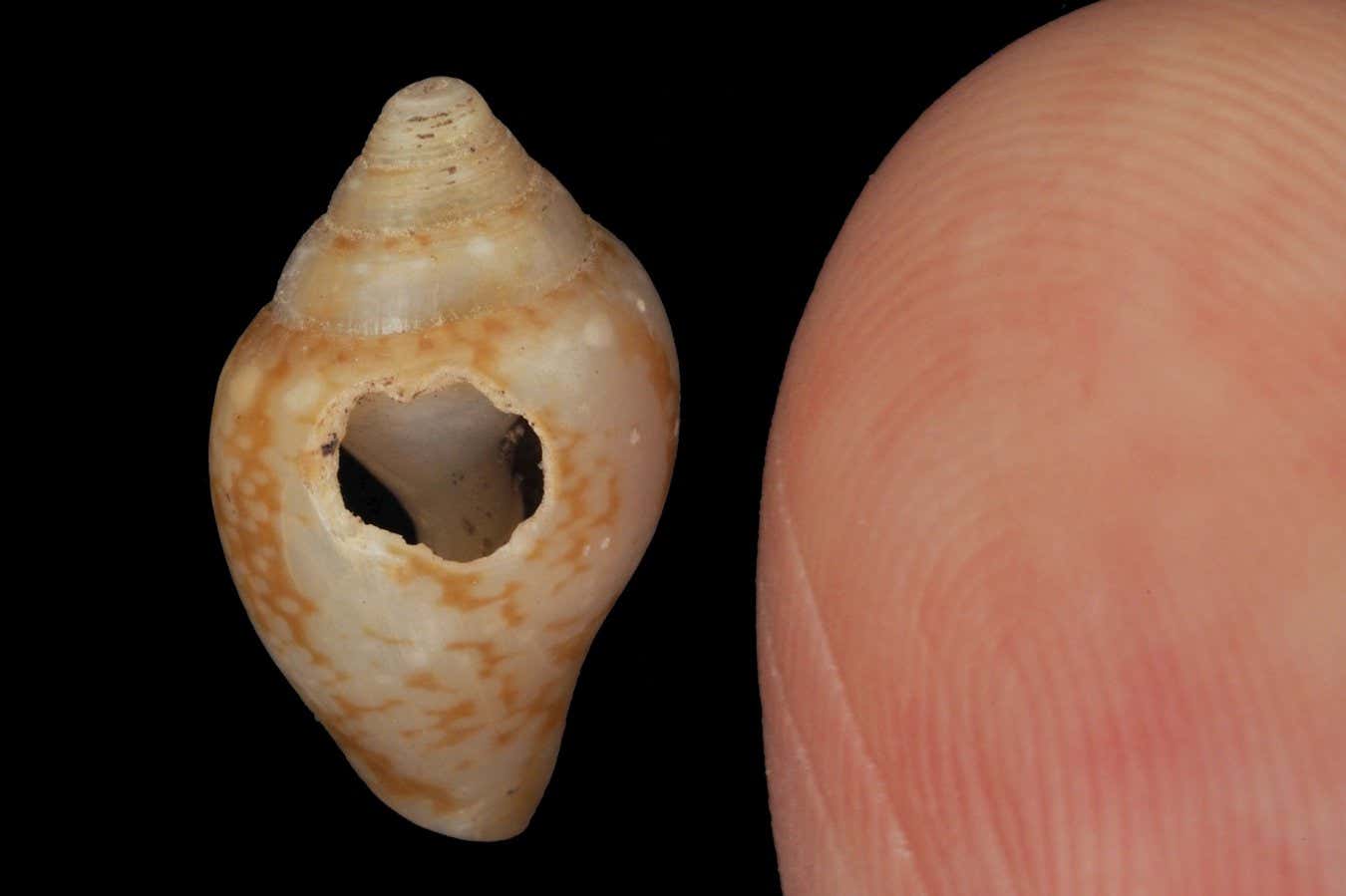
Nearly 30 examples of the shells of the small but pretty sea snail Columbella rustica were found throughout all layers of deposits left by both species.
In a few cases, these shells had their point broken off or had holes that may indicate a decorative purpose. Mostly, however, both species seemed to have simply kept them intact and valued them for some intrinsic reason.

A Columbella rustica shell associated with Neanderthal remains
Naoki Morimoto
While other shell types are present in the cave, Columbella rustica makes up the majority throughout the sequence, says Morimoto. “This strong preference suggests that both human groups shared a common cultural evaluation of this specific shell, finding it uniquely valuable or attractive.”
The “striking consistency” in both the stone-tool technology and the collection of shells is “difficult to explain by independent, parallel processes alone”, he says.
Although there is no definitive evidence for friendly relations between the two species, this is the scenario the team is leaning towards. “What we propose is that a model involving regional contact, cultural exchange or overlapping occupational territories offers a plausible explanation for the archaeological evidence,” says Morimoto.
John Gowlett at the University of Liverpool, UK, says the puzzle of the relationship between Neanderthals and our own species has gone from 100 to 1000 pieces. “For more than 200,000 years, modern humans, broadly the people of the south, had a fluctuating frontier with the people of the north, the Neanderthals,” he says.
“They must have been aware of one another regularly and the implication may have been a very strong ‘us and them’ distinction, but this paper helps show that this did not need to mean separate material cultures or even hunting patterns,” says Gowlett. “Both species seem to have had a predilection for shells, something that may go further back in time than we can yet see.”
There is evidence of Neanderthals and Homo sapiens sharing culture at other, older archaeological sites in the Levant, says Chris Stringer at the Natural History Museum in London, and recent studies suggest they probably interbred with each other in that region around 100,000 years ago.
“The human samples at Üçağızlı are too small to show the levels of population variation, but there could well have been interbreeding at that later time as well,” says Stringer.
Topics:
