

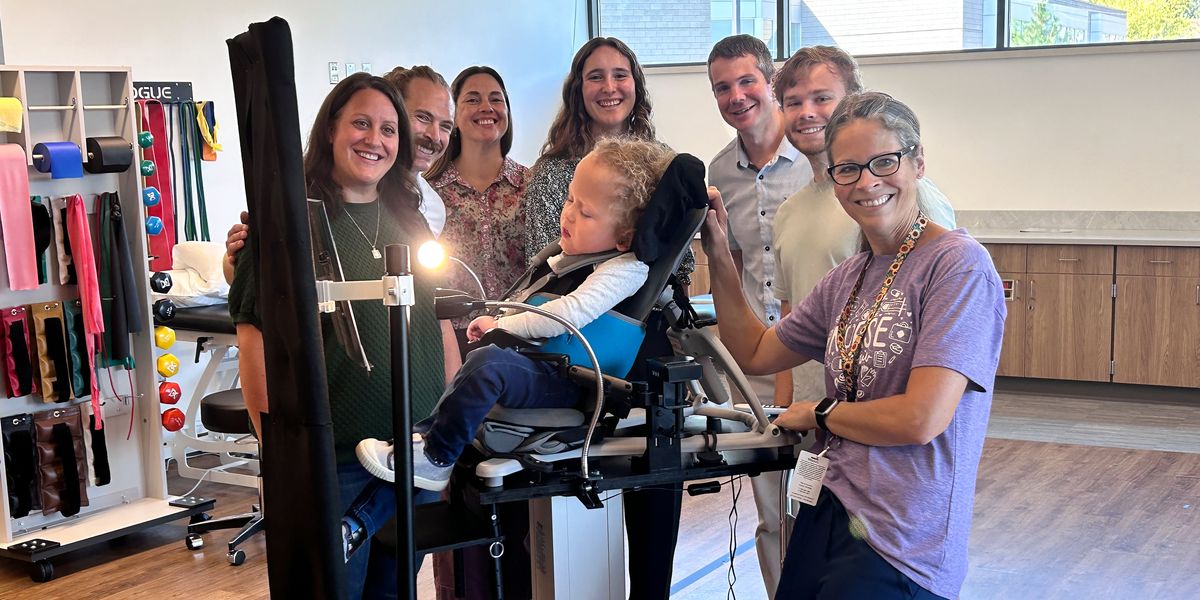
Researchers in the U.S. Pacific Northwest recently delivered a piece of assistive technology whose design began with a simple but important question: What will the person using this tech need?
Last month a team of engineers and occupational therapists from Whitworth University in Spokane, Wash. delivered a learning station they’d designed for a first grader with cerebral palsy.
David Schipf, assistant professor of engineering and physics at Whitworth, says the project’s success was due to the collaborative efforts between team members—engineers, physical therapists, and occupational therapists—and the child and his family. After multiple consultations with the family, the Whitworth team delivered their system.
“The station is very user-friendly, allowing Ryken to focus on his first-grade studies and putting him at eye-level with those speaking to him,” says Schipf. “He will also be able to move throughout the house as needed.”
The first grader, Ryken, has a form of cerebral palsy along with other disabilities, which include epilepsy, hearing, and visual impairments.
Ryken’s mother had initially contacted Schipf because Ryken was unable to participate fully in his education. And she’d discovered a lack of suitable equipment on the market that Ryken could use to meet his needs.
What Is User-Centered Design in Assistive Tech?
As advocates for user-centered design (UCD) have pointed out, functional assistive tech needs to “answer the needs” of the person it’s designed for—not just the needs of people designing it.
As one example, Shipf points to the station’s high-contrast black background, which allowed Ryken to view anything placed in front of him easily. “It had to have some adjustable features for his caregivers and for his teacher,” Schipf says. “And his mother wanted the seat on the learning center to be able to be raised up and lowered according to what he was doing at the time. So if he’s learning with his teacher to have it be lower to the ground, and then if he’s in the kitchen with his mom, to have it raise up to counter height.”
“The raising and lowering came from an electrical raising and lowering kind of a piston that we purchased,” he adds. “And it’s usually designed for kitchen tables for families that want a kitchen table that can raise and lower. So it had the load capacity that we needed. And then we just had a pretty large onboard power bank that could also provide an AC 120 voltage power source for the raising and lowering platform. … And then several of the mechanical components were custom designed and 3D printed.”
Katie Ericsson, assistant professor of occupational therapy at Whitworth, highlighted one of the students who worked on the project. This student suggested that emphasis also be placed on the aesthetics of the project, reminding the team that, “Hey, this is going to be in their home, and his mother doesn’t want this to look ugly in their home.”
A team of engineers and occupational and physical therapists in Washington state developed a customized communications device to help a father and his disabled daughter remain active and mobile—but also within reach of emergency services if assistance is ever needed.David Schipf
Making Assistive Tech More Collaborative
Schipf, Ericsson, and students are also working on another project to benefit those with disabilities. The project focused on developing an emergency communication device for a young woman in the Spokane area. She is in her 20s and is mobile but has speech difficulties. The project originated from her father’s concern for her well-being in case something happened to him while she was outdoors or traveling through the city.
The device fits within a fanny pack. The concept behind the device is simple. In the event of an emergency, the device is intended to send an SMS message to preprogrammed recipients with the press of a button.
“This father, he’s a little bit older, and he has some health problems,” Schipf says. “And he’s really concerned that he’s going to be on a hike with his daughter and that he’s going to pass out or something’s going to happen to him, and then she is going to be left alone without anybody to understand her speech and anybody to help her out. … And so we designed an electrical system that fits in a fanny pack.”
The device, Schipf says, has big, textured buttons that allow the wearer to send geolocated SMS alerts, in case of emergency. “So it’s location tracking and an SMS service,” he continues. “And then the other button on the device plays an audio message that tells any stranger she encounters to call her father.”
Both devices showcase the power of both collaboration and assistive technology. Although these devices were created for specific individuals, the technology used to make them can be modified or duplicated to serve the larger disability community as a whole.
“I know both the engineering students and the occupational therapy and physical therapy students, it’s much more meaningful to them when they get to see the face and talk to the actual clients,” says Ericsson. “It’s much more meaningful than just a textbook case study that we give them.”
From Your Site Articles
Related Articles Around the Web
