

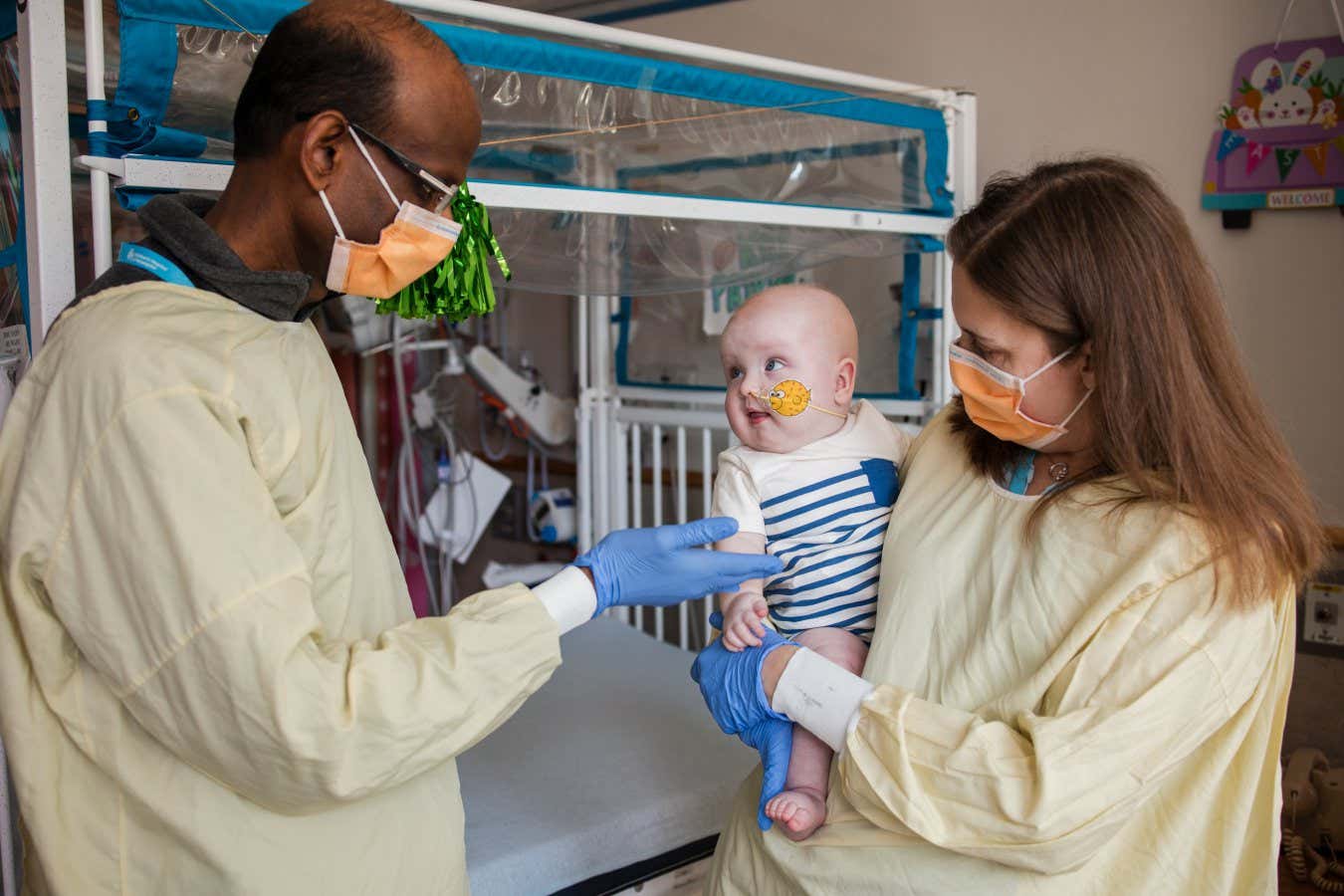
Baby KJ after a gene-editing infusion with researchers Rebecca Ahrens-Nicklas and Kiran Musunuru
Children’s Hospital of Philadelphia
A baby boy with a life-threatening genetic condition has become the first person to receive a bespoke CRISPR gene-editing treatment, giving a glimpse into what the future of medicine might look like.
It’s the first time anyone has been given a gene-editing treatment designed to correct a disease-causing mutation found only in that individual, Rebecca Ahrens-Nicklas at the Children’s Hospital of Philadelphia, Pennsylvania, told a press briefing. “He’s showing some early signs of benefit,” she says, but it is too soon to tell how well the treatment worked.
The researchers published the details as soon as possible in the hope that it will inspire others, says team member Kiran Musunuru at the University of Pennsylvania. “We very much hope that showing that it’s possible to make a personalised gene-editing therapy for a single patient in several months will inspire others to do the same,” he says.
“I don’t think I’m exaggerating when I say that this is the future of medicine,” he says. “This is the first step towards the use of gene-editing therapies to treat a wide variety of rare genetic disorders for which there are actually very few treatments currently in development at all.”
The boy, KJ, inherited mutations in each of his two copies of a gene for a liver enzyme called CPS1. Without this enzyme, ammonia builds up in the blood when proteins, including ones we eat, are broken down, damaging the brain. More than half of children born with a CPS1 deficiency die, says Ahrens-Nicklas.
She and Musunuru have been developing treatments for this kind of condition that target the liver, allowing them to rapidly create a base-editing therapy – a form of CRISPR – that corrects one of KJ’s two copies of the CPS1 gene.
The team contacted US regulators early on. “They recognised that this was an unusual circumstance,” says Musunuru. “KJ was very, very sick, and there wasn’t time for business as usual. When we formally submitted our application to the FDA [Food and Drug Administration] when KJ was 6 months of age, the FDA approved it in just one week.”
KJ was given a low dose of the treatment in February 2025 when he was 6 months old, followed by larger doses in March and April. He is now able to eat more protein than before, despite taking lower amounts of other medications to manage his condition.
Ideally, children would be treated even earlier to prevent the long-term damage conditions such as CPS1 deficiency can cause. As New Scientist reported last year, Musunuru aims to one day edit human genes before birth.
Other gene-editing therapies are designed to work for many people, regardless of the specific mutation causing their condition. For instance, the first ever approved gene-editing treatment, for sickle cell disease, works by turning on the production of fetal haemoglobin, rather than by correcting the mutations in adult haemoglobin that cause the condition. Despite being a “one-size-fits-all” treatment, it still costs £1,651,000 per course of treatment in England.

KJ with his family after the treatment
Children’s Hospital of Philadelphia
Personalised treatments are likely to be even more expensive. Musunuru says he can’t put a number on KJ’s treatment, because the companies involved did much of the work for free. But the price will come down, he thinks. “As we get better at doing this, economies of scale will kick in and you can expect the cost to come down orders of magnitude,” he says.
One reason personalised gene-editing treatments haven’t been developed before is that regulators have regarded therapies targeting different mutations in the same gene as separate, meaning companies would have had to restart the approval process from scratch for every different mutation. But there is now a move towards what is called a platform approach, where regulators will give broad approval to a therapy for a condition, whichever mutation is targeted.
“Platform-based approaches, like genome editing with CRISPR – as we’re seeing with KJ’s treatment – offer a scalable way to treat even the rarest diseases,” says Nick Meade at the Genetic Alliance UK, a charity that helps people with rare diseases. “This at last makes treatment a realistic prospect for thousands of families.”
Topics:
