

On the shores of Lake Geneva in Switzerland, École Polytechnique Fédérale de Lausanne is home to many roboticists. It’s also home to many birds, which spend the majority of their time doing bird things. With a few exceptions, those bird things aren’t actually flying: Flying is a lot of work, and many birds have figured out that they can instead just walk around on the ground, where all the food tends to be, and not tire themselves out by having to get airborne over and over again.
“Whenever I encountered crows on the EPFL campus, I would observe how they walked, hopped over or jumped on obstacles, and jumped for take-offs,” says Won Dong Shin, a doctoral student at EPFL’s Laboratory of Intelligent Systems. “What I consistently observed was that they always jumped to initiate flight, even in situations where they could have used only their wings.”
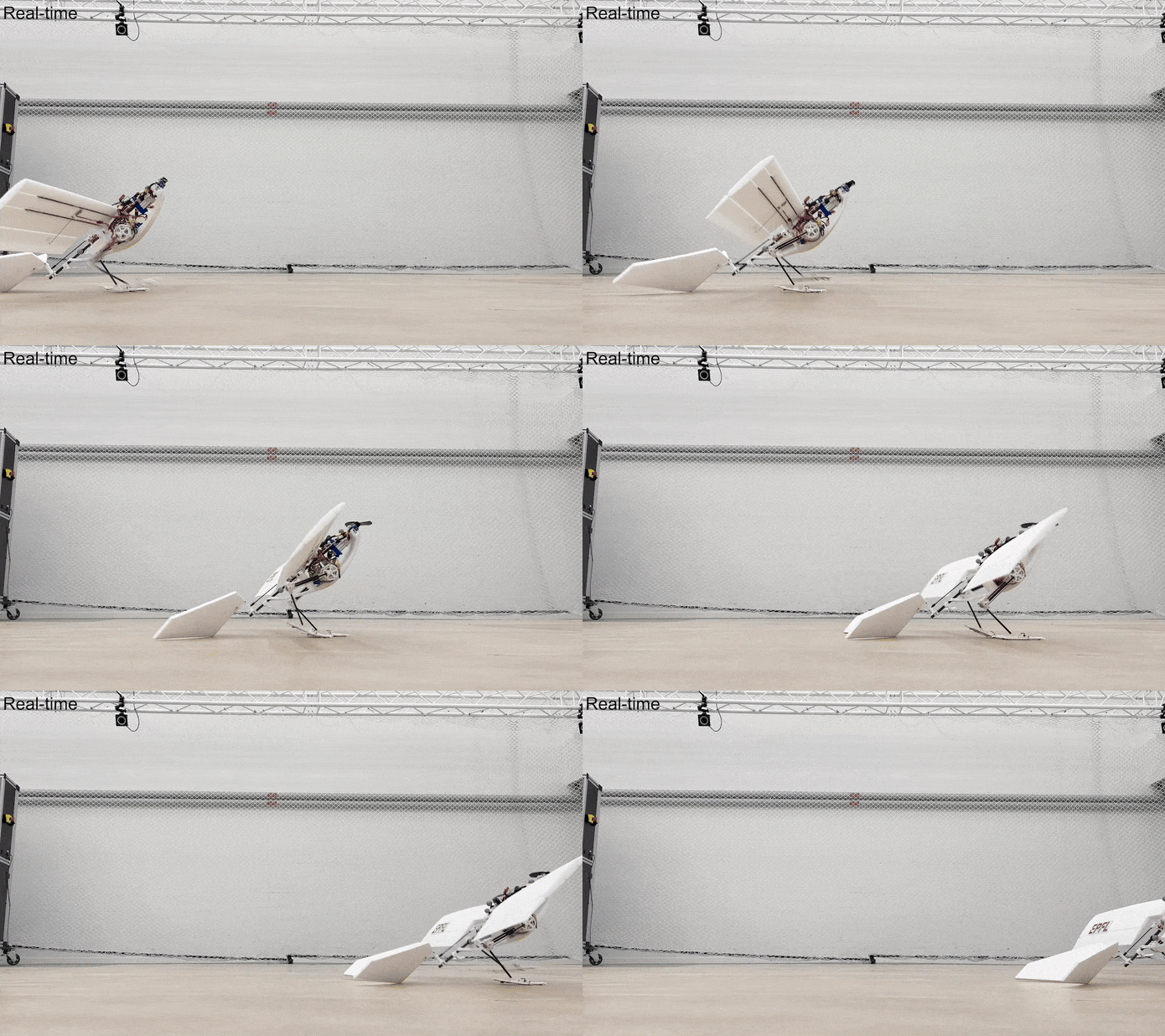
Shin is first author on a paper published today in Nature that explores both why birds jump to take off, and how that can be beneficially applied to fixed-wing drones, which otherwise need things like runways or catapults to get themselves off the ground. Shin’s RAVEN (Robotic Avian-inspired Vehicle for multiple ENvironments) drone, with its bird-inspired legs, can do jumping takeoffs just like crows do, and can use those same legs to get around on the ground pretty well, too.
The drone’s bird-inspired legs adopted some key principles of biological design like the ability to store and release energy in tendon-like springs along with some flexible toes.EPFL
Back in 2019, we wrote about a South African startup called Passerine which had a similar idea, albeit more focused on using legs to launch fixed-wing cargo drones into the air. This is an appealing capability for drones, because it means that you can take advantage of the range and endurance that you get with a fixed wing without having to resort to inefficient tricks like stapling a bunch of extra propellers to yourself to get off the ground. “The concept of incorporating jumping take-off into a fixed-wing vehicle is the common idea shared by both RAVEN and Passerine,” says Shin. “The key difference lies in their focus: Passerine concentrated on a mechanism solely for jumping, while RAVEN focused on multifunctional legs.”
Bio-inspired Design for Drones
Multifunctional legs bring RAVEN much closer to birds, and although these mechanical legs are not nearly as complex and capable as actual bird legs, adopting some key principles of biological design (like the ability to store and release energy in tendon-like springs along with some flexible toes) allows RAVEN to get around in a very bird-like way.
EPFL
Despite its name, RAVEN is approximately the size of a crow, with a wingspan of 100 centimeters and a body length of 50 cm. It can walk a meter in just under four seconds, hop over 12 cm gaps, and jump into the top of a 26 cm obstacle. For the jumping takeoff, RAVEN’s legs propel the drone to a starting altitude of nearly half a meter, with a forward velocity of 2.2 m/s.
RAVEN’s toes are particularly interesting, especially after you see how hard the poor robot faceplants without them:
 Without toes, RAVEN face-plants when it tries to walk.EPFL
“It was important to incorporate a passive elastic toe joint to enable multiple gait patterns and ensure that RAVEN could jump at the correct angle for takeoff,” Shin explains. Most bipedal robots have actuated feet that allow for direct control for foot angles, but for a robot that flies, you can’t just go adding actuators all over the place willy-nilly because they weigh too much. As it is, RAVEN’s a 620-gram drone of which a full 230 grams consists of feet and toes and actuators and whatnot.
 Actuated hip and ankle joints form a simplified but still birdlike leg, while springs in the ankle and toe joints help to absorb force and store energy.EPFL
Why Add Legs to a Drone?
So the question is, is all of this extra weight and complexity of adding legs actually worth it? In one sense, it definitely is, because the robot can do things that it couldn’t do before—walking around on the ground and taking off from the ground by itself. But it turns out that RAVEN is light enough, and has a sufficiently powerful enough motor, that as long as it’s propped up at the right angle, it can take off from the ground without jumping at all. In other words, if you replaced the legs with a couple of popsicle sticks just to tilt the drone’s nose up, would that work just as well for the ground takeoffs?
The researchers tested this, and found that non-jumping takeoffs were crappy. The mix of high angle of attack and low takeoff speed led to very unstable flight—it worked, but barely. Jumping, on the other hand, ends up being about ten times more energy efficient overall than a standing takeoff. As the paper summarizes, “although jumping take-off requires slightly higher energy input, it is the most energy-efficient and fastest method to convert actuation energy to kinetic and potential energies for flight.” And just like birds, RAVEN can also take advantage of its legs to move on the ground in a much more energy efficient way relative to making repeated short flights.
 Won Dong Shin holds the RAVEN drone.EPFL
Can This Design Scale Up to Larger Fixed-Wing Drones?
Birds use their legs for all kinds of stuff besides walking and hopping and jumping, of course, and Won Dong Shin hopes that RAVEN may be able to do more with its legs, too. The obvious one is using legs for landing: “Birds use their legs to decelerate and reduce impact, and this same principle could be applied to RAVEN’s legs,” Shin says, although the drone would need a perception system that it doesn’t yet have to plan things out. There’s also swimming, perching, and snatching, all of which would require a new foot design.
We also asked Shin about what it would take to scale this design up, to perhaps carry a useful payload at some point. Shin points out that beyond a certain size, birds are no longer able to do jumping takeoffs, and either have to jump off something higher up or find themselves a runway. In fact, some birds will go to astonishing lengths not to have to do jumping takeoffs, as best human of all time David Attenborough explains:
BBC
Shin points out that it’s usually easier to scale engineered systems than biological ones, and he seems optimistic that legs for jumping takeoffs will be viable on larger fixed-wing drones that could be used for delivery. A vision system that could be used for both obstacle avoidance and landing is in the works, as are wings that can fold to allow the drone to pass through narrow gaps. Ultimately, Shin says that he wants to make the drone as bird-like as possible: “I am also keen to incorporate flapping wings into RAVEN. This enhancement would enable more bird-like motion and bring more interesting research questions to explore.”
“Fast ground-to-air transition with avian-inspired multifunctional legs,” by Won Dong Shin, Hoang-Vu Phan, Monica A. Daley, Auke J. Ijspeert, and Dario Floreano from EPFL in Switzerland and UC Irvine, appears in the December 4 issue of Nature.
From Your Site Articles
Related Articles Around the Web
