

This spring, former Democratic Gov. Christine Gregoire made headlines by declaring her own party’s lawmakers had what she called a “spending problem” in Olympia, noting the state budget doubled over the last decade. She urged legislators to avoid “stacking one more tax, one more rule,” and “one more regulation,” atop a state economy she said was being battered by an unpredictable and increasingly skewed tax climate.
Gregoire’s remarks followed a whirlwind legislative session where lawmakers, led by Senate Majority Leader Jamie Pedersen, D-Seattle, passed the state’s first ever income tax on those earning more than $1 million a year.
So when the former governor summoned a new partnership aimed at resuscitating economic development as a political priority in Washington state, she invited lawmakers, including Pedersen, to attend. Was this a chance to scold them for contributing to the malaise she was calling out?
I don’t think that was her intention. But the convening did give Pedersen an unscripted moment to explain himself — and his answer showed he and Gregoire may have found a new middle ground for the state’s ruling political party on taxes and the economy.
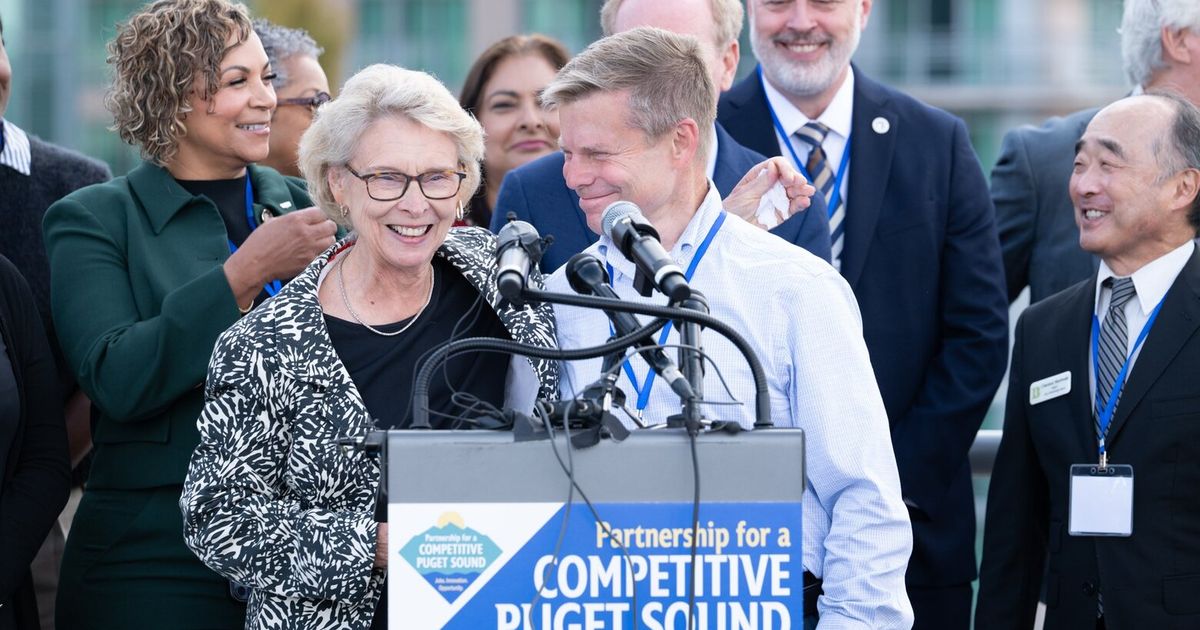
At the Sept. 14 event, Pedersen got called to answer a question from Bloomberg journalist Anna Edgerton. Because of Pedersen’s role as the architect of the state’s new income tax on high earners, a few nervous laughs emerged from the pro-business crowd. The awkward moment gave way to levity when a smiling Gregoire put her arm around Pedersen and squeezed his shoulder. It was the former governor’s way of disarming any tension.
Edgerton asked whether lawmakers were considering a Seattle-style payroll tax. Pedersen replied that the chance of state lawmakers pursuing a payroll tax is “vanishingly unlikely” if voters defeat the income tax’s repeal measure, Initiative 645, at the ballot box.
The state Senate majority leader also said he supported a more “plain vanilla” tax code for Washington state, making it less of a standout with some of the highest sales and business excise taxes in the country. Even if a new income tax will eliminate a longtime competitive advantage of doing business in Washington, he would likely find many business leaders that would agree with his sentiment.
The payroll tax, however, is an electric third rail for business. A short time later, Brad Smith, Microsoft’s president, used the corollary of cigarette taxes to explain how a higher levy diminishes the behavior — and a tax on jobs will produce less of them. Witness Seattle’s JumpStart payroll tax and the ways it has pushed jobs to Bellevue. A statewide version would do the same, only on a national scale.
An income tax on millionaires, by contrast, is popular with the public, according to recent polling. And while some business owners have lined up to fight for Initiative 645 to repeal the tax, many business organizations have remained on the sidelines.
But voters also expect results for those revenues, not to mention a Legislature that’s deliberative and thoughtful about its tax policy, as Gregoire argues.
That’s what made the 9.9% levy on earnings over $1 million hard to stomach — roughly a third of the estimated $4 billion in new revenues would go to tax credits for families struggling to make ends meet. The other two-thirds are paying for Olympia’s expansionary spending habits, which seem to grow unabated every year.
Since 2023, budget writers have seemingly flipped every couch cushion possible in Olympia, dangerously drawing down the state’s reserves to the lowest in the nation. Worse, they have hastily passed taxes that have been a sucker punch to many businesses across the state. In 2025, lawmakers pushed through, in just nine days, an expansion of the state’s sales taxes to business services. It was decisions like that which prompted Gregoire to take up the economic development mantle and push back on her party.
But with Democrats in control of all the levers of Washington state government, and an initiative challenge notwithstanding, what might compel the ruling party to stop considering even more new taxes?
As The Times editorial board interviewed candidates in legislative races where incumbent Democrats were challenged by other Democrats before the August primary, appetites to pursue additional state taxes in 2027 covered a spectrum. Some were unabashed.
“If a company wants to leave (Washington state), I think there needs to be an exit tax,” argued Natalie Bornfleth, a candidate in the 26th district that spans Bremerton to the Key Peninsula.
In some ways, the left-lane battles that emerged here reflect a national debate, following what has been a breakout year for Democratic Socialist candidates around the country.
Yet for Washington state, following two years of tax increases, a creeping-up unemployment rate and another billion-dollar-plus budget deficit looming in 2027, some Democrats argued it was time to hold the line on spending.
“As painful as cuts are, that’s what we’ll have to do,” Rep. Janice Zahn, a Democrat from the 41st District comprising south Bellevue, Mercer Island, Sammamish and Newcastle, told the board.
Gov. Bob Ferguson finds himself leading the charge for prudence. His Office of Financial Management, which negotiates with the unions for the state’s workers, has resolutely argued against any across-the-board wage increases, citing the state’s fiscal predicament. An agreement with the Washington Federation of State Employees has not yet been made public.
Even Seattle Mayor Katie Wilson this past week rolled out a no-new-taxes proposal, as the self-described socialist works to plug a $175 million deficit.
“Effective government is a progressive value,” Wilson said.
It’s an argument made well recently by Joe Nguyễn, Seattle Metro Chamber of Commerce CEO who used to serve as a state senator. Economic success makes a robust social safety net possible — they are not mutually exclusive things, he argued. Both must be nurtured and protected.
“Wherever you stand on taxes or economic development, we cannot fund progressive values from an empty treasury,” Nguyễn wrote in a recent Times op-ed.
Coming back to Gregoire, what we saw on the Seattle waterfront earlier this month was a kind of detente: Gregoire, the former governor, imploring state lawmakers to finally embrace fiscal discipline and consider how taxes and regulations can wound Washington’s economy; and Pedersen, the income tax champion, explaining his philosophy that the time had come for a more progressive — but also more business-friendly “vanilla” — state tax code.
Are there still many political uncertainties ahead? Certainly. This fall’s election, along with a lawsuit on its constitutional merits, could doom the income tax. If that happens, all bets are off, and taxes will again be the talk of the 2027 legislative session.
And additional levies may still be proposed from the Legislature’s far-left flank. But if the income tax is defended at the ballot box, it appears they’ll be far less likely to proceed anywhere outside of a committee hearing.
What should happen in the halls of Olympia, as Gregoire has successfully argued, is that lawmakers must return to an era of budget sustainability and a willingness to measure whether what does get spent is improving the lives of Washingtonians.
