California voters have rejected the proposed 5% billionaire wealth tax, and perhaps the political establishment is finally beginning to understand that capital does not remain where it is being hunted. Proposition 40 was defeated by approximately 52.8% to 47.2%, despite promises that the government could raise $100 billion simply by taking a portion of the wealth accumulated by its richest residents. I have warned repeatedly that California is driving away the very people and businesses responsible for generating its tax revenue. The politicians look at someone’s net worth and imagine it is a pile of cash sitting in a bank account waiting to be seized. They have no comprehension of how wealth is created, how businesses are financed, or why investors relocate when governments threaten their assets.
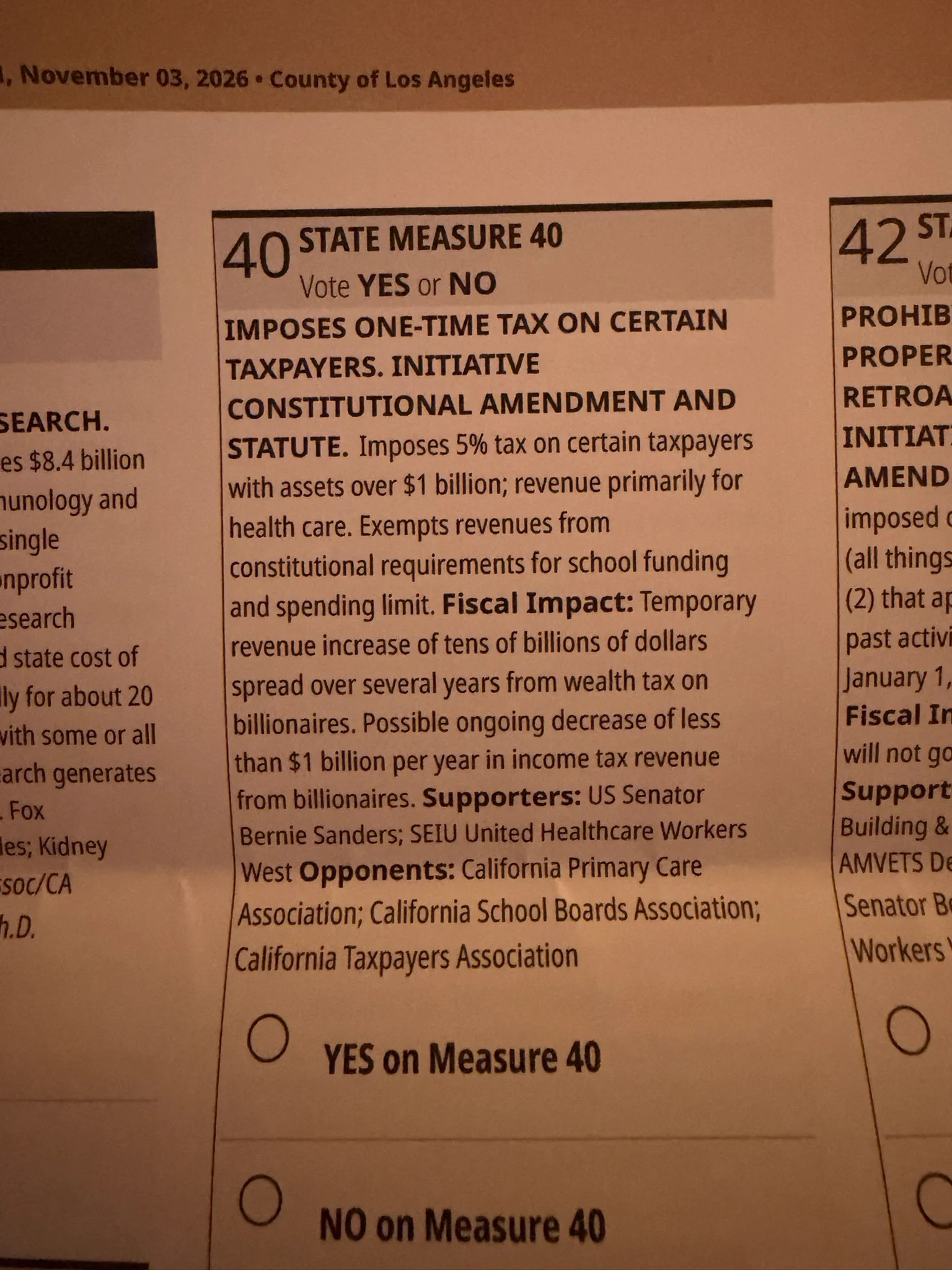
The proposal, backed by the Service Employees International Union-United Healthcare Workers West, would have imposed a one-time 5% tax on the net worth of California residents holding more than $1 billion in assets. The money was supposed to offset reductions in federal healthcare funding, with additional allocations for education and food assistance. Bernie Sanders campaigned in support of the measure, arguing that California’s wealthiest residents should contribute more to public services. Yet even Governor Gavin Newsom opposed the proposal, warning that it could accelerate the departure of wealthy taxpayers and undermine the state’s finances. Imagine that. California has reached the point where even Newsom recognizes that there are consequences to threatening the state’s remaining capital base.
I wrote back in January that the mere proposal of this tax was enough to send enormous sums of wealth looking for a new home. Google co-founder Larry Page moved his family office from California to Delaware and began acquiring property in Florida. Peter Thiel expanded his presence in Miami, while David Sacks established an office in Austin. Larry Ellison had already shifted his principal residence to Hawaii. These individuals have the resources to relocate their investments and personal affairs wherever the tax environment is more favorable. Venture capitalist Chamath Palihapitiya estimated that California risked losing access to approximately $1 trillion in billionaire wealth. That was an estimate of wealth potentially leaving the state’s tax base, not a verified accounting of cash transferred out of California. Nevertheless, the warning was obvious long before voters went to the polls.
The socialists cannot grasp that a billionaire’s wealth is generally tied up in ownership interests, businesses, and investments. A founder holding $10 billion in company shares does not necessarily have $500 million in cash available to satisfy a 5% wealth tax. That person may have to sell shares, borrow against assets, or liquidate investments to pay the government. Politicians see a number on paper and immediately calculate how much of it they can spend. They never consider what happens when the owner decides to leave. According to CalMatters, wealthy opponents contributed approximately $378 million to defeat the measure, while supporters raised roughly $33.5 million. Google co-founder Sergey Brin alone contributed about $102 million to an opposition committee.
California has become dangerously dependent upon high-income earners and volatile capital gains. When markets rise, tax revenues surge, and politicians expand permanent spending programs as though those receipts will continue forever. When markets decline or wealthy taxpayers relocate, revenues collapse while the obligations remain. The state already imposes a top marginal income tax rate of 13.3%. Capital considers those differences when deciding where to invest, expand businesses, and establish residency. California may have extraordinary technology companies and universities, but those advantages do not make it immune to competition.
Governments never want to admit that they have promised more than the economy can sustain. They identify a politically convenient target and convince voters that confiscating more of someone else’s wealth will solve the problem. The wealthy become the first target because politicians assume the public will not object. Once that source proves insufficient, they must either reduce spending, borrow more, or expand taxation to other groups. California’s Legislative Analyst’s Office has repeatedly warned about structural budget problems, yet the political debate remains focused on finding another pool of money. A one-time wealth tax is particularly questionable when used to finance recurring expenditures. Once the proposed $100 billion is spent, the healthcare and education obligations remain. What happens then?
The economic consequences of capital flight extend far beyond the income taxes paid by wealthy residents. Businesses provide employment, purchase services, finance commercial property, and generate economic activity that produces additional tax revenue. When founders and investors relocate, not every employee or company immediately follows them. But decisions about where to establish new offices, invest future capital, and expand operations gradually shift elsewhere. That is how an economic center loses its competitive advantage. The damage may unfold over years, allowing politicians to deny responsibility until the decline becomes impossible to ignore.
What is particularly revealing is that the billionaire tax divided California’s own political establishment. Newsom opposed it, as did Planned Parenthood of California and the California Teachers Association. Their concerns included the potential loss of wealthy taxpayers and uncertainty surrounding the distribution of revenue. Meanwhile, supporters argued that the money was necessary to protect healthcare services and accused wealthy opponents of using their financial power to influence the election. California needs revenue to support its commitments, but increasing the tax burden on a small, highly mobile group may undermine the very tax base upon which those commitments depend.
California has created a dangerous dependence upon a relatively small group of taxpayers while encouraging political campaigns that portray those same taxpayers as an unlimited source of revenue. The government cannot assume that the people financing its spending commitments will remain indefinitely regardless of the tax burden. Capital has no loyalty to a particular state merely because a business was founded there. It moves in search of opportunity, security, and a reasonable expectation that the returns on investment will not be arbitrarily confiscated.