


Technology Reporter
 Mater
MaterFor a country famous as Big Tech’s European address, Ireland’s hospitals often lag far behind in technology.
They lack shared computerised patient records, or unique identifiers to track people when they move between clinics.
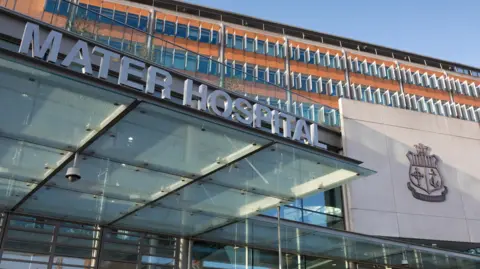
In July 2024, a computer system failure made Dublin’s Mater hospital push back surgeries and beg people not to come to its A&E.
Three years before, Russian ransomware attackers shut down the Irish health system’s entire computer network, and published 520 people’s medical records online.
But Ireland now has ambitious goals to modernise its healthcare.
That includes a programme called Sláintecare. Announced in 2017, the plan is to use some of its €22.9bn (£20bn; $24bn) budget surplus to create a healthcare service that is free at the point of care, like the UK’s or Canada’s.
To improve healthcare, pinch points like diagnostics will have to be improved.
It’s a problem being tackled at Dublin’s Mater hospital, 164-years-old and the location of Ireland’s busiest emergency department.
That’s especially so in winter, when one day early this January Irish A&E departments had 444 people on trolleys waiting to be seen.
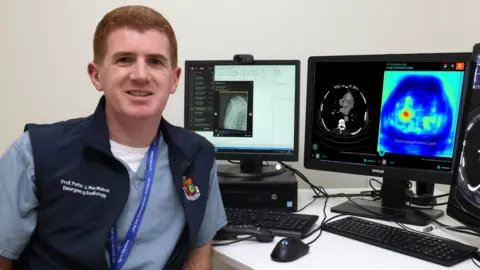
“In Ireland, the big problem we have is waiting lists, and in particular waiting for diagnostics, for MRI [magnetic resonance imaging] or CT [computed tomography] scans,” says Prof Peter McMahon, a consultant radiologist at the Mater.
Because of Prof MacMahon, who as a medical student dabbled as a hobbyist programmer, the Mater is now among the first hospitals in Ireland to use artificial intelligence (AI) across its radiology department – the part of a hospital providing medical imaging to diagnose diseases and guide treatment.
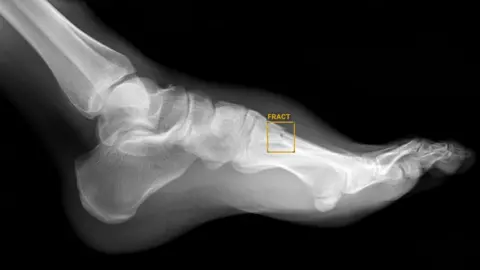
To make sure patients with the most urgent needs are seen first, Prof MacMahon says: “We use AI to immediately analyse all head scans for bleeds, all chest scans for blood clots, and all bone x-rays for fractures.”
The AI is particularly helpful in assisting younger doctors, when they don’t have experienced consultants to turn to.
“Now a nurse or junior doctor at 2am isn’t alone, they’ve got a wing man,” he says.

 Mater Hospital
Rural hospitals face different kinds of challenges.
Letterkenny University Hospital in Donegal is without MRI facilities at evenings and weekends.
Currently, a patient urgently needing an MRI scan at night can face an ambulance ride to Dublin.
But now, Prof MacMahon and the Mater’s AI research fellow Paul Banahan have trained a trial AI model to create a “synthetic MRI” from CT scans, to immediately triage patients with suspected spinal injuries.
That was done by feeding a “generative AI” model around 9,500 pairs of CT and MRI images of the same area on the same person.
Now the AI can predict what the MRI scan would look like from the CT scan, something available in all emergency departments.
And since radiology scans also come with doctors’ text reports, he is also exploring using large language models to identify important disease patterns and trends.
 Peter MacMahon
Applying AI to medical images in Ireland is easier since the country has stored scans in a central, digital filing system since 2008.
But a lot of other important information, like medical notes or electrocardiograms (ECGs), remains largely in paper format in most Irish hospitals, or in smaller databases that are not shared centrally.
That will “severely delay” applying AI to spot potential diseases and improve clinical care, points out Prof MacMahon.
Ageing IT systems in Irish healthcare are more broadly a challenge.
“Quite bluntly, a lot of hospitals are dealing with legacy IT systems where they’re just trying to keep the show on the road,” says Dr Robert Ross, a senior computer science lecturer at Technological University Dublin.
“Doing anything else like integrating AI is not easy to do,” he says.
Using AI in healthcare is not without problems.
An example here is AI speech-recognition tools. Using them could let doctors spend less time on note-taking and report writing.
But some have been found to make things up, including to invent non-existent medication.
To prevent such AI from hallucinating, “you need to make sure it’s penalised in its training, if it gives you something that doesn’t exist,” says Prof MacMahon.
AIs can have biases, but “humans have biases too”, he points out.
A tired doctor, expecting a young patient to be healthy, can overlook their blood clot.
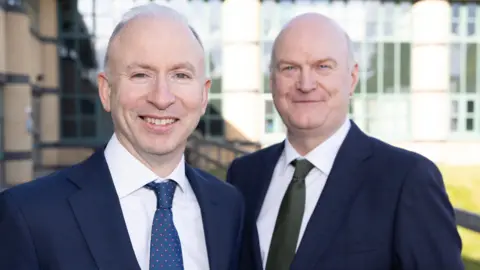
“For whatever reason we’re far more open to accept human error”, than in new health technology where “the acceptable risk is zero”, says Prof Seán Kennelly, a consultant at Tallaght University Hospital and professor at Trinity College Dublin.
This means we “continue with the illusion of 100% accuracy in humans”, and ignore areas where AI-supported technology can make better clinical decisions, he says.
 Tallaght University Hospital
Healthcare regulators, who already have a “weak enough” understanding of software as a medical device, haven’t at all caught up with rules for AI, says Dr Aidan Boran, founder of an Irish medical tech start-up called Digital Gait Labs, and a researcher at Dublin City University.
For example, getting a CE mark, which shows that a medical device meets EU safety regulations, includes providing details about the factory where the product is manufactured.
But in the case of software that is not relevant says Dr Boran. “For us, manufacturing literally means copying software,” he points out.
AI can have a black box problem: we can see what goes in them and what comes out, but the deep learning systems that power these models are so complex that even their creators do not understand exactly what happens inside them.
That can create difficulties for a doctor trying to explain treatment decisions that involve AI, says Dr Paul Gilligan, head of St Patrick’s Mental Health Services, one of Ireland’s largest mental health providers that runs St Patrick’s Hospital in Dublin.
When AI influences their decisions, doctors need to “be able to articulate the reasoning behind those decisions in a manner that is accessible and understandable to those affected,” he says.
