

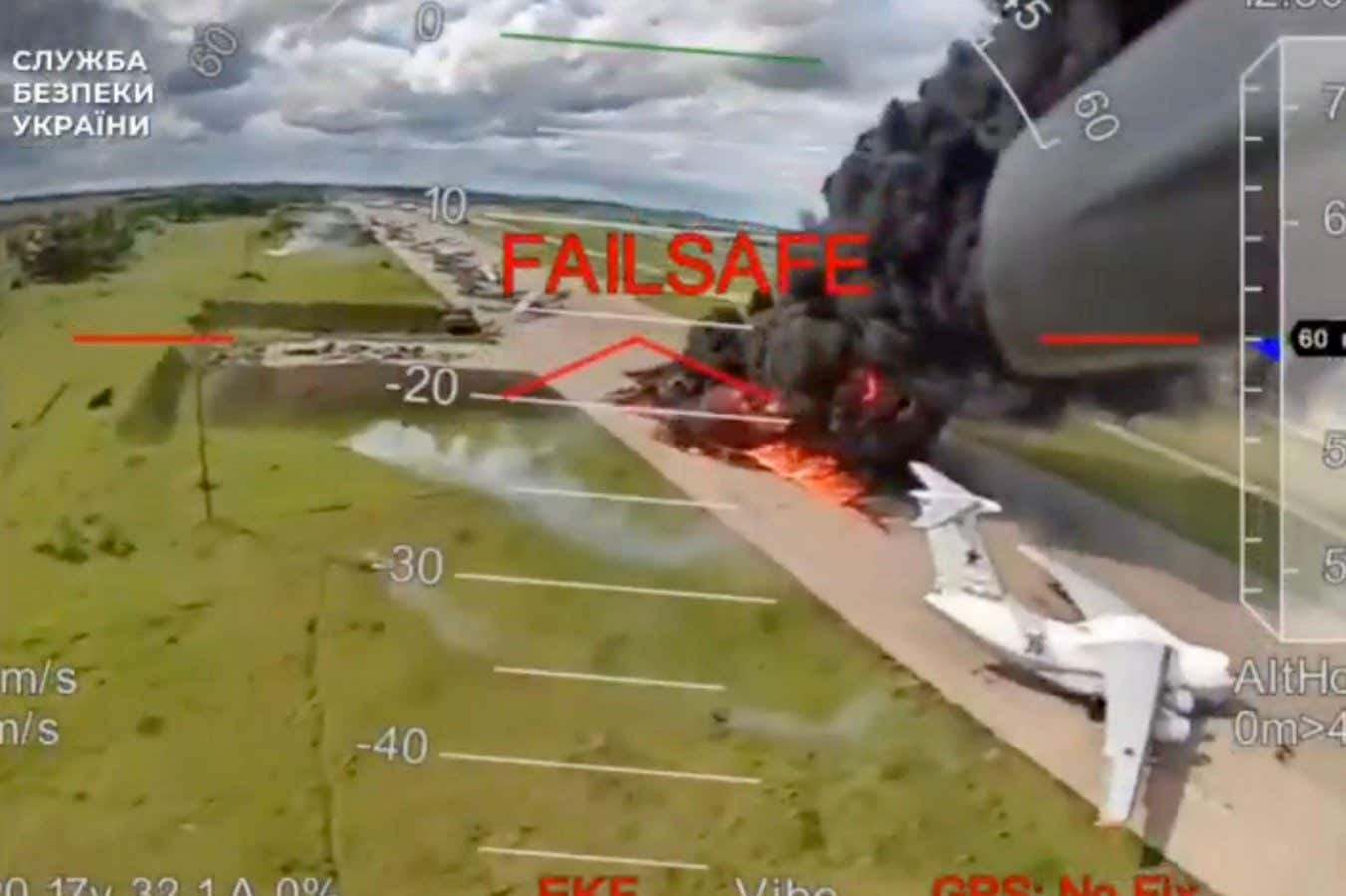
An image taken by a Ukrainian drone during Operation Spiderweb
UPI/Alamy
On 1 June, Ukraine stunned the world with an audacious attack against Russian airbases. Using cheap, small drones concealed inside trucks that had penetrated deep into Russian territory, Ukraine says it was able to hit dozens of nuclear-capable strategic bombers, taking out a reported $7 billion of military hardware.
The drone-smuggling attack, codenamed Operation Spiderweb, was an incredible feat of military planning – but it also highlighted a vulnerability that has defence chiefs around the world concerned that their assets could be hit next.
“The risk potentials of small drone attacks to US or UK air bases right now are 100 per cent,” says Robert Bunker at US consultancy firm C/O Futures. “You simply need a group with the intent and capability, which is a very low bar to overcome.”
Ukraine’s security service, the SBU, says it used 117 first-person view drones for the attack, adapting them from racing quadcopters to carry a couple of kilograms of explosives each. The country produced around 1.5 million of these drones for battlefield use last year, costing just a few hundred dollars each. They are typically limited to a range of around 20 kilometres, but as Spiderweb shows, they can be delivered to the target area and flown remotely.
The attack came as no surprise to US defence analyst Zachary Kallenborn, who predicted exactly this kind of threat to strategic bomber aircraft in a 2019 paper. “Ukraine did far more in scale and impact than I could have imagined. I figured such an attack might be a small part of a far larger strike on adversary nuclear delivery vehicles, but Ukraine managed to destroy 34 per cent of the nuclear bomb force with an incredibly complex and coordinated operation. That’s amazing.”
So, what can nations do to protect themselves from similar attacks? Broadly, there are three approaches: the physical, the electronic and the kinetic.
The first sounds simple – just erect a physical barrier to keep drones away. Some of the Russian planes hit by Ukraine were parked in bays surrounded by protective concrete blast walls or earthen banks designed to shield against nearby fire or explosion, but these don’t stop attacks from above. Russia is now hastily building hardened aircraft shelters, but these are expensive, costing millions apiece, and are only big enough for fighters. Larger strategic bombers are supposed to be based away from the front lines, out of danger, and so it was thought they didn’t need protecting in this way.
Anti-drone nets are a cheaper alternative, and one that is already employed by both Ukraine and Russia on the battlefield. Russian authorities have reportedly advised airbases to erect such barriers in response to Ukraine’s attack, but the problem is that such nets are pretty easy to take out.
“Netting will provide a pretty good defence versus the initial UAS [Uncrewed Aerial System] that is making an attack run,” says Bunker. But drones are so cheap that attackers can simply send a first wave in to take out the nets before the rest continue to their targets, he says.
What about electronic protections? On the front lines, both Russia and Ukraine use electronic jamming tools to break radio links between drones and their operators. That works to some extent in a battlefield situation, but because jammers typically operate at short range, an airbase would need to be blanketed in them. “They must be deployed and monitored 24/7,” says Bunker.
That creates its own problems. Operation Spiderweb used commercial cellphone networks, but attackers might use any frequency to control their drones, and jamming every frequency may not be an option. “Jammers interfere with friendly signals too,” says Kallenborn. “To prevent such an attack, we may need to accept greater risk to friendly operations.”
In addition, the SBU says its drones were designed to anticipate jamming and were fitted with a an AI backup system that guided them to targets without operator input. Such drones are essentially immune to jamming,
That leaves kinetic measures, otherwise known as shooting down the drones. The Russian airbases were well protected against conventional air attacks with surface-to-air missiles and mobile anti-aircraft units, but these couldn’t detect or engage the small drones.
“Such weapons systems need advanced acquisition and targeting capabilities to have any chance of taking down an armed UAS,” says Bunker. “If humans are operating them, they have to be dispersed throughout a facility for defensive coverage and manned 24/7, which creates an immense personnel and economic burden.”
Automated defences offer a potential solution, and Ukraine is already deploying AI-controlled anti-drone machinegun turrets to protect cities against Russian attacks using large Shahed drones. But despite costing around $100,000 each, turrets like these could easily be outmatched by the smaller, cheaper drones used in Operation Spiderweb. “Massed drones may present a challenge,” says Kallenborn.
In short, there are no good solutions – and yet, militaries urgently need to find a way to mitigate this imminent threat. A US Air Force general recently told a Senate committee that there were over 350 instances of unauthorised drones flying over military bases inside the US in 2024 alone. US airbases in the UK have also seen similar drone incursions.
“Although many are certainly just hobbyists, at least some are certainly adversarial,” says Kallenborn. Those adversarial drones are most likely to be collecting intelligence, rather than attempting an attack – for now, he says. “If we were at war with China, that could change.”
All of this means that a repeat of Operation Spiderweb, whether in Russia or elsewhere, is looking very possible. “This goes well beyond even being a major vulnerability gap,” says Bunker. “The dyke can’t be plugged. It’s literally crumbling in front of us and will soon burst.”
Topics:
