

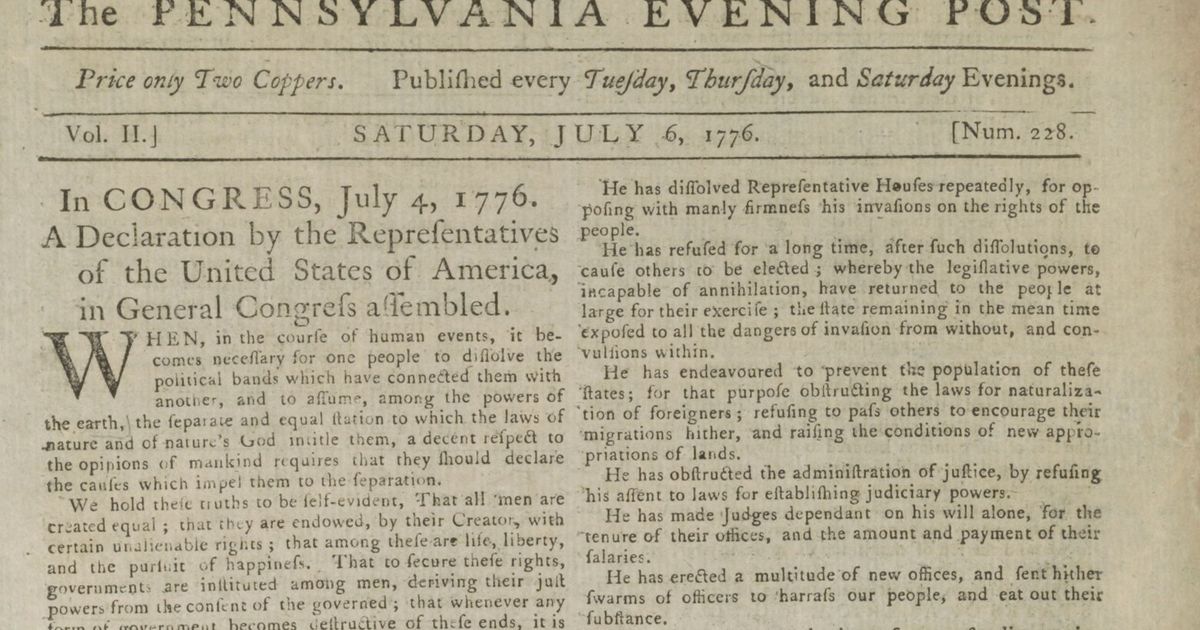
As we celebrate the 250th anniversary of the Declaration of Independence, it is important to recognize the important role that local journalism played in advancing independence.
The founders of the United States understood the need for a free press. Although newspapers were heavily censored by the British crown, by the early 18th century, American journalists were becoming more independent in determining what they would publish.
It was not without risk to criticize those in office. An example is the New-England Courant, a newspaper established in 1721 by James Franklin with the help of his younger brother and apprentice, Benjamin. The elder Franklin’s articles so annoyed leaders in Boston that he was arrested and barred from publishing his newspaper. In response, Franklin named Benjamin as editor, allowing them to continue publishing.
Local journalism took a major hit on March 22, 1765, when the British Parliament passed the “Stamp Act.” This legislation, passed with no input from the colonists, imposed a tax on “every skin or piece of vellum or parchment, or sheet or piece of paper.” More specific to journalism, the legislation stated that taxes would be collected for “every paper, commonly called a pamphlet, and upon every newspaper, containing public news, intelligence, or occurrences, which shall be printed, dispersed, and made public.”
Representatives from nine colonies met in New York City to discuss their opposition to the Stamp Act. This was the first time the colonies united in their determination to fight British policies. The delegates argued that Parliament did not have the power to tax the colonies because they were unrepresented in Parliament, leading to the phrase “No Taxation without Representation.”
The colonists had strong support from London merchants, which prompted Parliament to abolish the Stamp Act. The Parliament, however, issued the Declaratory Act, which made it clear that the king and Parliament had full legislative power over the colonies and could tax them despite the lack of representation.
As tensions continued to grow between Britain and the colonies, colonists followed the situation through the growing number of newspapers and pamphlets that were published. White Colonists tended to be more literate than those in most countries, making it more likely that these outlets for news would flourish. The newspapers were often political in their focus. Newspapers, originally aimed at a local audience, began to circulate throughout the colonies. This brought the colonies together in their opposition to new dictates from the British Parliament or crown.
Pamphlets also played a strong role in bringing the colonies together. The most popular pamphlet was Thomas Paine’s Common Sense. Paine arrived in America in January 1774 at the invitation of Benjamin Franklin. Common Sense was published only one year later. It outlined the reasons that the colonies should become independent of Britain. The pamphlet sold more than 500,000 copies during the first year of publication. According to historians, “Common Sense owed its success to the broad circulation of newspapers throughout the country.”
Certainly, the arguments Paine made in Common Sense greatly influenced the principles articulated in the Declaration of Independence only a few months later. With the signing of the Declaration, newspapers worked with each other to spread the word. The first printings of the document were made in Philadelphia, where the Declaration was adopted.
On July 4, 1776, John Dunlap printed 200 copies of a broadside (flyer) with the text of the Declaration. Benjamin Towne followed, printing the document in the July 6 edition of his newspaper, The Pennsylvania Evening Post. From there, copies of the Declaration were sent not only to the American populace but also overseas, where it influenced what became the French Revolution and other declarations of independence.
It is not surprising, given the important role that local and then national newspapers played in supporting independence, that the First Amendment to the Constitution establishes that “Congress shall make no law … abridging the freedom of speech, or of the press.”
It is also worth noting that local and national newspapers play that same role today. As Madeleine K. Albright noted: “The ability of a free and independent press to hold political leaders accountable is what makes open government possible — it is the heartbeat of democracy.”
This was originally published in The Journal of the San Juan Islands.
