

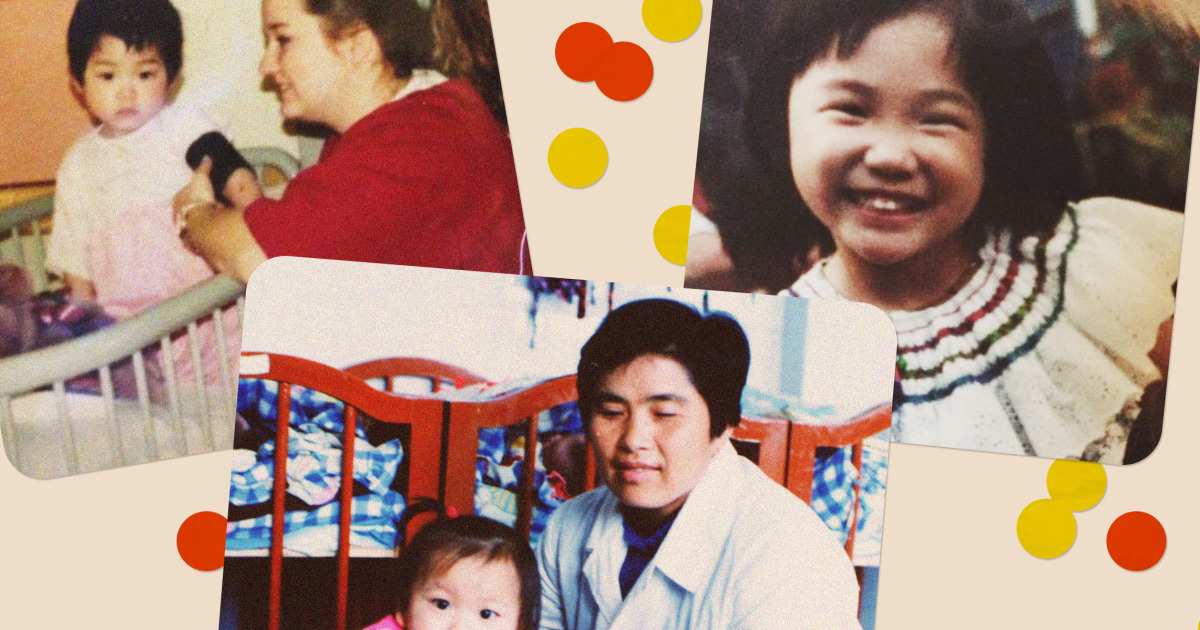
After China introduced earlier this month that it’s suspending international adoptions, Maze Felix, a 28-year-old Chinese language adoptee, mentioned they have been struck with a heady mixture of “anger, reduction, grief, confusion — all of it.”
Felix, who makes use of they/them pronouns, is among the many greater than 80,000 kids who have been adopted from China to the U.S. prior to now three a long time. They have been adopted on the age of two by dad and mom in Cleveland. They usually’re not alone. From feeling reduction that relinquished kids can now preserve their start cultures to mourning the tip of a program that was central to their very own experiences, Chinese language adoptees say the brand new coverage has solely made an already-complicated expertise really feel much more complicated.
Grace Newton, an adoption researcher and the writer of the adoption-focused Purple Thread Damaged weblog, advised NBC Information that no matter whether or not adoptees really feel positively or in any other case concerning the improvement, “there’s extra to it than simply that.”
“The sensation is simply this mismatch,” Newton mentioned. “How might this large factor that has influenced so many elements of our life simply merely be over on a coverage degree, when it will probably by no means actually be over for us on a private degree?”
However given the vary of opinions, in the end it’s been necessary for a lot of adoptees to search out connection amongst these with their shared experiences, Newton argued.
“We’re a bunch that can ‘go extinct,’” mentioned Newton, a Chinese language adoptee herself. “With that, it feels much more necessary to search out one another and be in neighborhood with one another.”
At a press convention in early September, China’s Overseas Ministry spokesperson Mao Ning confirmed that worldwide adoptions would now not proceed, “consistent with the spirit of related worldwide covenants.” Exceptions, she mentioned, will probably be made for foreigners adopting the kids or stepchildren of blood family members in China, as much as the third diploma of kinship.
It comes after China greenlit worldwide adoption in 1992, resulting in roughly 160,000 Chinese language kids being adopted to different international locations, with half going to the U.S. However prior to now few years, these adoptions have slowed considerably. Through the top of the pandemic in 2020, China suspended adoptions altogether, and no kids have been adopted to the U.S. for the following two years. However they resumed, with the U.S. consulate issuing 16 visas for adoptions from China between October 2022 and September 2023.
The slowed worldwide adoption coincides with a 2016 reversal of China’s one-child coverage, which restricted every Chinese language household to at least one baby as a way to management inhabitants development. Lately, the nation has additionally struggled with a large decline in start charges, signaling main financial and political challenges forward. In an effort to course-correct, China turned to a “three-child policy” in 2021. And native governments have introduced incentives together with tax deductions, longer maternity depart and housing subsidies. Nonetheless, a report by the Beijing-based Yuwa Population Research institute mentioned the subsidies have both been inadequate or simply not applied because of an absence of funding. And for two years in a row, the nation’s inhabitants has continued to drop.
Katelyn Monaco, a 25-year-old adoptee primarily based in Quincy, Massachusetts, mentioned the brand new rule stirred up reflections on the one-child coverage, a vital backdrop to the event. The coverage led to tens of hundreds of child ladies and kids with disabilities touchdown within the nation’s social welfare system. It was additionally the coverage underneath which Monaco mentioned she was adopted, and it’s been troublesome “figuring out that that’s the tip of people that could have related experiences as me.”
However Monaco mentioned she additionally sees positives, optimistic that the brand new change might assist present kids in orphanages an opportunity to stay with their start tradition, nation and heritage. Typically, adoptees grieve the separation they expertise from their cultures, she mentioned. And people adopted right into a household of a unique race can usually really feel ethnically remoted, emotions she mentioned she felt. Monaco identified that some adoptees additionally face authorized challenges in securing citizenship, including an institutional layer to their id struggles. At present, adoptees born on or earlier than Feb. 27, 1983, are usually not given computerized citizenship, in response to the Child Citizenship Act.
“For me that was actually troublesome,” Monaco recalled. “Rising up with a single mother, though she liked me and she or he tried her greatest, she didn’t have the sources or data to assist me perceive my Chinese language heritage.”
For Felix, probably the most troubling points of the brand new rule is its potential affect on data for current adoptees. Felix, a Los Angeles-based mannequin, actor and signal language interpreter, was adopted from Yangzhou, China. They mentioned they’ve lengthy accomplished DNA assessments in an effort to entry their outdated medical data, adoption papers and different documentation. With little readability on the destiny of these paperwork, Felix and lots of different Chinese language adoptees mentioned they’re involved that any potential for orphanage visits, start guardian searches and different ties to their residence nation will probably be abruptly severed.
“I used to be eager for one thing that basically was by no means going to occur … potential cultural connection, or cultural reconnection,” Felix mentioned. “My very own life seems like there’s much less validity as a result of they’re closing a door on this.”
A consultant from the Chinese language authorities didn’t elaborate on how adoptees’ documentation could be dealt with.
Newton famous that there have been many instances by which records were falsified or contained sparse data. Even so, there’s been particular person and collective documentation “that we even existed in China,” she mentioned.
“There’s an enormous concern that we as a bunch are simply going to be probably a footnote in historical past or not even talked about in any respect,” Newton mentioned.
With the door closed on worldwide adoption, Newton emphasised that to ensure that these at the moment in Chinese language social welfare institutes to thrive of their start nation, additionally they want extra help. She mentioned cash that China as soon as funneled into bolstering worldwide adoption needs to be allotted to strengthen social help for youngsters and people with disabilities within the system. And extra needs to be accomplished to disrupt the social stigma round having a incapacity within the nation, she mentioned.
“The state of affairs actually is a little bit bit extra sophisticated for these youngsters with intense disabilities, particularly with the rising prices of dwelling in China,” Newton mentioned. “Lots of people, even now that the [one-child policy] is over, are deliberately opting to solely have one baby. The social infrastructure wants to alter in order that households can afford to maintain their baby if they’ve disabilities.”
Whereas individuals have had a variety of reactions to the information, all those that spoke to NBC Information underscored that adoptees needs to be central to discussions on the change of coverage, although that has not usually been the case. Newton mentioned adoptees are sometimes seen as “perpetual kids” whose factors of view don’t should be thought-about. And talking to adoptees in activism areas can really feel uncomfortable for a lot of outdoors the adoptee neighborhood when their spiritual convictions or different broadly held beliefs are challenged. There’s additionally the misunderstanding that adoption is a “one-time occasion,” moderately than an expertise processed in waves throughout a lifetime, Newton mentioned.
“It could not happen to some that we’d have ideas or emotions about it, as a result of our adoption already occurred,” Newton mentioned of the brand new coverage. “It needs to be ‘over’ for us.”
