

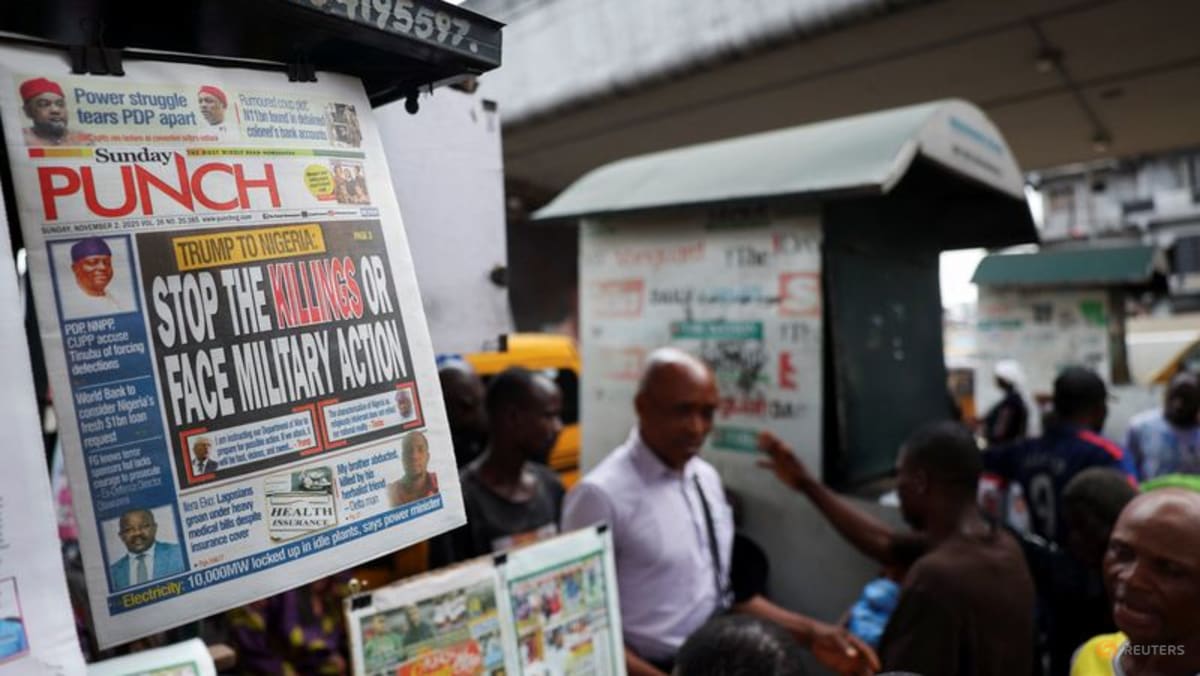
ABUJA: Nigerians across the religious spectrum pushed back Monday (Nov 3) on US President Donald Trump’s threats of military intervention over the killing of Christians in the country.
Africa’s most populous country, which is roughly evenly split between a mostly Christian south and Muslim-majority north, is home to myriad conflicts, which experts say kill both Christians and Muslims, often without distinction.
But claims of Christian “persecution” in Nigeria have found traction online among the US and European right in recent weeks.
“Christians are being killed, we can’t deny the fact that Muslims are (also) being killed,” Danjuma Dickson Auta, a Christian and community leader, told AFP.
Trump said on social media over the weekend that he had asked the Pentagon to map out a possible plan of attack.
Asked by an AFP reporter aboard Air Force One if he was considering putting US troops on the ground or using air strikes, Trump replied: “Could be, I mean, a lot of things – I envisage a lot of things.”
“They’re killing the Christians and killing them in very large numbers,” he said Sunday. “We’re not going to allow that to happen.”
Pushing back on the accusations, President Bola Tinubu said over the weekend that “religious freedom and tolerance have been a core tenet of our collective identity”.
ETHNIC VIOLENCE
Auta, 56, hails from Plateau state, where Christians and Muslims have long lived side by side.
The state has also seen explosions of violence – including deadly sectarian riots in the capital Jos in 2001 and 2008.
In recent years, Plateau and other states in Nigeria’s “Middle Belt” have suffered deadly clashes between mostly Christian farmers and Fulani Muslim herders over dwindling land and resources.
The conflict has often resulted in massive death tolls on the side of the farmers, with entire villages razed.
Smaller-scale attacks on herders – including retaliatory killings of random ethnic Fulanis or their cattle – often generate fewer headlines in both the local and international press.
Though the violence appears on the surface to fall across ethnic and religious lines, experts say the root causes lie in poor land management and policing in rural areas.
