

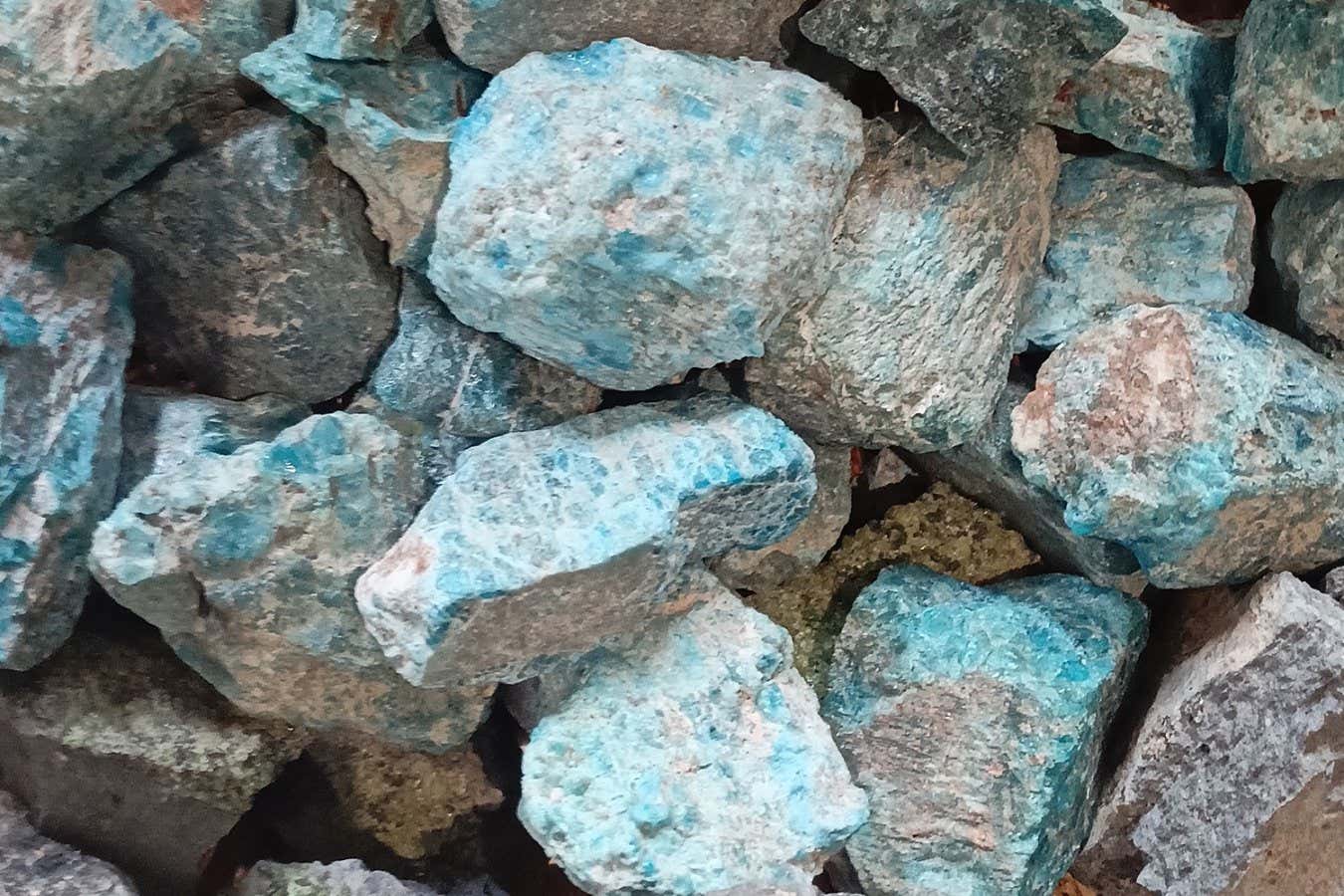
Olivine rock naturally reacts with carbon dioxide, but it is a slow business
Renhour48 via Wikimedia/CC0 1.0 Universal
A new process could enable crushed rocks to capture carbon dioxide from the air much more quickly, turbocharging a carbon removal technique that is already being widely adopted.
Natural silicate minerals such as basalt react with water and CO2 to form solid carbonate materials, a process known as enhanced rock weathering (ERW). Studies suggest spreading crushed silicate rocks on agricultural land can increase the amount of carbon that soils can absorb, while also improving crop yields for farmers.
But Matthew Kanan at Stanford University in California believes the carbon benefits of ERW have been overblown, because natural silicates don’t weather quickly enough to extract meaningful amounts of carbon from the air. “The data is very clear: they do not weather at useful rates,” he says.
Converting silicates into more reactive minerals would increase the weathering rate, making ERW a viable climate solution, he says. Kanan and his colleague Yuxuan Chen, also at Stanford University, have developed a way to produce magnesium oxide and calcium silicate using a process inspired by cement production.
“You can take a calcium source and a magnesium silicate, heat them up, and you end up making a calcium silicate and a magnesium oxide,” says Kanan. “The core reaction is what we call an ion exchange, where we are swapping magnesium for calcium.”
“The reason that’s powerful is because now that calcium silicate is reactive and so is the magnesium oxide,” he says. “I put in one reactive thing and I get two out.” The materials weather thousands of times faster than standard silicates, says Kanan.
The kilns used in the process need to be heated to 1400°C for the reaction, with the energy likely to be provided by natural gas. This means the method would produce significant carbon emissions, but Kanan suggests these could either be captured at source or offset by reserving some of the reactive minerals to capture on-site emissions.
Once the emissions involved in producing the materials are accounted for, 1 tonne of reactive material removes about 1 tonne of carbon dioxide from the atmosphere. The researchers can currently make 15 kilograms a day of reactive rocks, but hope to turn the idea into a commercial venture by selling the materials to farmers to use on agricultural land.
Rachael James at the University of Southampton, UK, contests Kanan’s claim that conventional ERW doesn’t work, pointing out that there are many documented examples of successful enhanced weathering trials. But she welcomes any attempt to accelerate the weathering rate of silicates.
“Anything we can do to speed up weathering rates would be hugely beneficial, because the climate crisis needs action now,” she says. “Weathering is an inherently slow process and, frankly, I’d rather see meaningful carbon dioxide removal on timescales of 10 years than 50 years.”
However, she warns that the team is likely to face issues with scaling up production and deployment. Using the minerals in an agricultural system may not guarantee all the captured carbon is locked away permanently, she says.
Phil Renforth at Heriot-Watt University in Edinburgh, UK, says the proposal is a clever idea, but much more research is needed to understand how it should be deployed. “They essentially produce cement minerals, which may not be ideal candidate minerals for the addition to agricultural soils,” he says.
Topics:
