


 Hysata
“If you remember being a kid and blowing up a balloon or into a milkshake, your cheeks got sore because there is an energy penalty associated with bubble formation.”
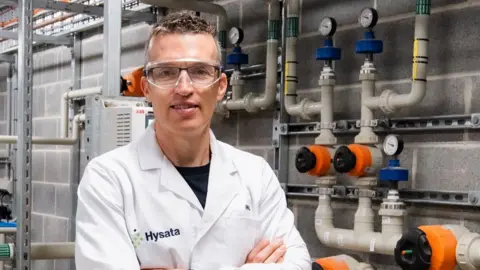
Paul Barrett, the Dublin-born chief executive of the Australian green energy firm Hysata, is explaining the plan to create the cheapest hydrogen in the world – by eliminating bubbles.
The company, based at Port Kembla, an industrial hub south of Sydney, is using a familiar process known as electrolysis, which involves passing electricity through water to split it into hydrogen and oxygen.
But Hysata has developed a special material which sits in the water and which it says makes its electrolyser much more efficient than competing products.
The company says it can produce a kilo of hydrogen using 20% less electricity than conventional methods.
Hydrogen is the most abundant element on the planet and, crucially, when used as a fuel or in industrial processes it does not produce carbon dioxide (CO2).
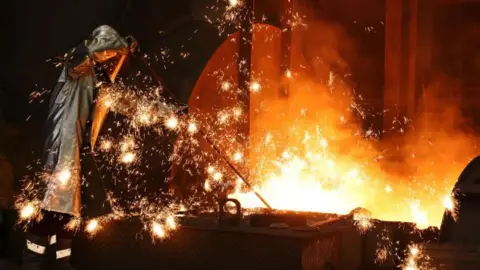
Many see hydrogen as the answer to cutting carbon dioxide emissions, particularly in heavy industry like steelmaking and chemical production.
Hydrogen production comes in four varieties – green, grey, blue and black.
The green variety is produced with renewable energy, grey comes from splitting methane into carbon dioxide and hydrogen, while blue is made in the same way, but the CO2 by-product is captured and stored.
The production of black hydrogen comes from partially burning coal.
But if there is to be a transition to green hydrogen then its supply needs to be massively increased.
“Ensuring you have the production of green hydrogen close enough to the demand point and being able to regulate the supply of that is probably the biggest challenge,” explains Dr Liam Wagner, an associate professor at Perth’s Curtin University.
“The efficiency of production and the amount of energy required to run these processes is the biggest frontier.”

 Getty Images
Australia is rich in natural resources and has long been the world’s quarry. It’s an export-driven nation; its coal has helped to power Japan, while its iron ore has underpinned much of China’s growth. Many hope that hydrogen could follow.
“The prospects for hydrogen are as a way of exporting energy to countries that can’t produce enough of their own either as hydrogen in a liquid form or as ammonia, which I think is the most likely,” Dr Wagner adds.
Hysata hopes to play a part in that. Its device was initially invented by researchers at the University of Wollongong in the state of New South Wales.
In a conventional electrolyser, bubbles in the water can be clingy and stick to the electrodes, clogging up the process and leading to energy loss.
By using a sponge-like material between the electrodes, Hysata eliminates those troublesome bubbles.
“It is not unlike your kitchen sponge in terms of what it does. It is just a lot thinner,” says Mr Barrett.
“It’s pretty easy to manufacture at a super low cost,” he adds.
Cost and efficiency have been major hurdles for the hydrogen sector, but Hysata has recently raised US$111m (£87m) in investment to beef up its production.
 Ema Frery
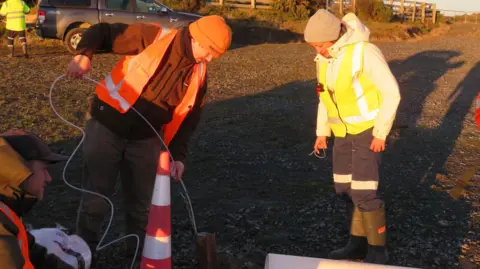
“What we are speaking about is natural hydrogen which is coming directly from the earth,” explains Dr Ema Frery, a research team leader at CSIRO, Australia’s national science agency.
“A lot of rocks that are in Australia can produce hydrogen. We have a lot of old granites that are now close to the subsurface and can generate hydrogen through radiogenic processes.”
So-called geogenic hydrogen is also known as white or gold hydrogen.
Dr Frery, a French-born geoscientist based in Western Australia, is investigating how it might be extracted, stored and used in an economically viable way.
“A conventional hydrogen system can consist of a rock capable of generating hydrogen at a given rate, migration pathways and a reservoir where the hydrogen can be stored.
“Surface seeps at the top of the reservoir can indicate the presence of a hydrogen system at depth,” she says. “It is happening in other countries. In Mali, people are extracting natural hydrogen from the ground for more than ten years to produce electricity for a local village.”
Despite the research work, some doubt that hydrogen will become a big export for Australia.
One of those is the Institute for Energy Economics and Financial Analysis (IEEFA), a global research organisation which advocates the use of renewable energy.
Exporting hydrogen from Australia would “make no financial sense”, according to Amandine Denis-Ryan, the chief executive of the IEEFA in Australia.
“Hydrogen shipping would be prohibitively expensive. It requires extremely low temperatures and large volumes, and involves high losses. Using hydrogen locally makes much more sense.”
She hopes that government funding will not be “wasted” on such projects.
Like bubbles on electrodes, new technologies and processes invariably hit sticky patches where progress is hindered and doubts amplified, but the architects of hydrogen’s advance are confident it has a key part to play in our energy transition.
Bahman Shabani, a professor at RMIT University’s School of Engineering in Melbourne, is working to store surplus renewable energy using an electrolyser, a storage tank and a fuel cell that together act like a battery.
“Hydrogen is gaining popularity all around the world. If you look at the investment levels in China, for example, in Japan, in Germany, in Europe in general, in the United States, they are all realising the importance of this area.”
