

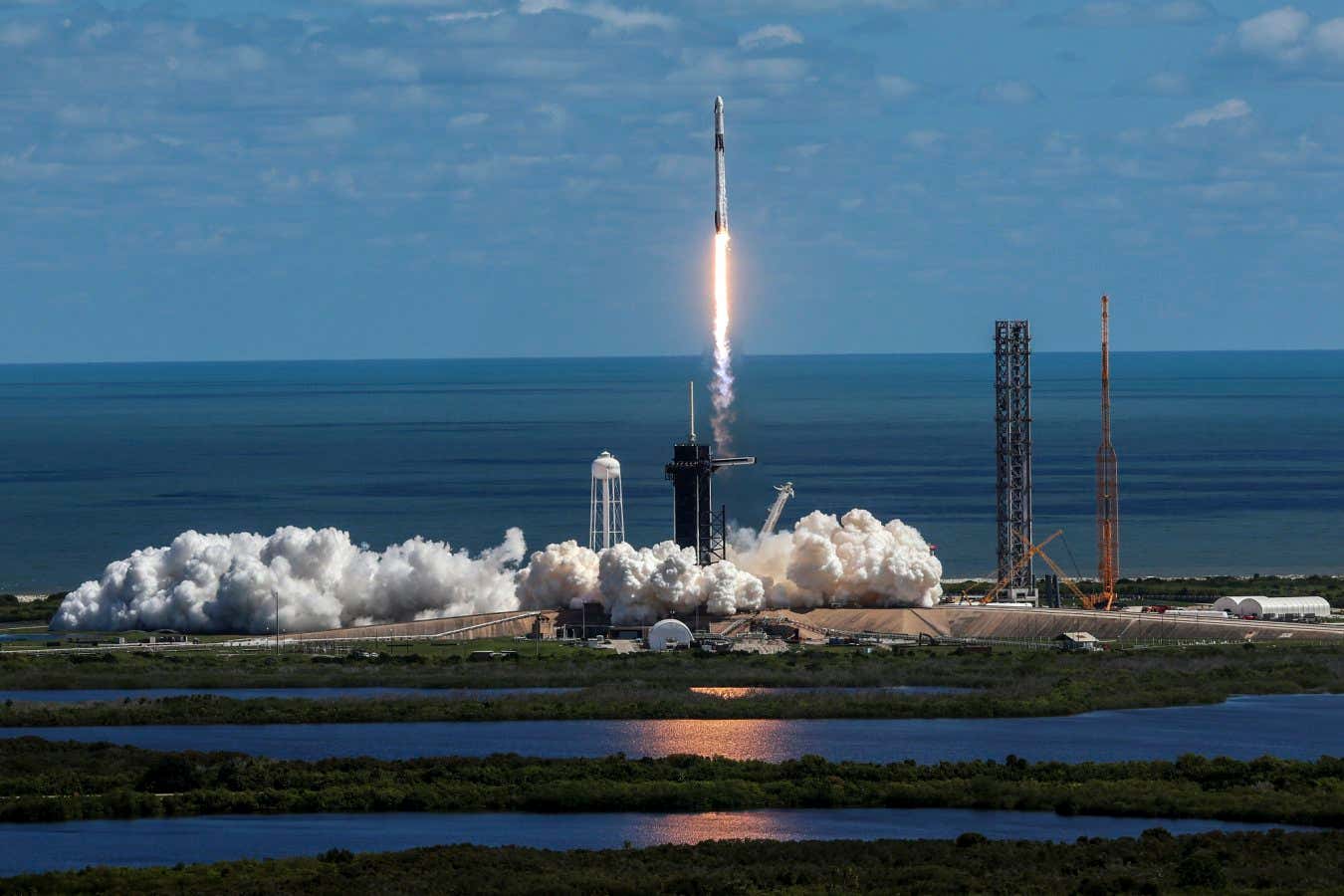
Rockets could carry cooling aerosols to high altitudes
Kevin Dietsch/Getty Images
Reusable rockets that deliver sun-reflecting aerosols to the top of the stratosphere could cool the planet – with fewer negative side effects than lower-altitude solar geoengineering. But a fleet of climate-cooling rockets would come with its own downsides.
The rise in global average temperatures has focused more research attention on solar geoengineering, the controversial notion of cooling the climate by reflecting sunlight away from the planet. The best-known approach, called stratospheric aerosol injection (SAI), would involve releasing a constant supply of reflective particles like sulphur dioxide into the stratosphere.
In SAI scenarios, researchers normally envision using specialised high-flying cargo planes to inject aerosols at an altitude of around 20 kilometres. According to climate models, this would mask the warming due to rising concentrations of greenhouse gases. But it would create numerous other climate risks, both known and unknown.
One major issue is that the aerosols would absorb sunlight and heat up the stratosphere itself, even as surface temperatures cooled below. Due to wind patterns, the aerosols would accumulate in the tropical stratosphere, causing greater warming there than other parts of the atmosphere. That, in turn, could disrupt the jet streams and circulation patterns that impact weather around the world.
The aerosols could also accelerate the breakdown of ozone by chlorine, delaying the repair of the ozone hole over Antarctica by as much as five decades.
Pengfei Yu at Jinan University in China and his colleagues modelled whether injecting aerosols at a much higher altitude of 50 kilometres, near the top of the stratosphere, would change these dynamics. They found the extremely high-altitude injection would have more of a cooling effect than lower-altitude approaches because the aerosols would remain aloft longer, especially at the poles. This extra elevation would also prevent the aerosols from heating the lower stratosphere until they travelled closer to the poles, avoiding most of the disruptive warming in the tropical stratosphere.
Finally, the researchers found the aerosols would break down a separate chemical that eats away ozone, leading to a net delay in ozone recovery of just five years. “We didn’t know [injecting at] 50 kilometres would have this different picture,” says Yu.
Planes cannot reach anywhere near 50 kilometres, so the researchers suggest using rockets. They estimate up to 80 reusable hydrogen-powered rockets, launching every other day, could inject between 3 million and 8 million tonnes of aerosol each year. They write that this would be “well within the scope of current technology”.
While this might be possible in theory, it would be far more complicated than lower-altitude approaches to SAI, says Douglas MacMartin at Cornell University in New York. Some of the benefits, such as avoiding warming in the tropical stratosphere, could be achieved more easily by injecting at higher latitudes, rather than higher altitudes, he says.
“It’s a little bit more efficient because you’re putting it up higher in the atmosphere – but the costs are astronomical in comparison,” he says.
The high-altitude approach also wouldn’t avoid many of the other risks of solar geoengineering, such as the rapid increase in temperatures that would occur if injections ever stopped. “What if the rockets explode at the surface?” says Yu. “That’s a valid concern.”
Topics:
