

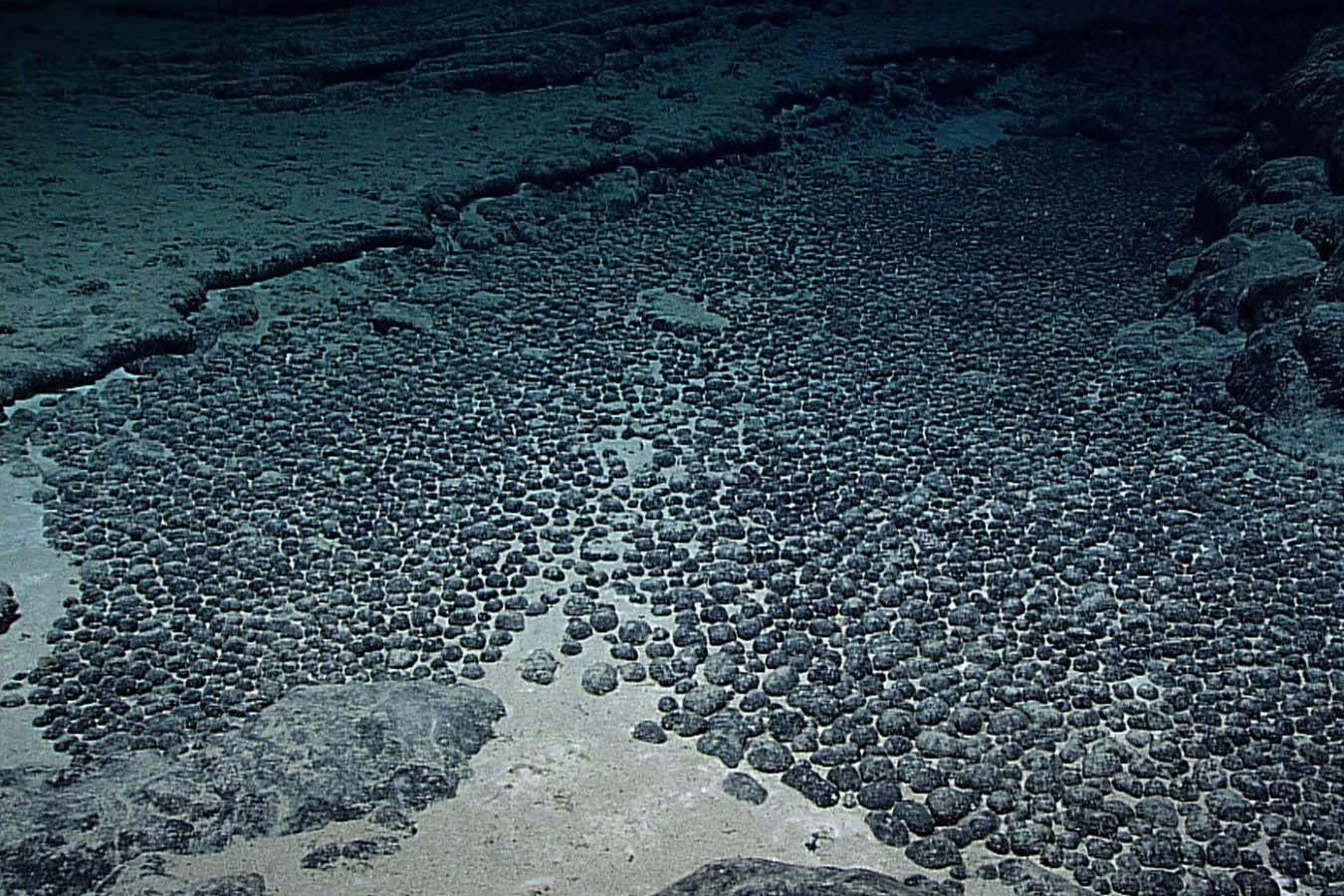
Manganese nodules on the sea floor may be a source of oxygen
Science History Images/Alamy
Marine scientists who made headlines last year with their discovery that deep sea nodules could be producing “dark oxygen” are embarking on a three-year research project to explain their findings.
Amid swirling controversy over their research, project lead Andrew Sweetman at the Scottish Association for Marine Science says he hopes the new scheme will “show once and for all” that metallic lumps of rock are sources of deep sea oxygen and start to explain how the process is working. “We know that it’s going on, and what we need to now do is show it again, and then really start getting at the mechanism,” he says.
Sweetman had spent more than a decade studying life on the sea floor before his shock discovery made headlines in July last year, and confounded the research community. Previously, it was thought that oxygen production relied on the presence of plants, algae or cyanobacteria to perform photosynthesis, powered by sunlight.
But Sweetman’s team found rising oxygen levels on nodule-rich areas of sea floor, thousands of metres below the ocean surface where no light can penetrate and no plants grow. The researchers suggested that the nodules could be acting as “geobatteries”, generating an electric current that splits water molecules into hydrogen and “dark” oxygen, produced naturally without photosynthesis.
Sweetman found himself at the centre of a media storm. Life changed overnight, he says – he even gets stopped on the street by people wanting a photograph with him. “It’s been very surreal,” he says.
But the discovery also brought challenges. The research has attracted criticism from some scientists and deep-sea mining companies, who plan to mine the nodules for precious materials needed for the green energy transition.
The Metals Company (TMC), which funded some of the research that led to Sweetman’s 2024 paper, has been among the fiercest critics of his findings. Its scientists have published a paper arguing the discovery is “completely unsupported” by evidence and raising concerns about the study’s methodology.
“After decades of research using the same methods, no credible scientist has ever reported evidence of ‘dark oxygen’,” Gerard Barron, the CEO and chairperson of The Metals Company, said in a statement. “Extraordinary claims require extraordinary evidence. We’re still waiting.”
Other researchers have also raised concerns about Sweetman’s use of data and say faulty equipment or misuse of the landers could have produced unusual readings. To date, none of the responses have completed the peer review process.
Concerns have also been raised with the journal that published Sweetman’s study, Nature Geoscience. “We have been looking into [these concerns] carefully following an established process. However, a decision as to what action may be taken, if any, has not been made at this time,” a spokesperson for the journal told New Scientist.
Sweetman insists his study is accurate and he will be responding to TMC’s criticisms in a formal rebuttal to their paper. But he says his experience at the centre of the controversy has been “extremely tiring” and upsetting. “There’s been lots of discussion. A lot of mining companies have been saying lots of different things, a lot of it not so nice, which has been a challenge to live through,” he says. “It’s definitely had a bit of an impact on me. The online bullying hasn’t been nice to be exposed to, and it has been continuous.”
Sweetman’s new research project, funded via a £2 million grant from Japanese charity The Nippon Foundation, aims to lay some of the controversy to rest. Sweetman’s team will use brand new, custom-built landers capable of descending to 12,000 metres below sea level, twice the depth reached by the previous study, to hunt specifically for dark oxygen production in the Pacific Ocean.
The first of three research expeditions will set sail in January 2026 from San Diego, California, with the aim of confirming nodule-driven oxygen production in the deep ocean with fresh data. Once again, the landers will seal off samples of water and sediment from the sea floor to measure changes in oxygen concentrations. The researchers will also test for the presence of hydrogen, which would also be produced if seawater electrolysis is occurring. And they will inject isotopically labelled water into samples to trace any chemical changes to the elements.
Sweetman is bullish about the prospects of finding dark oxygen production. “I know it’s happening. We have found this now in six places. I know we are going to find it,” he says.
A further two expeditions will seek to investigate what microbial or electrochemical mechanisms may be at play, and start to explore the potential contribution of dark oxygen production in deep ocean ecosystems. It is the first research of its kind to directly explore these processes – Sweetman’s initial discovery was, by his own admission, “serendipitous”. “I didn’t set out to show this; we just set out to measure sea floor respiration,” he says of his initial work.
NASA is also interested in studying the nodules, Sweetman says, to investigate whether similar processes could be supporting life on other moons and planets.
Deep-sea mining firms will be watching the project closely. They are hoping to start operations later this year, but are still waiting for the International Seabed Authority to finalise its rules on deep sea mining. More evidence of deep sea oxygen production would deal a severe blow to their hopes of establishing a mining industry on the sea floor.
Sweetman says firms should hold off mining the seabed until scientists know more about the potential role of dark oxygen production in ocean ecosystems. “All we are asking for is a little more time to go out and try to figure out what is going on,” he says.
Article amended on 24 January 2025
The article was amended to correctly attribute some of the criticisms of Sweetman’s research.
Topics:
