

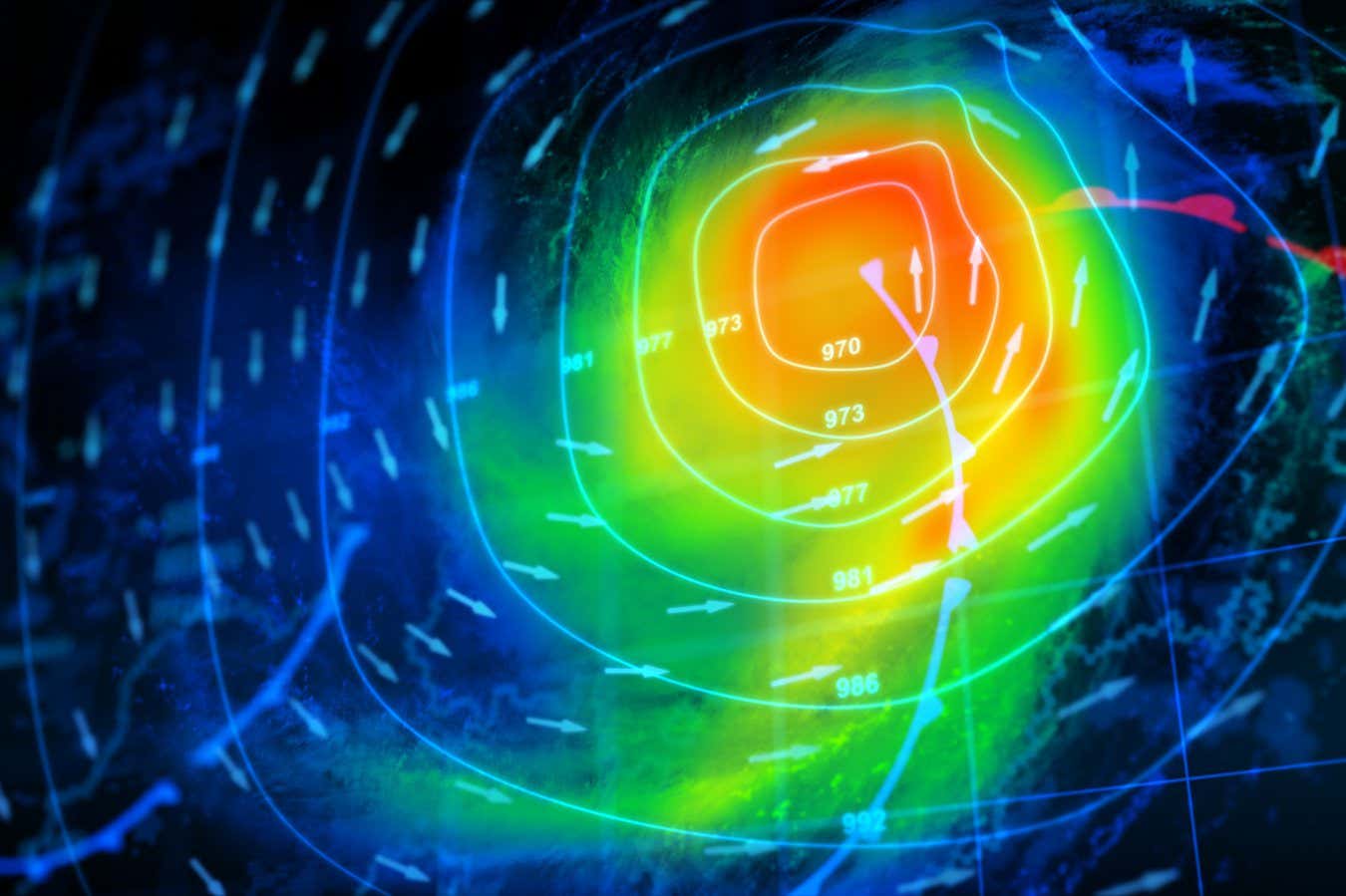
Today’s weather forecasts rely on simulations that require a lot of computing power
Petrovich9/Getty Images/iStockphoto
Google DeepMind claims its latest weather forecasting AI can make predictions faster and more accurately than existing physics-based simulations.
GenCast is the latest in DeepMind’s ongoing research project to use artificial intelligence to improve weather forecasting. The model was trained on four decades of historical data from the European Centre for Medium-Range Weather Forecasts’s (ECMWF) ERA5 archive, which includes regular measurements of temperature, wind speed and pressure at various altitudes around the globe.
Data up to 2018 was used to train the model and then data from 2019 was used to test its predictions against known weather. The company found that it beat ECMWF’s industry-standard ENS forecast 97.4 per cent of the time in total, and 99.8 per cent of the time when looking ahead more than 36 hours.
Last year, DeepMind worked with ECMWF to create an AI that beat the “gold-standard” high-resolution HRES 10-day forecast more than 90 per cent of the time. Prior to that, it had developed “nowcasting” models that predicted the chance of rain in a given 1-square-kilometre area from 5 to 90 minutes ahead using 5 minutes of radar data. And Google is also working on ways of using AI to replace small parts of deterministic models to speed up computation while retaining accuracy.
Existing weather forecasts are based on physics simulations run on powerful supercomputers that deterministically model and extrapolate weather patterns as accurately as possible. Forecasters usually run dozens of simulations with slightly different inputs in groups called ensembles to better capture a range of possible outcomes. These increasingly complex and numerous simulations are extremely computationally intensive and require ever more powerful and energy-hungry machines to operate.
AI could offer a less costly solution. For instance, GenCast creates forecasts with an ensemble of 50 possible futures, each taking just 8 minutes on a custom-made and AI-focused Google Cloud TPU v5 chip.
GenCast operates with a resolution of cells around 28 square kilometres at the equator. Since the data used in this research was collected, ECMWF’s ENS has been upgraded to a resolution of just 9 kilometres.
Ilan Price at DeepMind says the AI may not need to follow suit and could offer a way forward without collecting finer data and running more intensive calculations. “When you have a traditional physics-based model, that is a necessary requirement for getting more accurate predictions, because it’s a necessary requirement of more accurately solving the physical equations,” says Price. “[With] machine learning, [it] isn’t necessarily the case that going to higher resolution is a requirement for getting more accurate simulations or predictions out of your model.”
David Schultz at the University of Manchester, UK, says AI models present an opportunity to make weather forecasts more efficient but they are often overhyped, and it is important to remember that they rely heavily on training data from traditional physics-based models.
“Is it [GenCast] going to revolutionise numerical weather prediction? No, because you still have to run the numerical weather prediction models in the first place to train the models,” says Schultz. “If you never had ECMWF in the first place, creating the ERA5 reanalyses, and all the investment that went into that, you wouldn’t have these AI tools. That’s like saying ‘I can beat Garry Kasparov at chess, but only after I study every move he ever played’.”
Sergey Frolov at the US National Oceanic and Atmospheric Administration (NOAA) thinks the AI will need training data with higher resolution to progress further. “What we’re fundamentally seeing is that all these approaches are getting stopped [from advancing] by the fidelity of training data,” he says. “And the training data comes from operational centres like ECMWF and NOAA. To move this field forward, we need to generate more training data with physics-based models of higher fidelity.”
But for now, GenCast does offer a way to run forecasts at lower computation cost, and more quickly. Kieran Hunt at the University of Reading, UK, says just as a collection of physics-based forecasts can generate better results than a single forecast, he believes ensembles will boost the accuracy of AI forecasts.
Hunt points to the record 40°C (104°F) temperatures seen in the UK in 2022 as an example. A week or two earlier, there were lone members of ensembles predicting it, but they were considered anomalous. Then, as we drew nearer to the heatwave, more and more forecasts fell in line, allowing early warning that something unusual was coming.
“It does allow you to hedge a little if there is one member that shows something really extreme; it might happen, but it probably won’t,” says Hunt. “I wouldn’t view it as necessarily a step change. It’s combining the tools that we’ve been using in weather forecasting for a while with the new AI approach in a way that will certainly work to improve the quality of AI weather forecasts. I’ve no doubt this will do better than the kind of first wave of AI weather forecasts.”
Topics:
