

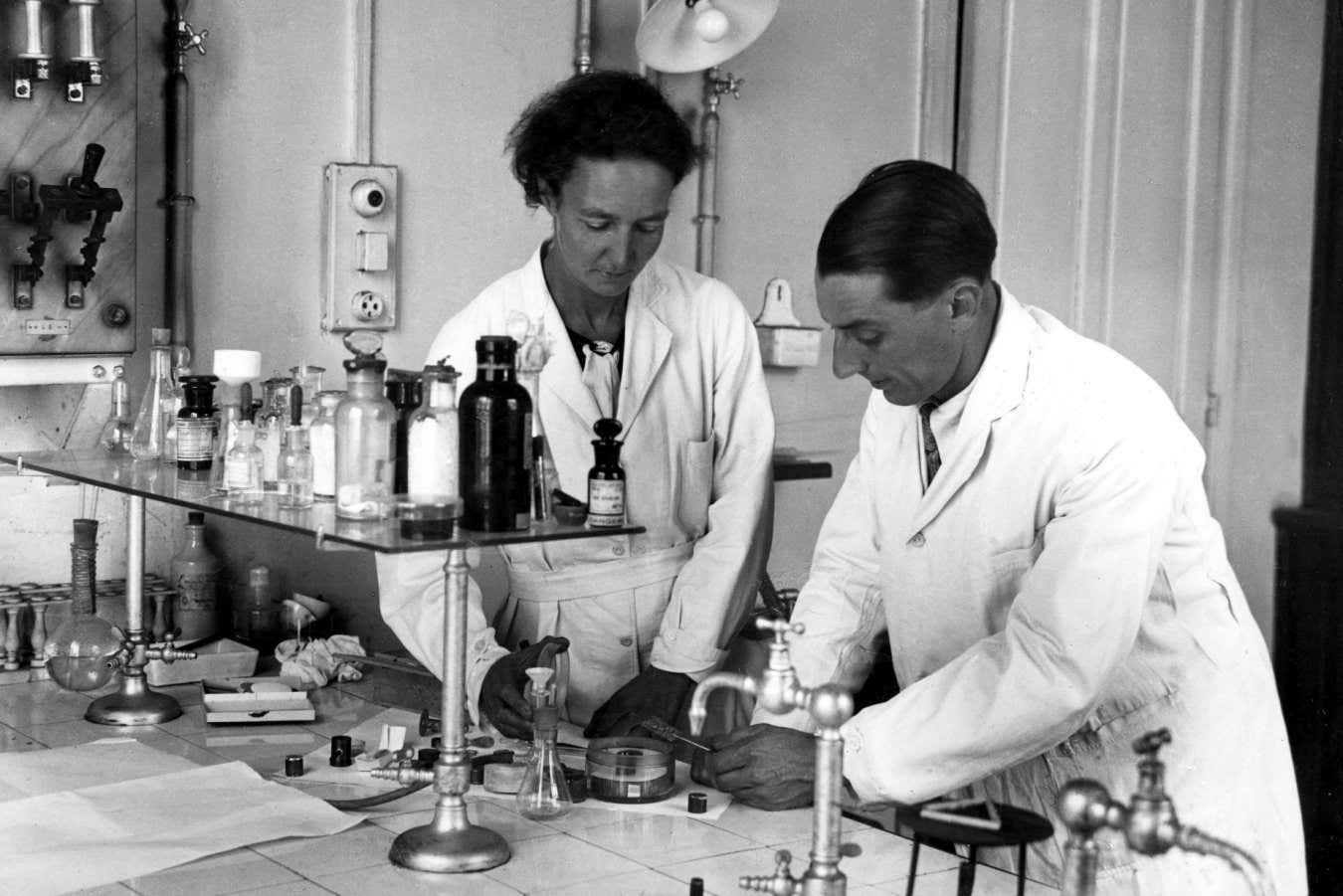
Irène Joliot-Curie and her husband Frédéric Joliot caught a glimpse of the neutron in their experiments
Smith Archive/Alamy
Destroyer of Worlds
Frank Close (Allen Lane (UK); Basic Books (US))
When particle physicist and University of Oxford professor emeritus Frank Close learned he had non-Hodgkin’s lymphoma in 2023, his treatment included three weeks of radiotherapy, giving him a fresh perspective on radiation’s power.
Later, his 10-year-old grandson gave him a fulsome account of the Tsar Bomba – the 50-megaton nuclear weapon tested by the Soviet Union in 1961, and, to date, the most powerful human-made explosion. For Close, it was time to write an account of nuclear energy and its value as a double-edged sword, one with the power to heal ailments and kill billions at a stroke.
As a three-time winner of the Association of British Science Writers prize, Close knows his subatomic onions. Destroyer of Worlds: The deep history of the nuclear age 1895-1965 begins with the Trinity test blast of July 1945 – when detonations ceased to be solely chemical. Then he jumps back, covering events like the first atomic imprint on a photographic plate in 1896, and his journey into the nuclear age begins.
There is the tale of 19th-century scientist William Crookes who, grieving and drawn to spiritualism after his brother’s death, observed “luminous green clouds” inside a charged vacuum tube filled with gas. He assumed he had synthesised ectoplasm and proved the existence of phantoms. Theorist George Gamow also makes an appearance, with his evidence that uranium could release positively charged alpha particles without violating the principle of energy conservation.
Close’s main focus, however, is the female physicists who escaped their share of the nuclear limelight. He explains how, despite her PhD, Lise Meitner wasn’t allowed into the upper, male-only rooms of the University of Vienna during her tenure. That didn’t deter her from working with Otto Hahn to provide X-rays to wounded troops during the first world war, or from discovering element 91, protactinium, in 1917. Five years later, Meitner became Prussia’s first female Privatdozent (an academic, albeit non-salaried), and in 1925 won a Lieben prize.
The book also profiles Irène Joliot-Curie, daughter of Marie Skłodowska-Curie and Pierre Curie, who inherited her parents’ scientific talents. In 1910, Marie was involved in a scandal over an affair with a married physicist and was denied membership of the French Academy of Sciences. In the fallout, Irène tried to restore the family’s legacy, and Close describes the research she did with her husband Frédéric Joliot, in which the pair glimpsed (but failed to fully identify) the neutron. The 1932 unveiling of that particle by James Chadwick is “the moment when the science of nuclear physics began”, writes Close.
In another section, he sheds light on chemist Ida Noddack’s claim that uranium nuclei could be broken into isotopes of lighter elements. When she went on to argue that these nuclei could be split to create nuclear fission, she was branded a crank by her peers. Noddack was targeted, Close implies, not just as a woman, but as an industrial chemist from a turbine factory stepping on the toes of the nuclear physics elite.
Destroyer of Worlds tries to live up to the jeopardy of its title by attempting to solve the mystery of Ettore Majorana, a theoretical physicist described as a genius, “like Galilei and Newton” by Enrico Fermi, creator of the nuclear reactor. Majorana vanished in 1938, and his absence sparked rumours ranging from suicide to becoming a monk to fleeing the fascism engulfing Italy. Close, like others before him, can’t get a definitive answer.
Today, one fact is clear through the radioactive fog: it took many great minds to release the nuclear genie from its lamp, and for better or worse, there’s no putting it back.
George Bass is a writer based in Kent, UK
Love reading? Come and join our friendly group of fellow book lovers. Every six weeks, we delve into an exciting new title, with members given free access to extracts from our books, articles from our authors and video interviews. Topics:
New Scientist book club
