

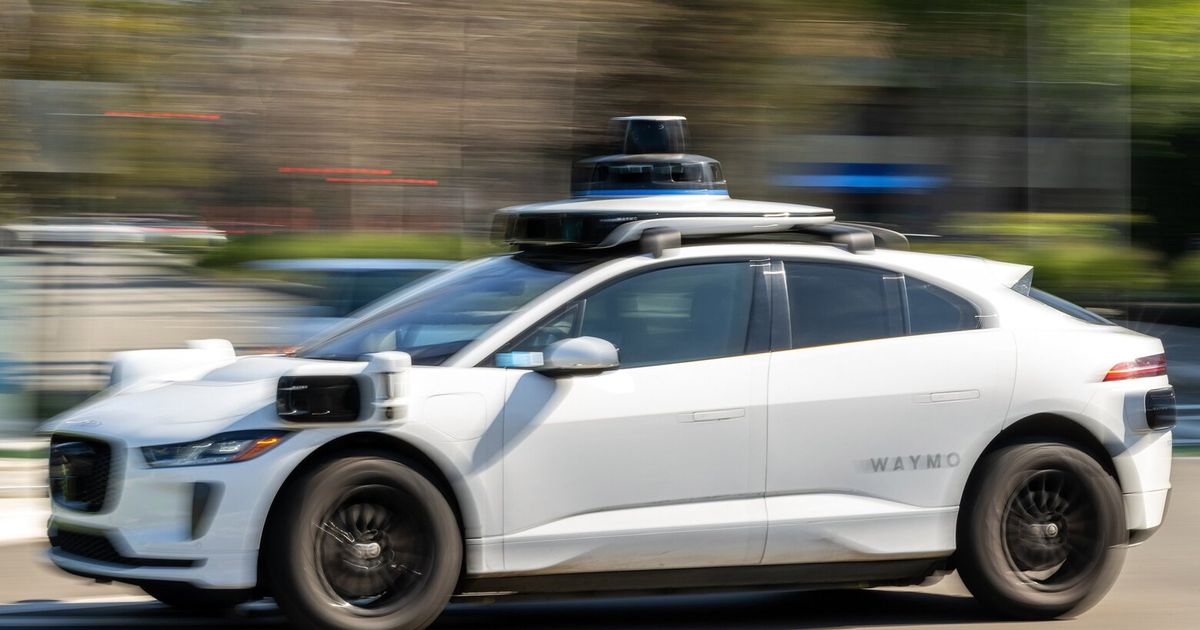
In late January, one of Waymo’s self‑driving vehicles struck a child near an elementary school in Santa Monica, Calif. Although the company, which recently announced its plan to come to Seattle, has framed this as an isolated incident, the broader narrative that treats the machine as inherently superior and places blame on citizens is anything but accidental.
Despite the crash, Waymo maintains its system performed better than a human driver. The car braked hard, reducing speed from about 17 mph to under 6 mph before impact. The company estimates that a fully attentive human driver would have only reduced the car’s speed to roughly 14 mph. The child, Waymo implies, was the reckless party: They “suddenly entered the roadway.”
This characterization should trouble us. At stake is not merely how we interpret a single crash, but the broader prospects for safer streets that protect vulnerable residents, including children. Cars don’t have to dominate public spaces and remain the default mode of transportation. Yet a look back at early car crashes during the automobile’s introduction into U.S. cities shows how 20th‑century court rulings and car company media campaigns constructed narratives of blame and responsibility, narratives that helped turn the urban landscape into one dominated by automobiles.
In 1905, three years before Ford released its Model T, a car struck and killed Branch Lewis Jr. His mother sued, only to confront a legal system already shifting away from systemic accountability. The 1907 ruling in Lewis v. Amorous set an important precedent. According to the pleadings, children were skating and playing in the street, and Branch, watching the others, “started across the street” when he was struck. The court ultimately placed responsibility solely on the “negligent” driver.
This and a series of other court decisions produced new social-legal subjects — negligent drivers, clumsy children and notably “bad mothers.” Streets that were once open to pedestrians transformed into corridors for traffic. Driving was framed as a right rather than a privilege. The automobile was categorized as an everyday object alongside bicycles and carriages rather than steamships and trains. This move placed the costs of road construction and maintenance on taxpayers, while shielding designers, manufacturers and the urban systems built around the car from liability.
In parallel, the auto industry invented “jaywalking” to deflect rising anger over car deaths onto pedestrians. The term “jaywalker” draws on an older slur — “jay” — used to describe someone of diminished judgment, effectively framing pedestrians who were hit by cars as irrational or incompetent. Today’s claims that autonomous vehicles perform “better than humans” repeat the same move, casting systemic danger as individual fault.
But isn’t our choice between bad and worse? Isn’t this a better option than distracted human drivers? Here too, a historical comparison is worthwhile. In the Netherlands, grassroots organizing by parents and caregivers — most famously the 1970s Stop the Child Murder movement — forced a reckoning over fatal accidents and helped shift policy toward safer streets. Dutch lawmakers established a “strict liability” perspective that places default civil liability on drivers in collisions with vulnerable road users such as bikers and children. An accompanying design philosophy and public investment rendered the Netherlands as the gold standard of transportation, setting an example of a systemic approach toward designing urban infrastructure that aims to eliminate accidents through redesign: protected cycle tracks, lower speeds. This approach treats human vulnerability as the design parameter, rather than an afterthought.
The stories we tell about technology shape our cities and our civic future. Companies such as Waymo have a high stake in framing public safety as a simplistic contest between distracted drivers and superior machines. Succumbing to this framing reinforces existing inequalities and strips our cities of proven public goods — including affordable public transit, walkable neighborhoods, and shared green and civic spaces that sustain social connection, health, and environmental well-being. If we are wise enough to learn hard-earned lessons of the 20th century, paid for with many lives and to the profit of the car industry, this may be the juncture at which we change the trajectory.
Seattle is on the right path with its Vision Zero commitment to creating “a culture of care and dignity for everyone who uses Seattle’s streets.” We must take care, however, that the surface allure of this technology as a safer option does not distract us from that vision.
