

Nearly 750 million people face hunger today, according to the U.N. World Food Program. And by 2050, global demand for food is expected to increase by 50 percent from 2010 levels, the World Resources Institute says.
A smart agriculture special-issue report recently released by the IEEE Smart Agri-Food Initiative says meeting the demand will require technology to expand food production. The report highlights research, case studies, and new ways of applying technology to inform farmers, engineers, and policymakers.
Leading the initiative is IEEE Fellow John Verboncoeur, chair of the smart-food program and professor of electrical and computer engineering at Michigan State University, in East Lansing.
“Food security is becoming a systems-engineering problem,” Verboncoeur says. “We’re no longer talking only about tractors and irrigation. We’re talking about sensing, communications, computation, automation, and sustainability all working together.”
Although not formally trained as an agriculture scientist, Verboncoeur’s first involvement with smart agriculture was as an undergraduate at University of Florida in 1985-86, where he helped develop an SmartAg aeroponics system for NASA for the International Space Station. It used mist to spray the plants’ roots and lightweight pneumatic structures to hold the vegetation in place.
He has also chaired the executive committee of Michigan State’s SmartAg Initiative since it launched in 2017. He chaired the program’s leading interdisciplinary efforts to apply engineering and digital technologies to farming and food systems.
Verboncoeur connects the shift of using engineering as a force multiplier for farming to lessons learned from the IEEE Smart Village program, which supports projects and organizations bringing electricity and educational and employment opportunities to remote communities. Agriculture, he argues, requires the same systems-level mindset.
“The challenge isn’t just inventing technology,” he says. “It’s making systems practical, affordable, and deployable.”
From digital twins to autonomous harvesting
A central theme across the Smart Agri-Food Systems report is the convergence of automation, data analytics, and sustainability.
One paper, “Smart Agriculture, Precision Agriculture, Digital Twins in Agriculture: Similarities and Differences,” addresses the confusion regarding how researchers and practitioners define and apply the technologies to farming.
The paper was written by Dilan Onat Alakuş, a research assistant in the software engineering department at Kırklareli University, in Türkiye, and Ibrahim Türkoğlu, a software engineering professor at Fırat University, in Elazığ, Türkiye.
Unclear terminology can lead to inefficient investment and poor adoption of the technologies, the two authors say. They note that agricultural methods based on traditional practices and intuition lack a thorough analysis of their environmental and economic impacts.
They describe how three technologies can benefit farmers:
• Smart agriculture systems integrate sensors, artificial intelligence, robotics, and analytics to improve efficiency and sustainability at scale.
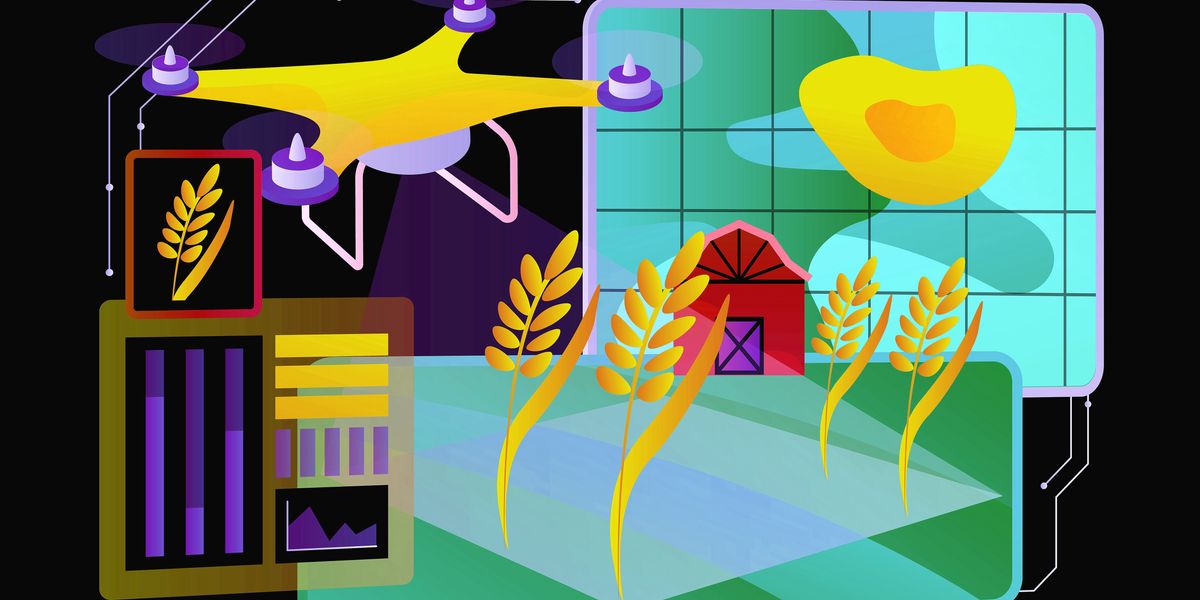
• Precision agriculture focuses on location-specific decisions. Farmers use GPS-guided equipment to map fields, deploy drones to monitor crop health, and install field sensors that track soil moisture and nutrient levels in targeted zones. The tools allow farmers to apply water, fertilizer, and pesticides only where needed—which can reduce waste and lessen environmental impact.
• Digital twins create virtual replicas of an agricultural area. The resulting models simulate the farmstead, crops, and irrigation systems, allowing growers to test scenarios and predict outcomes before implementing changes.
The authors emphasize that the categories overlap in practice. A digital twin might draw data from precision agriculture systems and feed recommendations into smart agriculture platforms.
Clearer distinctions help farmers select appropriate tools and avoid unnecessary complexity and costs, they say.
“This study contributed to conscious agricultural practices by differentiating agricultural technologies,” they wrote, adding that clearer definitions can increase productivity.
The report shifts from theory to application in a paper describing bustani, which means my garden in Arabic. The Bustanica project in Saudi Arabia is an automated hydroponic vertical farming system developed by researchers at the Prince Mohammad Bin Fahd University, in Al-Khobar, Saudi Arabia. The “Bustani: A Microcontroller-Based Automated Hydroponic Vertical Farming Solution” paper was written by Hussah Alotaibi, a computer engineer at Saudi Aramco, the country’s national oil company; Abul Bashar, Widad Karsou, and Shehvar Khan, researchers in the university’s computer engineering and computer science department; and Salahudean Tohmeh from the university’s robotics laboratory.
The Bustanica system combines hydroponics with aeroponics, in which plant roots hang in the air and receive nutrients through a misting system. Together, the approaches allow crops to grow in compact indoor environments, using far less water than traditional methods.
The method integrates IoT sensors that continuously monitor water chemistry and reservoir conditions.
The system grows crops in controlled indoor environments. A closed-loop design recirculates water to reduce waste. Sensors measure pH levels, nutrient concentration, and water levels. An Arduino Mega processes the sensor data. A NodeMCU ESP8266—a low-cost, open-source IoT platform—handles Wi-Fi communication and cloud connectivity.
The system sends the data through Google’s Firebase cloud platform, which acts as a real-time bridge between sensors and control systems.
A mobile app lets users monitor and control the system remotely. It displays real-time data on lighting, nutrient levels, and water pump activity. When conditions move outside optimal ranges, automated dosing pumps adjust the levels as needed.
Engineering can’t solve all the world’s problems. But it absolutely has a role to play in helping the world feed itself.” —John Verboncoeur, chair of the IEEE Smart Agri-Food initiative
The system operates as a feedback loop, collecting data, transmitting it to the cloud, analyzing the conditions, and automatically triggering adjustments.
LEDs simulate sunlight. Ultrasonic sensors measure water levels. Electrical conductivity sensors track nutrient concentration. During testing, the system maintained stable environmental conditions and adjusted dosing dynamically as readings changed.
The authors describe the outcome as “a fully functional and automated vertical sustainable farm that creates desirable growing conditions, along with an Android application that provides real-time monitoring and notifications.”
Beyond automation, bustani reflects a broader shift toward merging agriculture with consumer technology and smart-home systems. Future plans include integrating the Amazon Alexa virtual assistant and machine learning tools for plant disease detection and growth analysis.
Robotics and labor challenges
The “Toward an Efficient Tomato Harvesting Robot” paper addresses autonomous harvesting, a long-standing challenge in agricultural robotics. Tomatoes in the field vary widely in size, shape, and ripeness, and they can bruise during handling. The paper was written by IEEE Senior Member Hyoung Il Son—a professor of biosystems engineering and robotics at Chonnam National University in Gwangju, South Korea—and his graduate students Jongpyo Jun, Jeongin Kim, and Jaehwi Seol.
The paper describes how robotics is increasingly being used to target crops once considered too delicate or variable for automation.
The researcher combined 3D machine vision, robotic arms, suction-based grippers, and rotating cutting tools to build a harvesting machine capable of operating in unstructured outdoor environments. The system aims to reduce reliance on manual labor while improving harvesting efficiency and consistency.
Agriculture as a systems problem
Verboncoeur says the developments highlighted in the papers reflect a broad transformation in how engineers view the agricultural industry.
“Agriculture used to be seen primarily as managing the challenges of planting, watering, and fertilizing plants, and using machines to make the process less labor-intensive,” he says. “Now it’s also a data problem, a communications problem, an energy problem, and a resilience problem.”
Another featured paper, “Sustainable and Smart Agriculture: A Holistic Approach,” examines how technology can address environmental and demographic pressures. The paper was written by Surender Singh and Sannihit , researchers at the computer science and engineering and the civil engineering departments at Chandigarh University, in Mohali, India.
Farmers must increase food production while reducing environmental damage from depleting water resources, overapplication of fertilizer, deforestation, and greenhouse gas emissions, the authors say. They describe smart farming as “a revolution in food production” that can allow farmers to generate higher yields from existing resources through connected technologies and data systems.
The authors highlighted the issue of rapid urbanization. By 2050, they report, nearly 70 percent of the global population will live in cities, increasing pressure on food supply chains and distribution systems.
Wireless sensor networks will play a central role in the transformation, the researchers say. The networks use small, connected devices to monitor soil moisture, temperature, humidity, light intensity, and crop conditions. The system transmits the data to cloud platforms, where machine learning models analyze trends and recommend actions.
The authors emphasize that decision support, not automation alone, drives the greatest value of crop harvest. Farmers can integrate the information into crop management strategies to improve productivity while reducing their environmental impact.
They also note increasing collaboration between industry leaders such as Caterpillar, CNH, John Deere, and Kubota and technology companies including Bosch, Google, Intel, and Microsoft. Challenges remain, however, in communication reliability, sensor cost, and scalable data infrastructure, the authors say.
SmartAg beyond the farm
The implications of the tech advances that make farming more efficient extend beyond agriculture. Many of the same technologies—remote sensing, wireless sensor networks, AI analytics, and cloud platforms—support transportation, energy, and industrial systems.
The convergence explains IEEE’s growing involvement. Modern agriculture now combines electronics, communications, computing, and control systems.
Agriculture requires that integration, Verboncoeur says: “The challenge isn’t just inventing technology. It’s making systems practical, affordable, and deployable.”
What’s next for smart agriculture?
The special issue marks an early stage for the IEEE Smart Agri-Food initiative, which plans to develop standards; create structured ways for farmers, researchers, governments, and agribusinesses to work together; and devise deployment strategies for smart systems.
Future research is likely to focus on interoperability between platforms, data sharing, and scalable deployment models. Digital twins are expected to play a larger role as computing power and sensor density increase. Simulating agricultural systems before applying changes in the field will become commonplace, experts predict.
Adoption depends on more than technical capability, though. The central tension moving forward lies between innovation and practicality.
“Farmers face challenges in adopting such technology due to cost, electricity availability, communication infrastructure, and vulnerability of connected devices,” Singh and Sannihit wrote.
Smart agriculture offers improved efficiency, in addition to reducing the inputs of water, fertilizer, and time that would otherwise be spent on tasks machines can handle autonomously. But the benefits matter only if systems function reliably across diverse environments—from industrial farms to small, family-run operations in food-insecure regions.
For IEEE, agriculture now sits within core engineering domains. The stakes extend beyond technology itself, Verboncoeur says.
He adds that: “Food insecurity affects stability, health, education, and economic development. Engineering can’t solve all the world’s problems, but it absolutely has a role to play in helping the world feed itself.”
From Your Site Articles
Related Articles Around the Web
