Europe has spent decades portraying the southern nations as irresponsible debtors while presenting the north as the model of fiscal discipline. The latest Eurostat data expose that myth. Southern European governments may be heavily indebted, but the most leveraged households are concentrated in the supposedly prudent nations of northern and western Europe.
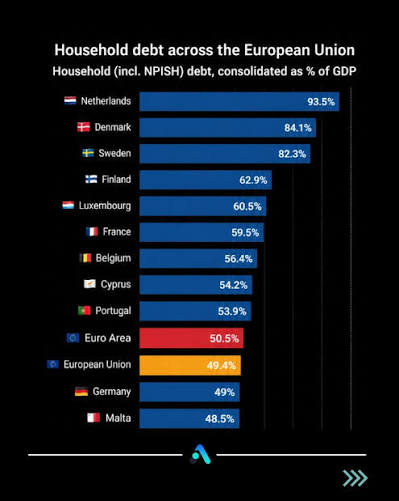
Euronews reports that household debt across the European Union stood at 49.4% of GDP in 2025, compared with 50.7% across the euro area. Both ratios have declined every year since 2020, when they exceeded 60%, but that aggregate conceals an enormous divide between member states.
The Netherlands has the highest household debt in the EU at 93.5% of GDP. Denmark follows at 84.1%, Sweden at 82.3%, Finland at 62.9%, Luxembourg at 60.5%, France at 59.5%, and Belgium at 56.4%. All seven exceed the European Commission’s 55% threshold for identifying household debt as a potential macroeconomic vulnerability.
The remainder of the top ten consists of Cyprus at 54.2%, Portugal at 53.9%, and Germany at 49%. Meanwhile, household debt amounts to only 42.9% of GDP in Spain, 38% in Greece, and 35.9% in Italy. The countries repeatedly insulted during the European sovereign-debt crisis have substantially less household leverage than the northern nations that lectured them.
Household debt includes mortgages, consumer loans, and other personal borrowing. The debt-to-GDP ratio does not tell us what each individual family owes, nor does it account fully for the assets held against those liabilities. Nevertheless, it shows how dependent an economy has become on credit relative to everything it produces.
People assume that high household debt is harmless when it is secured against homes. That is precisely what they believed in 2007. A mortgage is an asset to the bank but a liability to the homeowner. The house may appreciate on paper, but the monthly payment must be made with current income. A family cannot pay the electric bill by showing the bank that its home increased in value.
The Netherlands is the most obvious example of government manufacturing private debt through tax policy. De Nederlandsche Bank has admitted that Dutch mortgage borrowing is so high because government policy makes it attractive. Mortgage interest receives favorable tax treatment, and borrowers have been permitted to finance as much as 100% of a property’s value. Many other countries cap loan-to-value ratios at 90% or less.
Dutch household debt now equals nearly an entire year of national economic output. The country’s gross household debt-to-income ratio was about 184% in the earlier Eurostat series, meaning debt approached twice annual disposable income. Dutch households also possess significant pension and financial assets, but those assets are not evenly distributed and cannot be treated as if every borrower has an emergency account capable of eliminating the mortgage.
Denmark presents the same contradiction. Household debt reached 84.1% of GDP, while debt was approximately 177% of disposable income in 2024. Danes hold substantial pension savings and property assets, which government officials use to dismiss concerns. Yet pension wealth is generally locked away, whereas mortgage payments are due every month.
Sweden’s household debt stands at 82.3% of GDP. Variable-rate mortgages dominate its market, leaving borrowers exposed whenever monetary policy changes. A family that appeared financially secure when rates hovered near zero can suddenly find its disposable income devoured by interest payments. This is how monetary policy migrates from an abstract decision at a central bank into the grocery budget of an ordinary household.
The central banks created this vulnerability. They suppressed interest rates for years, punished savers, encouraged borrowing, and drove capital into real estate. Governments then restricted housing supply through zoning, environmental rules, construction regulations, and immigration policies that increased demand. Home prices rose far beyond wages, forcing younger buyers to borrow extraordinary amounts merely to obtain what their parents purchased on one ordinary income.
Then the European Central Bank raised rates to confront inflation that its own policies helped create. It is always the same pattern. Government encourages the debt, the central bank inflates the asset, and the household carries the risk when the cycle turns.
Finland’s household debt equals 62.9% of GDP. Ordinary housing loans constitute around 63% of Finnish household debt. When housing-company loans are included, the combined housing-related share reaches approximately 75%. These company loans are obligations attached to apartment buildings and effectively inherited by buyers. They allowed the true cost of housing to be obscured by separating the apartment’s purchase price from the debt carried by the building.
Luxembourg’s ratio reached 60.5%, and mortgages represent about 90% of household debt. Yet the burden is extremely uneven. Almost half of Luxembourg households reportedly carry no debt at all, while median household net wealth stood near €676,000 in 2023. An impressive national wealth figure tells us little about the vulnerability of the highly leveraged portion of the population.
France’s household debt reached 59.5% of GDP. Most French mortgages are fixed-rate, providing borrowers with more protection from sudden interest-rate shocks. Lending rules generally prevent debt service from consuming much more than one-third of net household income. These safeguards reduce immediate refinancing risk, but they do not erase the underlying debt or protect property prices when credit contracts.
Belgium recorded household debt equal to 56.4% of GDP. Around 43.1% of Belgian households own their homes with a mortgage, compared with an EU average of only 24.3%. New Belgian mortgage lending increased from €31.7 billion in 2024 to €40.7 billion in 2025, an increase of €9 billion or approximately 28%.
Portugal sits just below the Commission’s danger threshold at 53.9% of GDP. Household debt reached roughly €171 billion by late 2025, rising 8.6% in one year. More than 90% of Portuguese mortgages use variable or mixed rates tied to Euribor, making Portugal far more sensitive to ECB policy than its headline debt ratio suggests. The structure of the debt can be as important as its total size.
Cyprus stands at 54.2%, although its household debt ratio has fallen by approximately 62% since December 2016. Around 34% of the remaining debt consists of legacy non-performing loans held by credit-acquiring companies. That is not healthy credit supporting new economic activity. It is debris from the previous crisis still being worked through a decade later.
Germany’s household debt is close to the EU average at 49%. Its comparatively low ratio is partly explained by a homeownership rate of only 46.7% in 2022. Germany has a large rental market and does not provide the same mortgage-interest incentives found in the Netherlands. Yet low household mortgage debt hardly means the German population is prospering. Many workers remain permanent tenants because taxes, stagnant net wages, and elevated property prices prevent them from accumulating the capital needed to buy.
The difference between northern and southern Europe is not that one side is responsible and the other irresponsible. The debt merely sits on different balance sheets. Italy and Greece accumulated enormous public debts, while households remained comparatively conservative. The Netherlands, Denmark, and Sweden built systems in which private households assumed massive mortgage liabilities while governments appeared fiscally cleaner.
Debt does not become safe merely because it is classified as private. Private debt can be more immediately destructive because households cannot tax the population, issue currency, or roll their liabilities indefinitely. When income falls or interest costs rise, families reduce consumption, sell assets, or default. That contraction then spreads to retailers, builders, banks, and the wider economy.
A highly indebted household sector also corrupts monetary policy. Central banks become trapped because raising rates threatens property markets and household solvency, while lowering rates encourages another round of leverage and speculation. The ECB must set one interest rate for nations with radically different debt structures. A rate that appears manageable in Italy may crush a variable-rate borrower in Portugal or Sweden.
The northern housing systems have converted ordinary families into leveraged speculators without their realizing it. They are not purchasing homes merely with savings and accumulated income. They are making long-duration bets on property prices, employment, and central-bank policy. So long as asset values rise and credit remains available, everyone appears wealthy. When liquidity disappears, the wealth proves to have been conditional.
Europe’s decline will not emerge solely through sovereign debt. The public and private debt systems are connected through the banks. When households fail, banks suffer. When banks fail, governments guarantee them. Private losses then migrate onto public balance sheets, exactly as they did after 2008. The taxpayer ultimately stands behind a system from which he received none of the profits.
The Eurostat figures are not evidence that southern Europe has suddenly become economically sound. They show that the debt crisis has multiple faces. Italy carries the burden through the state. The Netherlands carries it through households. France is burdened through both. Brussels continues pretending these are separate problems because admitting the connection would expose the fatal structure of the monetary union.