

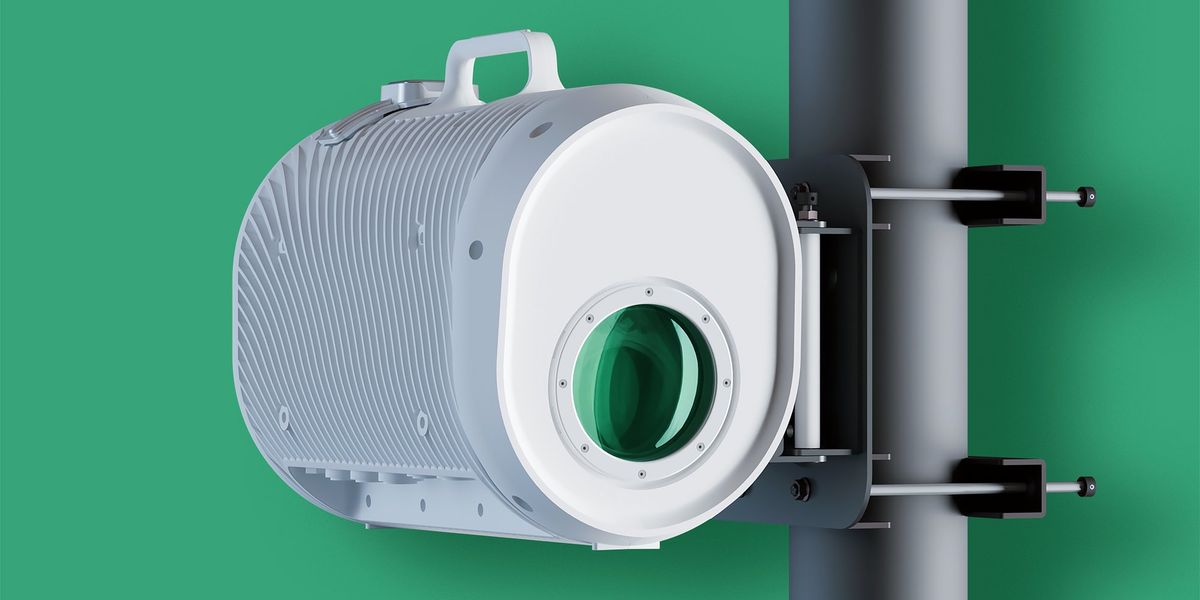
Taara started as a Google X moonshot spin-off aimed at connecting rural villages in sub-Saharan Africa with beams of light. Its newest product, debuting this week at Mobile World Congress (MWC), in Barcelona, aims at a different kind of connectivity problem: getting internet access into buildings in cities that already have plenty of fiber—just not where it’s needed.
The Sunnyvale, Calif.–based company transmits data via infrared lasers, the kind typically used in fiber-optic lines. However, Taara’s systems beam gigabits across kilometers over open air. “Every one of our Taara terminals is like a digital camera with a laser pointer,” says Mahesh Krishnaswamy, Taara’s CEO. “The laser pointer is the one that’s shining the light on and off, and the digital camera is on the [receiving] side.”
Taara’s new system—Taara Beam, being demoed at MWC’s “Game Changers” platform—prioritizes efficiency and a compact size. Each Beam unit is the size of a shoebox and weighs just 8 kilograms, and can be mounted on a utility pole or the side of a building. According to the company, Beam will deliver fiber-competitive speeds of up to 25 gigabits per second with low, 50-microsecond latency.
Taara’s former parent company, Krishnaswamy says, is also these days a prominent client. Google’s main campus in Mountain View, Calif., is near a landing point for a major submarine fiber-optic cable.
“One of the Google buildings was literally a few hundred meters away from the landing spot in California,” he says. “Yet they couldn’t connect the two points because of land rights and right-of-way issues.… Without digging and trenching into federal land, we are able to connect the two points at tens of gigabits per second. And so many Googlers are actually using our technology today.”
A Fingernail-Size Chip Shrinks Taara’s Tech
Krishnaswamy says his laser pointer and digital camera analogy doesn’t quite do justice to the engineering problems the company had to tackle to fit all the gigabit-per-second photonics into a weather-hardened, shoebox-size device.
The Taara Beam must steer its laser link across kilometers of open air so that the Beam device can receive it on the other end of the line. Effectively, that means the device’s laser can’t be off target by more than a few degrees.
Beam approaches the steering problem by physically shaping the laser pulse itself. Taara’s photonics chip splits the laser beam carrying the data into more than a thousand separate streams, delaying each one by a closely controlled amount. The result is a laser wavefront that can be pointed anywhere the system directs.
Krishnaswamy likens this to the effects of pebbles tossed into a pond. Dropping pebbles in a careful sequence, he says, can create interference patterns in the waves that ripple outward. “These thousand emitters are equivalent to a thousand stones,” he says. “And I’m able to delay the phase of each of them. That allows me to steer [the wavefront] whichever direction I want it to go.”
The idea behind this technology—called a phased array—is not new. But turning it into a commercial optical communications device, at Taara Beam’s scale and range, is where others have so far fallen short.
“Radio-frequency phased arrays like Starlink antennas are well known,” Krishaswamy says. “But to do this with optics, and in a commercial way, not just an experimental way, is hard.”
This isn’t how the company started out, however.
In 2019, when the company was still a Google X subsidiary, Krishaswamy says, Taara launched its first commercial product, the traffic-light-size Lightbridge. Like Beam, Lightbridge boasts fiberlike connection speeds, and it has to date been deployed in more than 20 countries around the world—including the Google campus.
Taara’s upgraded model, Lightbridge Pro, launched last month and is also on display this week at MWC. Lightbridge Pro adds one crucial capability Lightbridge lacked: an automatic backup. When fog or rain disrupts Lightbridge’s optical link, the system switches traffic to a paired radio connection. When conditions clear, Lightbridge Pro switches traffic back to the faster laser-data connection. The company says that combination keeps the link up 99.999 percent of the time—less than 5 minutes of downtime in a year.
Both Lightbridge and Lightbridge Pro mechanically position their mirrors, achieving three degrees of pointing accuracy. An onboard tracking system inside the unit also relocks the beams automatically whenever the unit gets shifted or jostled.
The Future of Taara Beam Deployment
Krishaswamy says that while Taara continues to install and support Lightbridge and Lightbridge Pro, he hopes the company can also begin installing Taara Beam units for select early customers as soon as later this year.
Mohamed-Slim Alouini, distinguished professor of electrical and computer engineering at King Abdullah University of Science and Technology in Thuwal, Saudi Arabia, says the bandwidth of free-space optical (FSO) technologies like Taara Beam and Lightbridge still leaves plenty of room to grow.
“Like any physical medium, free-space optics has a capacity limit,” Alouini says. “But laboratory experiments have already demonstrated fiberlike performance with terabits-per-second data rates over FSO links. The real gap is not in raw capacity but in practical deployment.”
Atul Bhatnagar, formerly of Nortel and Cambium Networks, and currently serving as advisor to Taara, sees room for optimism even when it comes to practical deployment.
“Current Taara architecture is capable of delivering hundreds of gigabits per second over the next several years,” he says.
Krishnaswamy adds that Beam’s compact form factor makes it suitable for more than just terrestrial applications.
“We’ll continue to do the work that we’re doing on the ground. But to the extent that space solutions are taking off, we would love to be part of that,” he says. “Data center-to-data center in space is something we are really looking at using for this technology.
“Because when you have multiple servers up in space, you can’t run fiber from one to the other,” he adds. “But these photonics modules will be able to point and track and transmit gigabits and gigabits of data to each other.”
For now, Taara’s ambitions are closer to Earth—specifically to the buildings, utility poles, and city blocks where fiber still hasn’t arrived. Which is, after all, where the company’s story began.
UPDATE 4 March 2026: The weight of the Taara Beam (8 kg) and the launch year of the Taara Lightbridge (2019) were both corrected.
From Your Site Articles
Related Articles Around the Web
