

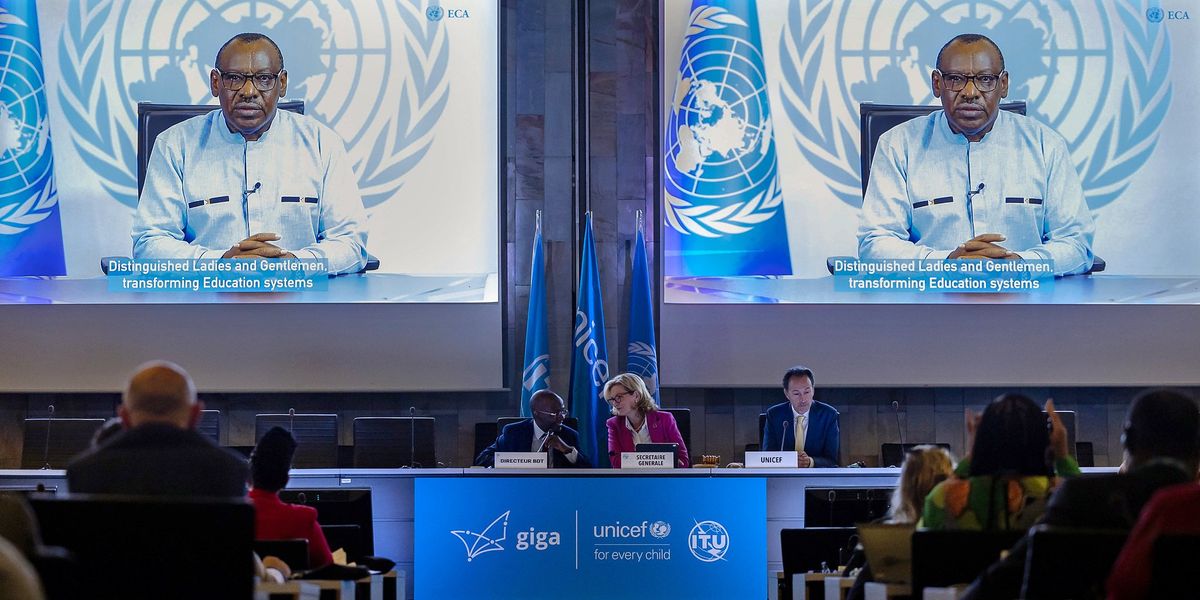
Connecting every school to the Internet is a monumental challenge that until recently no one had dared to tackle—in part because not all countries can even pin down the locations of all their schools. But a new joint initiative from the International Telecommunication Union (ITU) and UNICEF seeks to fill that gap. Dubbed Giga, the Geneva-based program has undertaken an ambitious mission to map and link up 6 million schools worldwide that are still offline by 2030.
The program’s initial results include mapping one-third of the world’s schools—as well as connecting and digitally enhancing the learning experience of nearly 8 million students from remote, marginalized, and rural communities across 141 countries.
“Giga is a lasting commitment to closing the educational gap while bridging the digital divide,” says Doreen Bogdan-Martin, who kickstarted the program five years ago at the ITU’s Telecommunication Development Sector. Now, as secretary general of the U.N. tech agency, she advocates “universal and meaningful connectivity” for the 2.6 billion people worldwide still cut off from the Internet, 360 million of them young.
With the cost of achieving this goal set at US $428 billion, the project’s success now hinges on Giga’s ability to innovate. The organization’s headquarters in Geneva is currently, for instance, investigating connectivity credit markets—which would create, according to Giga’s website, incentives akin to the carbon credits marketplace in the sustainable-energy world.
Meanwhile, Giga has set up in a former textile mill in Barcelona what it dubs “the largest research center worldwide developing open-source software to support school connectivity.”
The 30 computer scientists at Giga’s Catalan center have, for one, developed an innovative infrastructure mapping and modeling tool.
How to Find the World’s Schools
The team begins with high-resolution satellite imagery from industry partners like Maxar Technologies.
They next ask countries to divulge details about national electricity grids, fiber-optic cable routes, and other critical infrastructure. These have proved at times more reliable than the data turned up by ministries of education, telecom regulators, and local ISPs. “Countries frequently supply only city names without exact geographical coordinates, making precise mapping difficult,” says Gregori Mora-Cogul, ITU Lead at Giga Barcelona.
Giga uses machine learning models on these digital assets, models trained to pick out images of schools by recognizing unique features like playgrounds or a football pitch. Images of potential school locations are also cross-referenced with data from government censuses, OpenStreetMap (OSM), and Overture Maps.
Then, after pinpointing the geolocation of these candidate schools, local personnel are often summoned to travel out to the often-remote locations and verify firsthand the potential educational facilities that the machine learning model has surfaced.
Connecting Is Another Matter
Mora says the organization then works to help connect the schools either by fiber-optic cable (even going so far as to generate cost-efficient fiber-optic pathways). On the other hand, schools in regions with less fiber-optic availability require other tech. If a school happens to be less than 1 kilometer from the nearest cell tower, they’re connected using cellular modems. Point-to-point microwave links are also an option, as well as, for the most remote locations, very-small-aperture terminal (VSAT) or other broadband satellite connections.
“We are basically helping audit existing connections,” says Mora.
The schools Giga connects use an app developed by Giga to maintain that connection and fine-tune it with data on the school’s connectivity throughout a school day.
”You know how many kilometers of fiber you’re going to deploy, how many switches, splitters, and other equipment you’ll need,” says Walid Mathlouthi, global lead of the infrastructure-mapping contribution to the project with ITU’s Future Networks and Spectrum Management.
“Schools will be an anchor point as their connection will benefit communities and the population along the fiber path,” says Irene Kaggwa, Giga’s program manager. Botswana, for example, integrated Giga into its national digital development program and aims to bring high-speed Internet to hospitals and to the “kgotla”—the public consultation places in rural areas where people interact with the tribal administration. And this, in turn, allows communities to “[adapt] traditional spaces to serve the modern times,” says the country’s ambassador to the United Nations, Athaliah Lesiba Molokomme.
So far Giga has assisted Benin, Botswana, Brazil, Namibia, Rwanda, São Tomé and Príncipe, and Zimbabwe on infrastructure mapping—while 34 countries in all have been involved with the project to date.
From Your Site Articles
Related Articles Around the Web
