


 Google
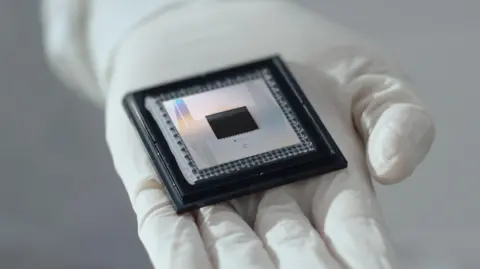
Google has unveiled a new chip which it claims takes five minutes to solve a problem that would currently take the world’s fastest super computers ten septillion – or 10,000,000,000,000,000,000,000,000 years – to complete.
The chip is the latest development in a field known as quantum computing – which is attempting to use the principles of particle physics to create a new type of mind-bogglingly powerful computer.
Google says its new quantum chip, dubbed “Willow”, incorporates key “breakthroughs” and “paves the way to a useful, large-scale quantum computer.”
However experts say Willow is, for now, a largely experimental device, meaning a quantum computer powerful enough to solve a wide range of real-world problems is still years – and billions of dollars – away.
The quantum quandary
Quantum computers work in a fundamentally different way to the computer in your phone or laptop.
They harness quantum mechanics – the strange behaviour of ultra-tiny particles – to crack problems far faster than traditional computers.
It’s hoped quantum computers might eventually be able to use that ability to vastly speed up complex processes, such as creating new medicines.
There are also fears it could be used for ill – for example to break some types of encryption used to protect sensitive data.
In February Apple announced that the encryption that protects iMessage chats is being made “quantum proof” to stop them being read by powerful future quantum computers.
Hartmut Neven leads Google’s Quantum AI lab that created Willow and describes himself as the project’s “chief optimist.”
He told the BBC that Willow would be used in some practical applications – but declined, for now, to provide more detail.
But a chip able to perform commercial applications would not appear before the end of the decade, he said.
Initially these applications would be the simulation of systems where quantum effects are important
“For example, relevant when it comes to the design of nuclear fusion reactors to understand the functioning of drugs and pharmaceutical development, it would be relevant for developing better car batteries and another long list of such tasks”.
What is quantum computing?
Apples and oranges
Mr Neven told the BBC Willow’s performance meant it was the “best quantum processor built to date”.
But Professor Alan Woodward, a computing expert at Surrey University, says quantum computers will be better at a range of tasks than current “classical” computers, but they will not replace them.
He warns against overstating the importance of Willow’s achievement in a single test.
“One has to be careful not to compare apples and oranges” he told the BBC.
Google had chosen a problem to use as a benchmark of performance that was, “tailor-made for a quantum computer” and this didn’t demonstrate “a universal speeding up when compared to classical computers”.
Nonetheless, he said Willow represented significant progress, in particular in what’s known as error correction.
In very simple terms the more useful a quantum computer is, the more qubits it has.
However a major problem with the technology is that it is prone to errors – a tendency that has previously increased the more qubits a chip has.
But Google researchers say they have reversed this and managed to engineer and program the new chip so the error rate fell across the whole system as the number of qubits increased.
It was a major “breakthrough” that cracked a key challenge that the field had pursued “for almost 30 years”, Mr Neven believes.
He told the BBC it was comparable to “if you had an airplane with just one engine – that will work, but two engines are safer, four engines is yet safer”.
Errors are a significant obstacle in creating more powerful quantum computers and the development was “encouraging for everyone striving to build a practical quantum computer” Prof Woodward said.
But Google itself notes that to develop practically useful quantum computers the error rate will still need to go much lower than that displayed by Willow.

 Google
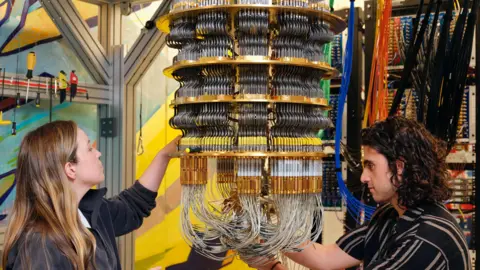
Willow was made in Google’s new, purpose-built manufacturing plant in California.
Countries around the world are investing in quantum computing.
The UK recently launched the National Quantum Computing Centre (NQCC).
Its director, Michael Cuthbert, told the BBC he was wary of language that fuelled the “hype cycle” and thought Willow was more a “milestone rather than a breakthrough”.
Nevertheless, it was “clearly a highly impressive piece of work”.
Eventually quantum computers would help with a range of tasks including “logistics problems such as cargo freight distribution on aircraft or routing of telecoms signals or stored energy throughout the national grid”, he said.
And there were already 50 quantum businesses in the UK, attracting £800m in funding and employing 1300 people.
On Friday, researchers from Oxford University and Osaka University in Japan published a paper showcasing the very low error rate in a trapped-ion qubit.
Theirs is a different approach to making a quantum computer that’s capable of working at room temperature – whereas Google’s chip has to be stored at ultra low temperatures to be effective.
Scientific findings from Google’s development of Willow have been published in the journal Nature
