

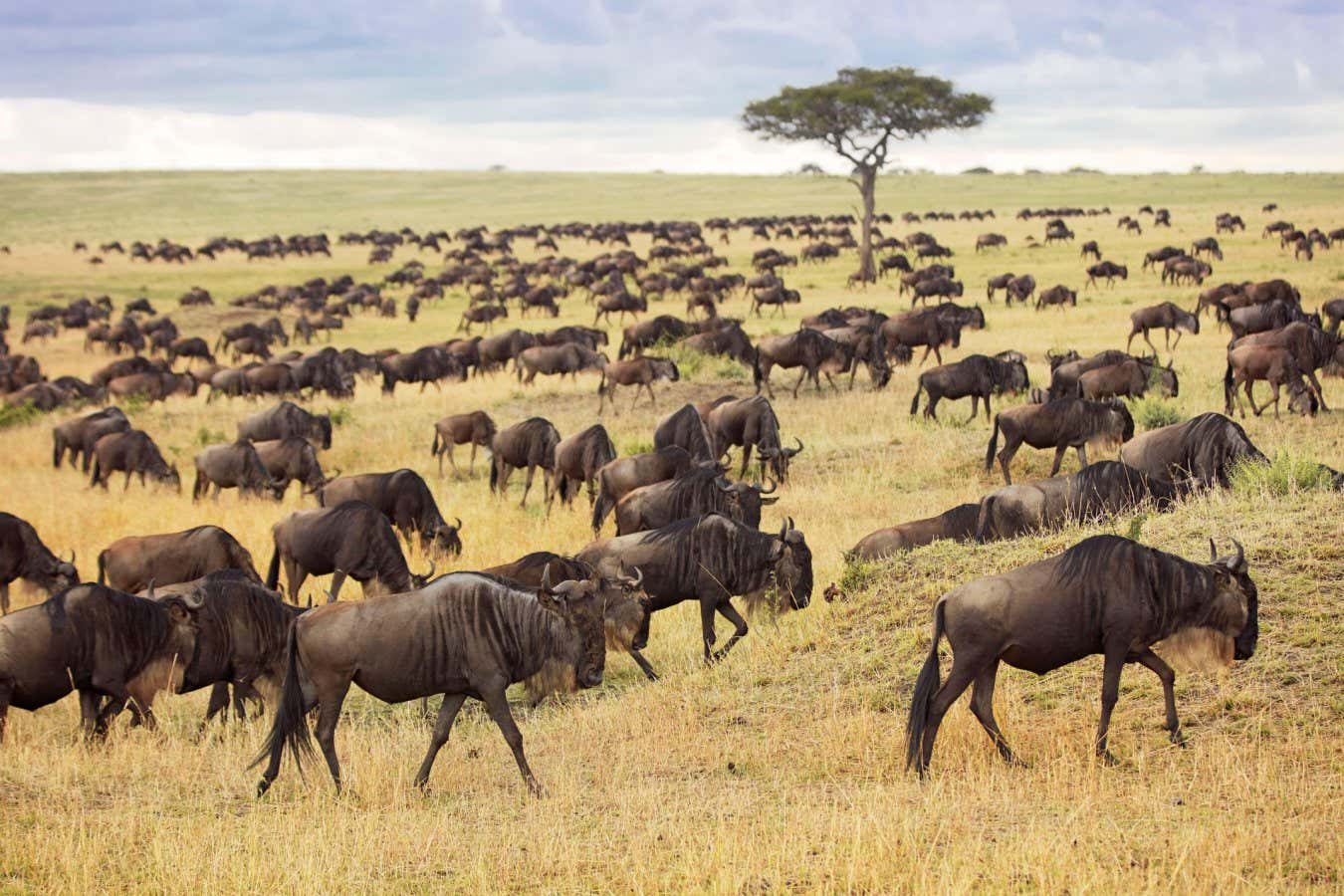
The wildebeest migration of the Serengeti involves fewer animals than we had thought
Nicholas Tinelli / Alamy
East Africa’s “Great Migration” is generally estimated to involve as many as 1.3 million wildebeest. But in reality, fewer than 600,000 of the animals might move across the Serengeti Mara landscape each year, according to an AI analysis of satellite images.
The Great Migration sees wildebeest, zebra and antelopes move between feeding and breeding grounds in Kenya and Tanzania, while also trying to dodge predators including lions, crocodiles and hyenas.
Assessing the number of animals involved is a tough task, traditionally achieved using crewed aerial surveys. Researchers can only survey a small area at a time, however, so they use statistical models to extrapolate densities across unsurveyed regions, which can introduce errors given herds are unevenly distributed and constantly on the move.
Satellite surveys can avoid these problems because one photo can cover hundreds of thousands of square kilometres, reducing the chance of double-counting animals and removing the need for extrapolative projections. It is impractical to manually count wildebeest in such vast images, but the animals can be tallied using AI instead. “Automation through AI does provide greater consistency and accuracy in counting,” says Isla Duporge at the University of Oxford.
For the new study, Duporge and her colleagues trained two deep-learning models – U-Net and YOLOv8 – to identify wildebeest using a dataset of images in which 70,417 of the animals had been manually labelled. Both models were then applied to over 4000 square kilometres of high-resolution satellite imagery. The images were captured on 6 August 2022 and 28 August 2023.
The two AI models gave similar results, counting 324,202 and 337,926 wildebeest in 2022, and 502,917 and 533,137 in 2023. The substantial difference between the 2022 and 2023 figures reflects the fact the two surveys were conducted at different times of August: it was already known the number of animals involved in the migration rises and falls through the month. “[But] what’s encouraging is that both deep learning models, which use very different approaches, produced consistent results,” says Duporge. “That consistency strengthens our confidence in the reliability of AI-based counts for tracking wildlife populations.”
The previous estimate of 1.3 million produced from aerial surveys has been in place, largely unchanged, since the 1970s. “Based on our findings, I suspect the true population size is closer to around 800,000 individuals, if we were able to count every individual with zero error,” says Duporge. “I think the aerial count is an overestimate and ours is a slight underestimate. We miss those under the trees and there will be some outside of the study area, but it’s very surprising that we can see no more than 533,137.”
Lower counts don’t necessarily mean wildebeest populations have collapsed. They may have altered their migration routes. But wildebeest do face significant challenges, including habitat loss and fragmentation due to agriculture. Accurate population estimates are crucial for informing targeted conservation efforts.
The research team previously trained an AI model to recognise elephants from satellite data, but this is the first time the approach has been used to conduct a census of individual mammals in a large, distributed population. The team is currently developing a similar method to detect and count African rhinos.
“I do believe we should be moving toward satellite and AI-based methods for counting wildlife populations, particularly for species that are widely distributed across large landscapes,” says Duporge.
The code for the researcher’s model has been made available at https://github.com/sat-wildlife/wildebeest
Topics:
