

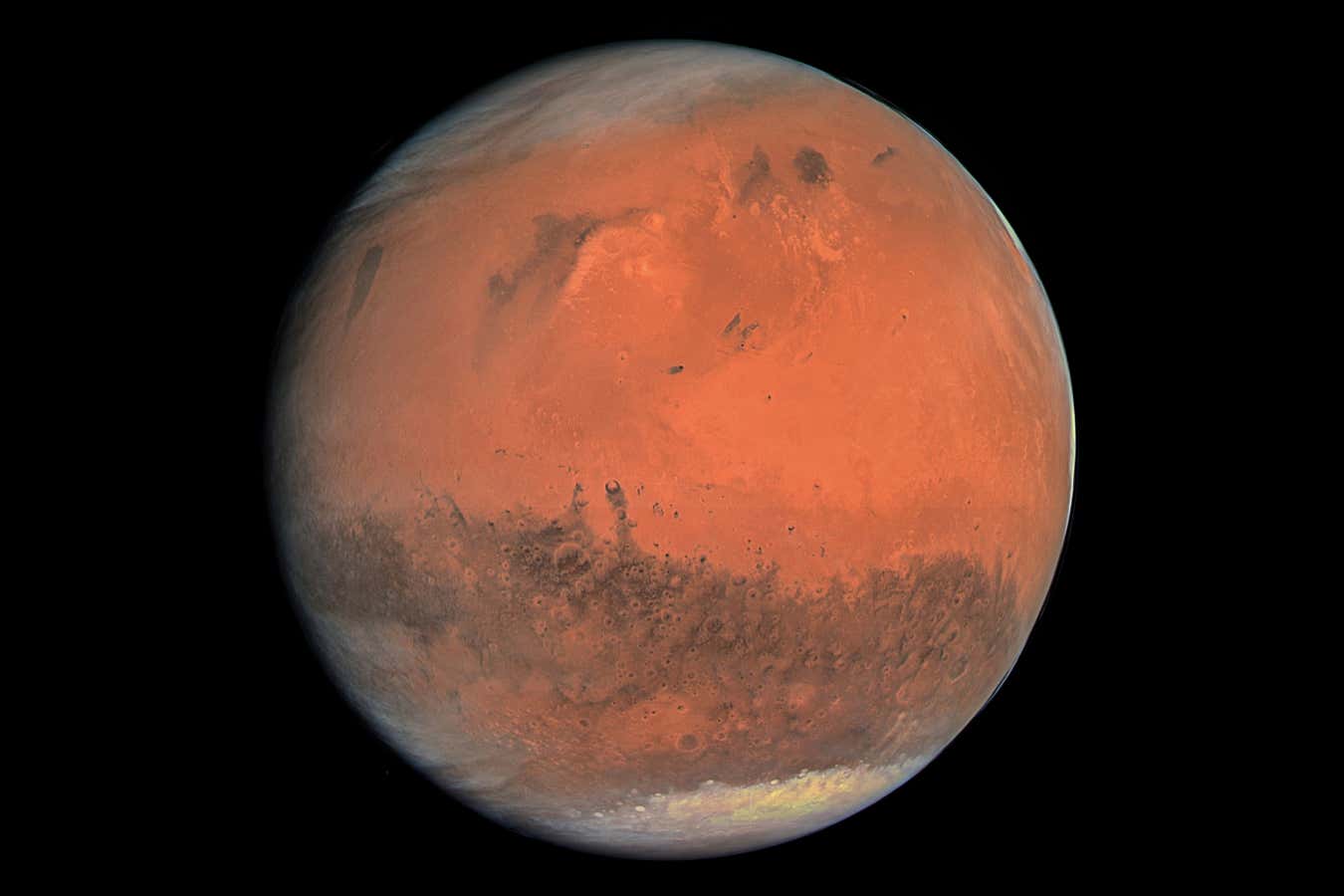
Mars – the kind of place to raise your kids?
ESA /MPS/OSIRIS/MPS/UPD/LAM/IAA/RSSD/INTA/UPM/DASP/IDA
As a kind of living embodiment of the dangers of techno-optimism, Elon Musk recently declared he means to create a self-sustaining settlement of 1 million people on Mars in the next 30 years. But few talk about the elephant in the room: “self-sustaining” means that women must become pregnant, give birth and somehow not die… on Mars.
Here on Earth – where we have breathable air, global supply chains, hospitals and medical specialists – UNICEF reports that in 2020 we lost 287,000 women to maternity-related deaths. A majority of these deaths occurred in areas where maternal care is hard to access. For example, in 2020 in the US, roughly 21 women per 100,000 died of maternity-related causes. In countries such as Chad, Nigeria and South Sudan, that number shoots to over 1000 per 100,000. And those are just deaths in the six weeks postpartum – morbidity rates continue to be elevated beyond this. So, let’s think about a place like Mars: 225 million kilometres from Earth, 40 per cent of Earth’s gravity, hardly any protection from space radiation, and planet-wide toxic dust storms. How do we think these astro-frontierswomen will fare?
Only about 15 per cent of astronauts have ever been women, so we currently have no data on pregnancy in space and little more on female astronauts overall. On Earth, well-timed hetero-coitus under ideal conditions has a roughly 25 per cent chance of producing a viable pregnancy. But it may not even be possible to get pregnant on Mars. Of the small amount of data we have, it seems that microgravity may impair the uterus’s ability to prepare for egg implantation. On Earth, you can improve rates with IVF, but SpaceX hasn’t released any plans to ship massive repro-labs. Maybe we should send astronauts with freezers full of frozen sperm, a turkey baster and a prayer?
If they should become pregnant despite it all, it is unlikely that conditions on Mars would be safe for maternal health. Microgravity in orbiting space stations is demonstrably bad for the musculoskeletal and cardiovascular systems: astronauts orbiting the Earth suffer bone loss, muscle atrophy and their vision degrades over time. Given that the heart changes shape in zero gravity, shifting from an ovoid to more of a fat sphere, and muscles that normally squeeze and support blood vessels atrophy, it is particularly worrying that mothers with pre-existing cardiovascular problems here on Earth are far more likely to experience severe morbidity or death.
Prenatal care can help. UNICEF presently recommends at least 4 visits to a healthcare provider during pregnancy. How will pregnant astronauts receive this minimum level of care? Perhaps they should all be board-certified maternal fetal medicine specialists with experience in field deliveries. Life-saving medications are a problem, too: the oxytocin needed to halt postpartum hemorrhaging has to be refrigerated at stable temperatures – add fridges to the launch list, then. And what if the fridges fail? The window for trips to Mars only opens once every two years, and it takes six months to get there from here. Even in perfect conditions, many medicines will expire well before resupply ships might arrive. It is also true that as many as 1 in 8 mothers suffer from postpartum depression. Because of the vast distance between Earth and Mars, calls with Earth providers will have up to a 20-minute time delay, so there will be no real-time conversations for rapid mental health support. Should we make all the astronauts psychiatrists, too?
Love reading? Come and join our friendly group of fellow book lovers. Every six weeks, we delve into an exciting new title, with members given free access to extracts from our books, articles from our authors and video interviews.
New Scientist book club
But there is a better way. Mars can be our next moonshot, but the technological payoff might not be about the rockets. We could use the excuse of Mars to deeply commit to research in women’s healthcare here on Earth, while also leaning into research on mammalian reproduction in space. Developing medications like shelf-stable oxytocin would immediately benefit women – right here, right now, on Earth. While the off-Earth environment may ultimately prove too dangerous for human pregnancy, fetuses could develop well in artificial wombs – if we can manage to build them. This technology could reduce maternal morbidity and mortality, while also giving women more choice.
Human pregnancy, birth and postpartum recovery without proper medical care results in so much pain and death. Not all the time, not every time, but an inexcusable amount of the time. We could choose to do better. If we’re unwilling to do it for women on Earth, let’s say we did it for Mars.
Kelly and Zach Weinersmith’s A City on Mars (Penguin) is the latest pick for the New Scientist Book Club: sign up here to read along with our members. Cat Bohannon is the author of Eve: How The Female Body Drove 200 Million Years of Human Evolution.
Topics:
