

Last month, the Israeli government launched a paid campaign on social media, claiming there is no famine in Gaza. It released a video showing food at restaurants and markets full of fruit and vegetables. “There is no famine in Gaza. Any other claim is a lie,” the video says.
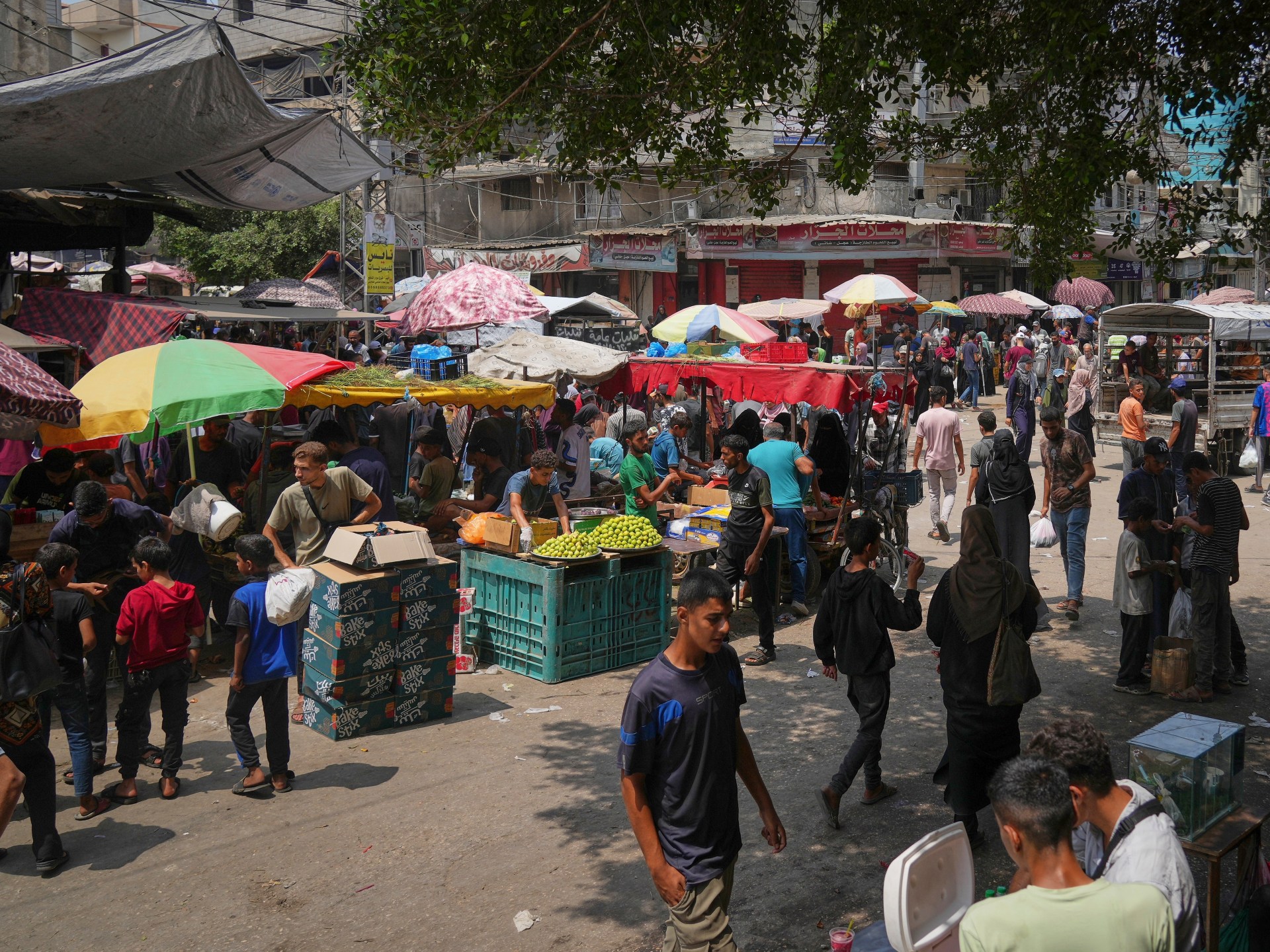
It is true that today you can see markets and shops with full shelves in southern Gaza. You can see crates of cucumbers and tomatoes, sacks of flour, cartons of eggs and bottles of oil. There are even cafes and restaurants serving pizza, drinks and improvised desserts made from whatever the market offers.
From a distance, these places look almost ordinary, like an attempt to preserve fragments of normal life. But in reality, these are places far out of reach. Their prices are astronomical, and even those who can afford them face another barrier: the cash crisis.
The few people who still have money in bank accounts have to pay a commission of 50 percent to withdraw cash. Banknotes are often so worn out that shops and cafes refuse to accept them. Thus, only a tiny, privileged minority can still sit at a cafe table and sip a coffee for $9 or have a small pizza for $18 while the rest of us can only watch.
The situation is similar at the market. Most people who pass by full stands do not pick up a bag of tomatoes or a tray of eggs. They only look, sometimes lingering in silence, sometimes moving on quickly with hollow eyes. For the majority, these goods are visible but untouchable, mocking in their abundance and hurtful in their unaffordability.
This is the paradox of hunger in Gaza: Food is available in certain places, but it is out of reach.
I still remember how in early August cheese and sugar briefly returned to the market after not being seen for months. Israel had just started letting in commercial trucks into Gaza instead of aid.
I cannot describe the sudden surge of joy that rushed through me at the sight of them. I hadn’t seen cheese in so long that even its shape looked strange to me. For a fleeting moment, I felt something I hadn’t dared to feel in months: excitement.
That morning, I had woken up dizzy from hunger. I had already lost more than 10kg (22lb) in just three months, and my body often trembled from weakness. But the sight of sugar and cheese on those shelves lit up a corner of my heart. Maybe, I thought, things would change now. Maybe the blockade was easing. Maybe we could begin to live again.
But when I asked the price, my heart sank. It was absurd. It would have been laughable if it wasn’t so cruel. A single kilo (2.2lb) of sugar cost $70 – more than some families’ weekly income before the war. A block of cheese that could barely feed one family for breakfast cost $10.
I didn’t buy anything. I walked away, consoling myself with the thought that maybe in a few days the prices would drop. They didn’t. Weeks later, flour, eggs and oil appeared – but again, sold at rates that mocked our hunger. A kilo of flour, which does not satisfy even one family’s daily needs, cost $45 although there were days when it fell to $26. A single small egg could cost $5.
These sudden reappearances of commercial goods are not random. They are not meant to feed the population, but to flood the markets with just enough products to be filmed and photographed amid the global pressure and pleas.
Once inside Gaza, the goods pass through several hands and a chain of intermediaries of Israeli suppliers who set inflated prices from the start, merchants who pay bribes or “protection fees” to armed groups and speculators who hoard supplies to resell later. By the time food reaches the shelves, it has appreciated in value so much that it has become a luxury item to be put on display rather than consumed.
These moments, these carefully timed “entries” of goods, have become weapons in themselves. Israel knows that the vast majority of Palestinians are now unemployed and fully dependent on aid to survive. Its cruelty is not only in the bombs or the blockade but also in the way it toys with our needs by allowing a few goods to enter, just to taunt us, to torture us.
Now, food has become a cruel reminder of what has been lost. To see a cucumber in the market is no longer to imagine a refreshing salad but to feel the sting of knowing you cannot afford it. To see sugar is not to think of tea shared with friends but to taste the bitterness of absence.
Mothers count the shekels in their hands, knowing they will never stretch far enough to buy food. Fathers avert their eyes from their children’s hungry faces, ashamed that even when shelves are full, they cannot bring home a single meal.
This deliberate manipulation turns every trip to the market into an act of humiliation, a reminder that survival is dangled before us but never granted.
What Gaza endures should not be called “famine” – food scarcity caused by drought, economic failure or natural disaster. This is deliberate starvation, engineered by the occupation. It is a slow, calculated deprivation enforced through blockade, bombardment and incited chaos.
Israel launched its propaganda campaign shortly before the Integrated Food Security Phase Classification hunger monitor finally announced famine in Gaza. By then, at least 376 Palestinians, almost half of them children, had died from starvation. Since then, the hunger death toll has surpassed 400. Israel has officially announced it plans to cut off aid to northern Gaza as its onslaught on Gaza City proceeds.
Meanwhile, the world has done nothing other than offer condemnations. It seems to prefer to console itself with the Israeli-supplied images of Gaza markets than acknowledge the bitter truth.
The views expressed in this article are the author’s own and do not necessarily reflect Al Jazeera’s editorial stance.
