

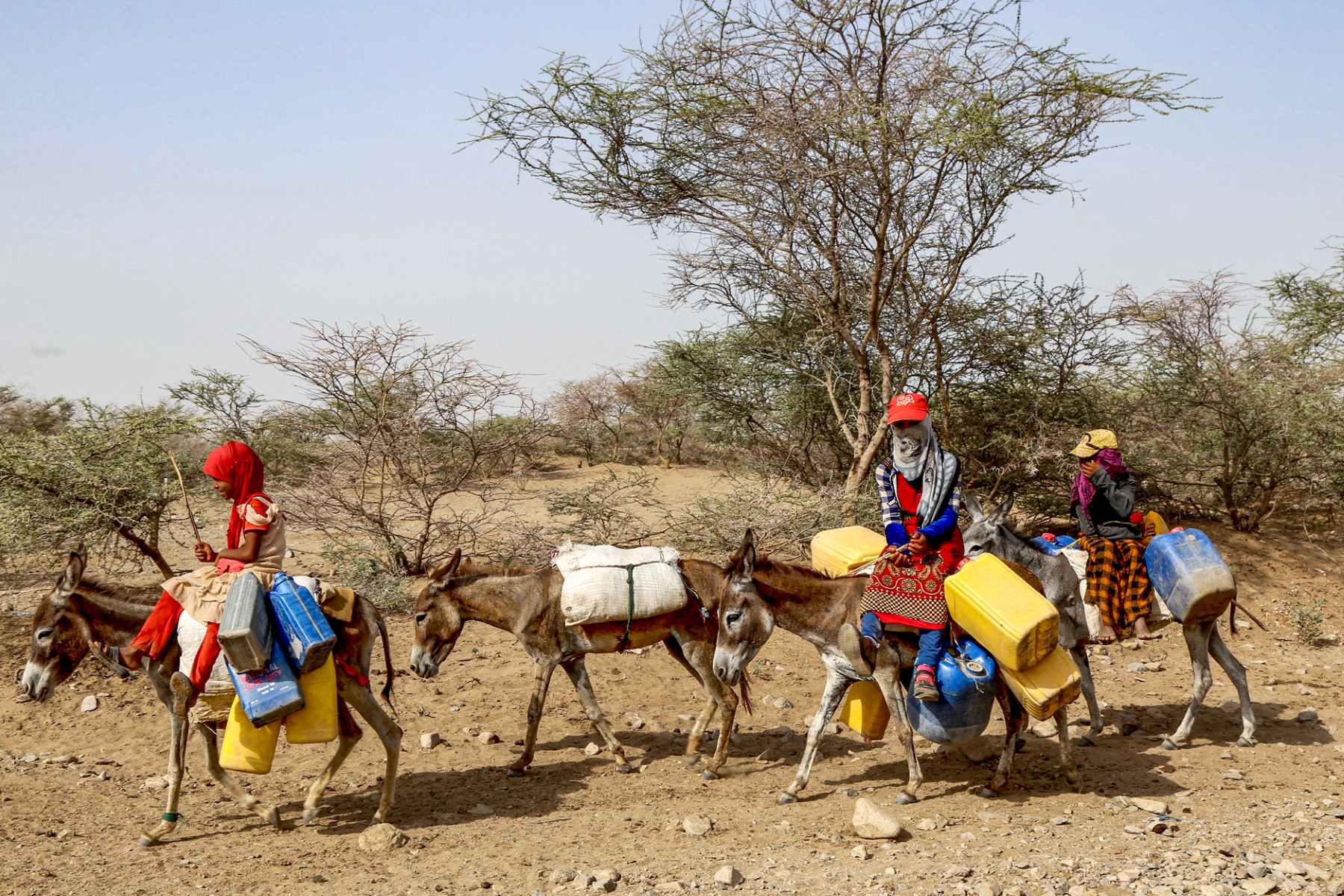
Mukalla, Yemen – Yemen is sweltering under a heatwave as temperatures soar above a blistering 40C (104F), turning houses into ovens. Long power cuts have added to the suffering of millions of people across the war-torn nation.
With authorities struggling to boost power supply, people have nowhere to escape from the hot and humid weather gripping much of the country’s southern, eastern and western regions, further compounding the humanitarian crisis in the most impoverished Arab nation.
Recommended Stories
list of 3 itemsend of list
Residents of coastal cities such as Mukalla and Aden, under the control of the internationally recognised government, say prolonged blackouts are hurting businesses, disrupting daily life, robbing people of sleep and aggravating health problems.
“Power was cut for eight hours and restored for only two,” Saddam Al-Jamlani, a resident of Aden, told Al Jazeera.
There is no respite from the heat and frequent blackouts in the northern part of the country under the Iran-backed Houthis either.
The growing frustration has also rekindled fears of unrest in a country still struggling to recover from more than a decade of conflict that has battered nearly every aspect of life.
In Aden, residents say electricity is available for only a few hours a day as temperatures approach 40C. Many describe their homes as ovens, with little respite from the heat and humidity.
Al-Jamlani said he and many others had hoped electricity supplies would improve during the Eid holiday (May 27), when thousands of residents left the city to visit relatives in the countryside, and many factories, workshops and businesses temporarily shut down. However, power cuts continued unabated, he said.
“The electricity situation in Aden during Eid remained unchanged, with no improvement,” he told Al Jazeera.
Crisis years in the making
For more than a decade, Yemen has been engulfed in a war between the Houthis and the internationally recognised government backed by Saudi Arabia, a conflict that has killed and wounded thousands of people, displaced millions and devastated much of the country’s infrastructure, including its electricity sector.
The collapse of public services and the worsening economic crisis have repeatedly fuelled public anger. In recent years, violent protests triggered by prolonged power outages and deteriorating living conditions have left people dead and injured, while rival political factions have sought to exploit public frustration to mobilise support against their opponents.
Earlier this year, shortly after Yemeni forces, backed by a Saudi-led coalition, pushed the UAE-supported Southern Transitional Council (STC) out of several southern provinces, Riyadh announced an $81.2m financial package to buy more than 300 million litres of fuel from the local market to operate dozens of power stations across Yemen.
The Saudi intervention in January, which came during the cooler months when electricity demand is lower, helped keep many power stations running around the clock and allowed residents in cities such as Aden to enjoy near-continuous electricity for the first time in years.
But as summer temperatures and humidity began to rise, the electricity situation deteriorated.
On May 27, Saudi Arabia announced another support package worth $150m to buy fuel derivatives for power stations in government-controlled areas of Yemen. Residents and business owners, however, say the assistance has yet to bring noticeable improvements to electricity supplies in many of the affected cities.
Searching for relief
In the port city of Mukalla, known for its hot and humid summers, Salah Mohammed and his wife, a childless couple, say they sleep less than five hours a day and suffer from skin conditions they blame on prolonged power cuts.
“When the power goes out at night, I wash myself and use a piece of cardboard to cool down. I don’t have a battery, an air conditioner or anything else,” Mohammed told Al Jazeera.
He said the most difficult time is at night, when the heat and humidity rob them of sleep. If electricity has not returned by dawn, he often heads to a nearby mosque for prayers and a chance to cool off in its air-conditioned hall.
“There is no comfort in the summer. The only time I feel cool is when I go to the mosque, which has air conditioning,” he said.
“If we sleep on the roof, we get bitten by mosquitoes. If we use a mosquito net, it becomes unbearably hot. My wife has pimples all over her body, and her face and legs are swollen. I also suffer from a skin condition.”
Businesses struggle
Severe summer blackouts have also crippled businesses, forcing some to close early, while others struggle with spoiled products and fewer customers as people avoid venturing out in the heat.
Muhanad Salem, who works at an auto repair shop in Mukalla, said the power cuts frequently shut down equipment, forcing workers to suspend operations or spend scarce money on fuel for a generator that often breaks down and requires repairs.

“Prolonged power cuts have hurt our work,” he told Al Jazeera, wiping sweat from his face with a hand and part of his T-shirt, both stained with grease. “We only switch on the generator when it is urgently needed, and even then, it sometimes breaks down and requires maintenance.”
Omer Baesa, a fish seller in Mukalla, said prolonged power cuts have forced him to buy ice from the local market to keep his fish fresh, though some still spoil due to inadequate refrigeration.
“I spend at least 10,000 Yemeni riyals [$6.7] a day on two bags of ice to preserve my fish for the following day, but sometimes I still find some of it rotten,” he told Al Jazeera as he cut fish with a knife behind his counter at Mukalla’s fish market.
The Yemeni riyal is trading at about 533 to the US dollar in Houthi-controlled areas, compared with about 1,500 to the dollar in government-controlled areas.
System on the brink
Yemen’s newly appointed electricity minister, Adnan al-Kaf, blamed the collapse of power services in government-controlled areas on ageing and deteriorating power stations, years of inadequate maintenance, delays in the arrival of critical spare parts, the high cost of electricity from private suppliers, weak revenue collection and an inflated payroll, among other factors.
“I would be lying if I told them [people] to expect a cool summer. I do not want to make empty promises,” al-Kaf told state television in April when asked whether Yemenis could expect better electricity services during the summer months.
“The situation is disastrous right now, and this summer is going to be difficult.”
Blackouts in Houthi-held areas
In Houthi-controlled areas, residents say the electricity situation is just as severe. Many households now rely almost entirely on solar power, as electricity from the state grid remains unavailable for long periods.
The situation has been further complicated by waves of Israeli air attacks targeting infrastructure in Houthi-controlled areas, including power facilities in the capital, Sanaa, and the western city of Hodeidah.
In Hodeidah, which is also known for its intense heat and humidity, residents recently expressed outrage after receiving sharply higher electricity bills despite frequent power outages. Many took to social media to vent their frustration.
Ali Omar, a resident of Hodeidah, posted a video complaining that his electricity bill had jumped from less than 3,000 riyals ($5.6) to 19,000 riyals ($35.6), even though his household relies primarily on solar power during the day.
“This cannot be my bill. It must belong to someone else,” he said in the video. “How did you calculate my electricity bill at 19,000 riyals when I use solar power during the day?”
