

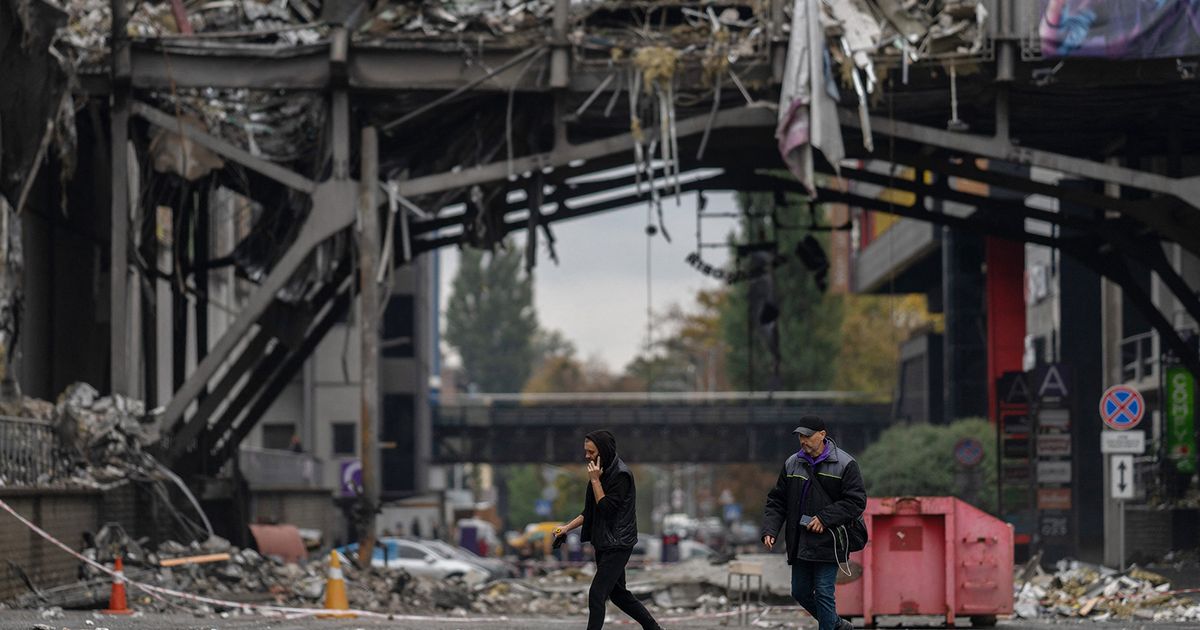
The drone that slams into a Ukrainian apartment building may have been designed in Iran, built in Russia with Chinese parts and launched alongside North Korean artillery shells.
Retired Rear Adm. Mark Montgomery came back from a couple of weeks in Ukraine with a blunt observation: Ukraine “is fighting Russia, North Korea, Iran and China.”
That is the core argument of “Axis of Aggressors: Countering the Cooperation of China, Russia, Iran and North Korea.” Montgomery wrote the book this summer with Bradley Bowman and Elaine Dezenski of the Foundation for Defense of Democracies.
The authors document 616 instances of security cooperation among the four regimes. These countries are not a formal alliance, and they don’t fully trust one another. They don’t have to. They share a goal, a weaker America, and help each other get there.
Ukraine’s battlefield shows how their cooperation works. North Korea has sent artillery shells and thousands of troops. Russia now builds Iran’s Shahed drone design in its own factories, using Chinese machine tools and components.
According to the book, China also buys as much as 95% of Iran’s oil exports while Russia and North Korea have signed a treaty with a mutual-defense clause.
The axis isn’t only fighting Ukraine. Since the United States and Israel struck Iran on Feb. 28, Americans have been at war with one of its members. Russia has reportedly passed Iran intelligence on U.S. military targets.
The Soufan Center describes Moscow’s help as repayment for Tehran’s drones. The weapons Iran sold to Russia were refined in Ukraine, and the lessons now flow back to the forces firing at Americans in the Gulf.
Hold that picture up against the last several weeks of American policy.
On Oct. 9, after a call with Russian leader Vladimir Putin, President Donald Trump lifted sanctions on Russian diesel through next April. The same day, Putin’s aide said Russia would continue fighting until it achieved “all its objectives.”
The next day, Trump called on Ukrainians to replace President Volodymyr Zelenskyy, and he said Zelenskyy “better damn well stop” striking Russian refineries.
According to Axios, a Ukrainian official said White House envoys Steve Witkoff and the president’s son-in-law Jared Kushner had threatened to cut off U.S. intelligence if the strikes continued. Within days, Ukraine’s Starshield satellite link was throttled.
The moral case is simple. One country invaded, and the other is defending its borders. Pressuring the victim to stop hitting the invader’s war machine while easing sanctions on the invader turns that reality upside down.
Set morality aside, and the policy still fails on American interests alone.
First, money. By Putin’s own account, Ukraine’s refinery strikes have cost Russia about 1% of its GDP. That revenue funds the same war machine Moscow shares with Tehran. Every dollar returned to Russia’s energy sector is a dollar available to a partnership that helps Iran target Americans.
Second, credibility. The book’s sharpest warning is what the authors call the simultaneity problem: four adversaries could force the United States into several crises at once. Montgomery’s example is a Chinese move on Taiwan, during which North Korea threatens South Korea to pin down American forces.
Deterrence in that scenario depends on whether our allies and enemies believe American commitments hold. They are watching what happens to Ukraine when fuel prices rise before an election.
Third, coherence. In July, Defense Secretary Pete Hegseth acknowledged to Congress that Russia and China were enabling Iran at different levels. Days later, the president said, “I don’t know that they are enabling.” An administration that cannot agree on whether the axis exists will not counter it.
High diesel prices squeeze real families, and they deserve an answer. That answer cannot be a sanctions waiver for a country whose partners are helping target American service members.
Congress has tools. Trump signed a Russia sanctions law on Sept. 18, and the diesel waiver seems to conflict with it. Lawmakers should demand accounting. The book’s prescriptions, closer coordination with allies and expanded defense production, are bipartisan in spirit. They deserve a hearing before the next crisis, not after it.
The four regimes have figured out they are stronger together. The danger is that Washington, D.C., is teaching them America is weaker alone, and that its word can be traded for a few cents at the pump.
