

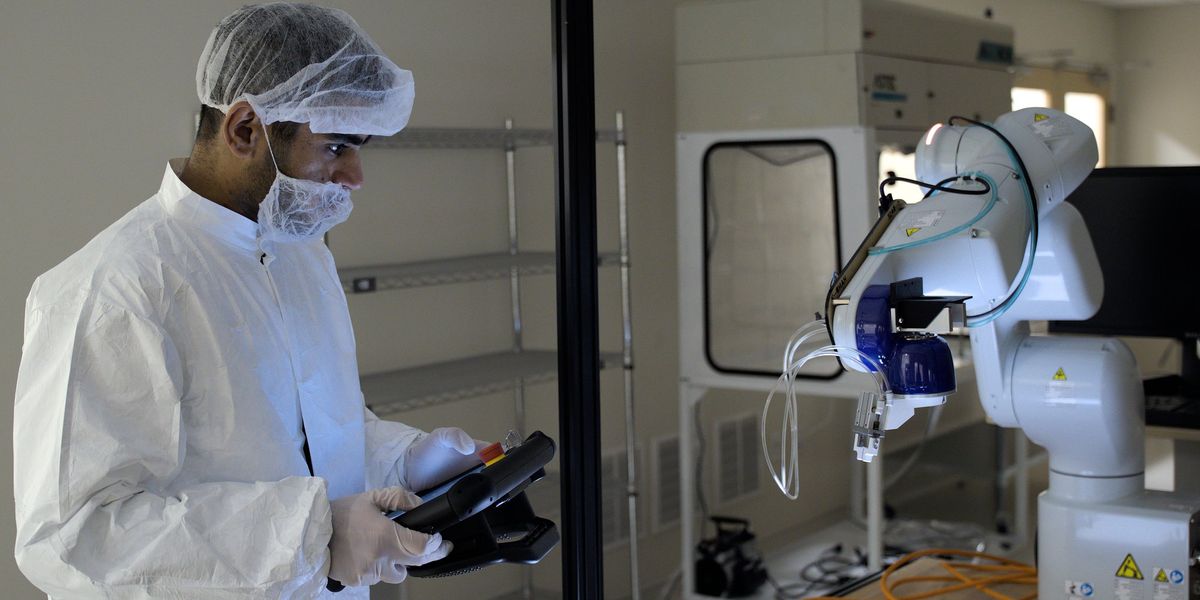
Innovation rarely happens in isolation. Usually, the systems that engineers design are shaped by global teams whose members’ knowledge and ideas move across borders as easily as data.
That is especially true in my field of robotics and automation—where hardware, software, and human workflows function together. Progress depends not only on technical skill but also on how engineers frame problems and evaluate trade-offs. My career has shown me how cross-cultural experiences can shape the framing.
Working across different cultures has influenced how I approach collaboration, design decisions, and risk. I am an IEEE member and a mechanical engineer at Re:Build Fikst, in Wilmington, Mass., but I grew up in India and began my engineering education there.
Experiencing both work environments has reinforced the idea that diversity in science, technology, engineering, and mathematics fields is not only about representation; it is a technical advantage that affects how systems are designed and deployed.
Gaining experience across cultures
I began my training as an undergraduate student in electrical and electronics engineering at Amity University, in Noida. While studying, I developed a strong foundation in problem-framing and disciplined adaptability.
Working on a project requires identifying what the system needs to demonstrate and determining how best to validate that behavior within defined parameters. Rather than starting from idealized assumptions, Amity students were encouraged to focus on essential system behavior and prioritize the variables that most influenced the technology’s performance.
The approach reinforced first-principles thinking—starting from fundamental physical or system-level behavior rather than defaulting to established solutions—and encouraged the efficient use of available resources.
At the same time, I learned that efficiency has limits. In complex or safety-critical systems, insufficient validation can introduce hidden risks and reduce reliability. Understanding when simplicity accelerates progress and when additional rigor is necessary became an important part of my development as an engineer.
After getting my undergraduate degree, I moved to the United States in 2021 to pursue a master’s degree in robotics and autonomous systems at Arizona State University in Tempe. I encountered a new engineering culture in the United States.
In the U.S. research and development sector, especially in robotics and automation, rigor is nonnegotiable. Systems are designed to perform reliably across many cycles, users, and conditions. Documentation, validation, safety reviews, and reproducibility are integral to the process.
Those expectations do not constrain creativity; they allow systems to scale, endure, and be trusted.
Moving between the two different engineering cultures required me to adjust. I had to balance my instinct for efficiency with a more formal structure. In the United States, design decisions demand more justification. Collaboration means aligning with scientists, software engineers, and technicians. Each discipline brings different priorities and definitions of success to the team.
Over time, I realized that the value of both experiences was not in choosing one over the other but in learning when to apply each.
The balance is particularly critical in robotics and automation. Resourcefulness without rigor can fail at scale. A prototype that works in a controlled lab setting, for example, might break down when exposed to different users, operating conditions, or extended duty cycles.
At the same time, rigor without adaptability can slow innovation, such as when excessive documentation or overengineering delays early-stage testing and iteration.
Engineers who navigate multiple educational and professional systems often develop an intuition for managing the tension between the different experiences, building solutions that are robust and practical and that fit real-world workflows rather than idealized ones.
Much of my work today involves integrating automated systems into environments where technical performance must align with how people will use them. For example, a robotic work cell (a system that performs a specific task) might function flawlessly in isolation but require redesign once operators need clearer access for loading materials, troubleshooting faults, or performing routine maintenance. Similarly, an automated testing system must account not only for ideal operating conditions but also for how users respond to error messages, interruptions, and unexpected outputs.
In practice, that means thinking beyond individual components to consider how systems will be operated, maintained, and restored to service after faults or interruptions.
My cross-cultural background shapes how I evaluate design trade-offs and collaboration across disciplines.
How diverse teams can help improve tech design
Engineers trained in different cultures can bring distinct approaches to the same problem. Some might emphasize rapid iteration while others prioritize verification and robustness. When perspectives collide, teams ask better questions earlier. They challenge defaults, find edge cases, and design technologies that are more resilient to real-world variability.
Diversity of thought is certainly important in robotics and automation, where systems sit at the intersection of machines and people. Designing effective automation requires understanding how users interact with technology, how errors propagate, and how different environments influence the technology. Engineers with cross-cultural experience often bring heightened awareness of the variability, leading to better design decisions and more collaborative teams.
Engineers from outside of the United States play a critical role in the country’s research and development ecosystem, especially in interdisciplinary fields. Many of us act as bridges, connecting problem-solving approaches, expectations, and design philosophies shaped in different parts of the world. We translate not just language but also engineering intent, helping teams move from theories to practical deployment.
As robotics and automation continue to evolve, the challenges ahead—including scaling experimentation, improving reproducibility, and integrating intelligent systems into real-world environments—will require engineers who are comfortable working across boundaries. Navigating boundaries, which could be geographic, disciplinary, or cultural, is increasingly part of the job.
The engineering ecosystems in India and the United States are complex, mature, and evolving. My journey in both has taught me that being a strong engineer is not about adopting a single mindset. It’s about knowing how to adapt.
In an interconnected, multinational world, innovation belongs to engineers who can navigate the differences and turn them into strengths.
From Your Site Articles
Related Articles Around the Web
