

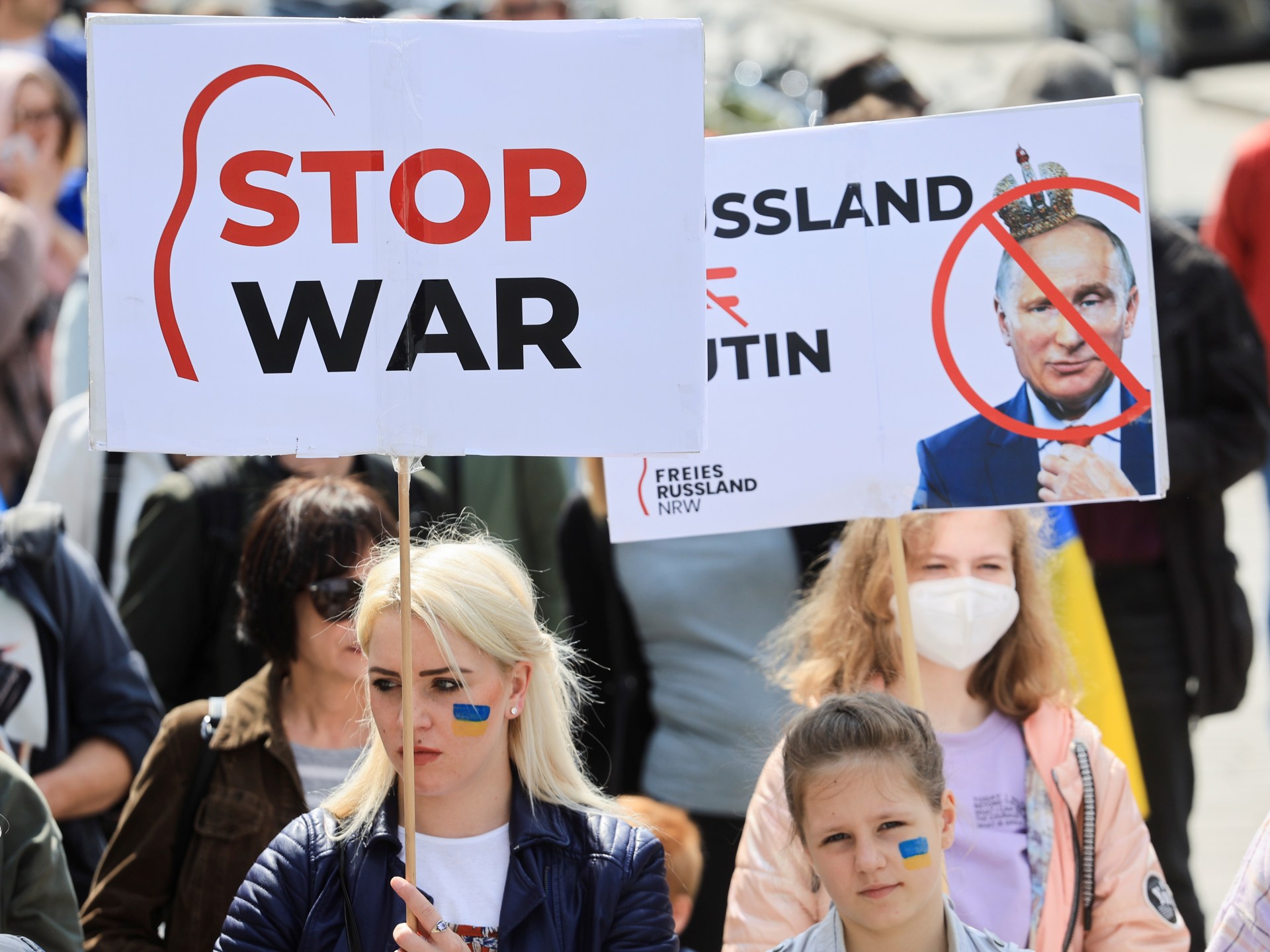
Earlier this month, Russian President Vladimir Putin signed into law new legislation that targets Russians living abroad who oppose his regime. The law restricts the provision of consular services to Russian citizens who have been sentenced in absentia in political cases.
This means that those convicted of a number of offences – including violating the “foreign agent law” or “discrediting” the Russian army – will not be able to renew their Russian passports and receive other essential consular services. This could affect thousands of Russian citizens. Individuals and organisations labelled “foreign agents” are already more than 1,600 and the number continues to grow.
This comes at a time when European countries are increasingly making more difficult residency renewal and asylum seeking for Russian citizens who condemned the invasion of Ukraine and had to flee their country. Russians of conscience are thus being punished by both sides for deciding to oppose a brutal war.
I know what that feels like.
In May 2022, Russia began legal proceedings against me and my family. It was one of the first known cases in which the Russian authorities sought to strip a person of citizenship because of their political beliefs and opposition to the war in Ukraine.
I had fled the country in March of that year after being arrested for protesting the war. After almost a year of proceedings, the final decision to strip me of my only citizenship was followed by the detention and intimidation of my family members, who were given three days to leave the country.
I became stateless while living in exile in Germany, with a ban on entering Russia for the next 50 years.
Fortunately, I am of Armenian descent, so I was able to apply for Armenian citizenship. It took a year to obtain it.
At the time, there were still humanitarian visa programmes available to Russians fleeing political persecution. But even those programmes had significant limitations. In my case, I would have had to leave the EU in order to apply, something I could not do without a valid passport.
Since then, Russia has systematically expanded the legal mechanisms for punishing people who oppose the regime from abroad. In 2023, a new citizenship law introduced provisions allowing the authorities to terminate the citizenship of naturalised citizens convicted of a broad range of “crimes”, including offences related to “discrediting” the Russian armed forces, extremism and actions deemed threats to national security.
As a result, more than 4,500 people have had their Russian citizenship revoked since October 2023 – something international media has largely found not newsworthy enough to cover.
The new legislation introduces a new mechanism to render Russian dissidents de facto stateless. Those targeted will continue to be Russian citizens on paper while effectively being stripped of the protection and services that citizenship is supposed to provide. Because their citizenship is not formally revoked, this means these people would not be able to benefit from the protections the 1961 Convention on the Reduction of Statelessness provides for.
This is not the first time Russians face mass loss of citizenship rights. With the start of the 1917 Bolshevik Revolution, hundreds of thousands of Russians fled the country, many of whom were stripped of their citizenship by the newly formed Soviet state. In response to the Russian refugee wave, the League of Nations introduced the so-called Nansen passport in 1922 as a travel document for people who were denied one by their state.
The Nansen passport system came to an end in 1942. Today, instead of building new mechanisms to give stateless people a secure legal status, governments around the world are increasingly making it harder for them.
For Russians, Europe has become increasingly more difficult to remain in. In Germany, one of the main destinations for fleeing Russian dissidents, the pathways to a humanitarian visa are now extremely limited. You have to be a prominent activist or someone whose existence is considered politically useful to European governments to receive meaningful protection. Worse still, the German government has begun deporting Russian military deserters to third countries, despite the risks they are likely to face if returned to Russia. Some of the expelled people end up in prison, others on the frontlines.
In Finland, more than 1,000 Russians have been deported and more than 1,100 asylum applications have been denied since the invasion of Ukraine. In the Baltic states, there are increasing restrictions for Russian citizens, including a recent ban on buying property in Estonia.
Russians do not have many other options apart from Europe. In the US, the government put an indefinite hold on asylum applications in December last year and has deported hundreds of Russian asylum seekers. In Central Asia, governments are deporting Russians at Moscow’s request. Asian countries, such as Vietnam and Thailand, have maintained relatively open entry policies, but they do not offer political asylum.
I understand why governments are suspicious of the Russian state and why they want to prevent sanctions evasion, espionage and other threats. But treating citizenship itself as a proxy for political loyalty creates a situation in which people opposing an authoritarian government get punished for fleeing from it to places where they should be able to find safety.
The issue is becoming even more urgent as fears of another wave of mobilisation are once again pushing Russians to consider leaving the country. There is currently no safe and guaranteed pathway for Russian men who refuse to serve and want to seek asylum abroad.
Meanwhile, Putin seems to be preparing the Russian population for endless war. Last month, he claimed that citizens he meets tell him: “If the special military operation [the war] ends, what would there be for us to do?”
Russia has spent years reorganising its political system, economy and society around war to the point where its leader now suggests people are unable to imagine life without it.
The Russians who are actively imagining and working towards peace are those who have made the dangerous choice of leaving the country. Instead of being punished for it by governments who claim to be against Putin’s regime, they should be afforded the right to seek asylum or other legal status so they can work towards Russia’s peaceful future in safety.
The views expressed in this article are the author’s own and do not necessarily reflect Al Jazeera’s editorial stance.
