

Congress shall make no law respecting an establishment of religion, or prohibiting the free exercise thereof; or abridging the freedom of speech, or of the press; or the right of the people peaceably to assemble, and to petition the Government for a redress of grievances.
— The First Amendment to the U.S. Constitution
In Republics, the great danger is, that the majority may not sufficiently respect the rights of the minority.
— James Madison, primary author of the Bill of Rights
Though the nation is celebrating the 250th anniversary of the Declaration of Independence this year, it is a mistake to think that citizens of the fledgling nation, let alone founders of its government, were in harmonized alignment about the best way forward.
The anti-Federalists were skeptical of a centralized federal government and worried that the states would not protect citizens’ civil liberties, perpetuating a different kind of tyranny than King George III was cited for in the Declaration. This tension led to the creation of the first 10 amendments to the Constitution, known as the Bill of Rights. It set foundational rights, not for the government, or the majority, but for those with less platform, less power and less influence.
Thirteen summers after the Declaration was signed, the First Congress convened. James Madison of Virginia, who became the fourth president, proposed a bill of rights to protect individuals from government overreach. His House colleagues supported his 17 proposals, which included the right to bear arms, not to suffer illegal search and seizure, and give evidence against yourself, among other things.
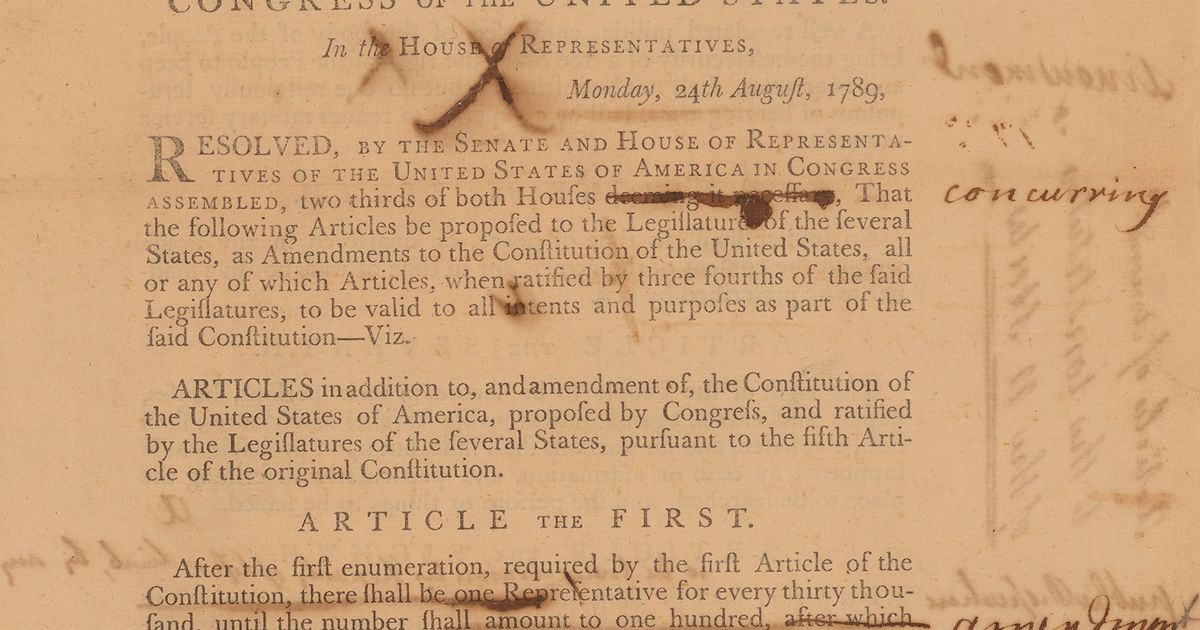
As a journalist whose profession is addressed, I always thought the First Amendment was first because it was the most important guarantor of civil liberties. But what we now know as the First Amendment actually was an amalgam of the proposal’s third and fourth articles. The Senate lopped off the first two — about congressional pay and number of constituents — and tinkered throughout. In the image accompanying this article, you can see the vigorous markup by senators — the scribbles and deletions on the paper probably done with finger-smudging turkey quill pens. It looks like a messy proof of one of my early newspaper stories from the days when I worked for a real editor.
You can see the original marked-up document yourself now at MOHAI, which is hosting the “Freedom Plane National Tour: Documents That Forged a Nation.” through Aug. 16.
Congress shall make no law …
The First Amendment is a robust statement affirming freedom of religion, speech and the press, the right to protest, and to petition government for redress of grievances.
These principles have been time-honored and well-used over these 235 years since ratification. According to the Freedom Forum’s annual survey, “Where America stands,” 95% of Americans have heard of the First Amendment, and nine in 10 agree it is vital. Yet only 10% can name all five protected freedoms unaided. A quarter of respondents couldn’t name one.
The 2025 survey found that people’s awareness of First Amendment issues was improving over time. During the Trump administration’s second term, First Amendment issues have inundated news feeds. President Donald Trump has sued media companies because of news he doesn’t like; pressured comedians and their network employers over their satire; passed out federal approval of media deals for his favorable treatment; and challenged the rights of researchers and educators with threats to cut off federal funding.
Over the centuries, there have been many violations of these individual freedoms. The courts have set some right but not others. And with recent changes in the judiciary, including the U.S. Supreme Court, many of these absolutes have been challenged, stretched and, perhaps, marked for harvest.
Respecting an establishment of religion, or prohibiting the free exercise thereof:
In 2022, the U.S. high court ruled in a case involving a Bremerton High School football coach who school officials discouraged from praying on the 50-yard line after games and inviting students to join. In trying to restrict the coach’s prayers, the school district argued this activity was a violation of the establishment of religion clause. The six conservative justices on the Trump-shaped court sided with the coach, discarding a 1971 precedent in Lemon v. Kurtzman with a three-pronged test.
Now, the 2022 Kennedy v. Bremerton School District ruling is being used to defend a Texas state law requiring public school classrooms to display the Ten Commandments. Multifaith families challenged the ruling. In April, the 5th U.S. Circuit Court of Appeals narrowly upheld the Texas law, and the American Civil Liberties Union of Texas is considering an appeal to the Supreme Court.
… Or abridging the freedom of speech,
Speech is the best-known among the five freedoms. In Freedom Forum’s survey, 73% of people could recall that freedom unprompted.
Hate speech, on its face, is protected but when it veers into advocating harm or putting people at risk it is not. The survey found some movement in people’s views on this. About 32% say preventing hate speech is more important than protecting free speech. That’s the lowest number since 2020, suggesting that people are increasingly understanding the difference.
… Or of the press;
This freedom is among those that conspicuously have born the brunt of Trump’s brazen challenges to news organizations. During the first year of his current term, he sued ABC for defamation and CBS because he didn’t like how “60 Minutes” edited an interview with his 2024 challenger Kamala Harris. Neither went to court but each network settled for $16 million.
Feel the chill?
More recently, Trump has sued The New York Times in search of administration leaks, The Wall Street Journal and the BBC. However, according to The Hill last week, those organizations are pushing back on this litigation, suggesting a trend away from what happened last year.
… Or the right of the people peaceably to assemble,
This freedom protects the right of people to gather and protest. Operative word here is “peaceably.”
What it does not protect, First Amendment experts say, are protests that are violent, destructive or that threaten people or property or interfere with commerce. Think of the pro-Palestinian protesters who took over a University of Washington Interdisciplinary Engineering Building in May 2025, causing about $1 million in damage. Not protected.
It doesn’t have to be that way. Same cause, a few years earlier; a constructive solution: When pro-Palestinian protesters were delaying the unloading of a container ship sailing under an Israeli flag, local elected leaders worked with them to provide a high-profile place to protest that did not block the unloading.
“We were 100% committed to ensuring the protesters have their right to protest,” recalled Stephanie Bowman, former Port of Seattle commissioner. “But we were not going to let them shut down the port’s lawful operations and moving of goods.”
That Block The Boat protest also met the Israeli ship in both Oakland, Calif., and Prince Rupert, B.C., but disruption there succeeded.
… and to petition the Government for a redress of grievances.
This freedom applies to asking government to make a law or reconsider a bad one. This is in play when you see signature-gatherers working on petitions or even ballot initiatives. You have the right to testify before city councils, school boards and the Legislature.
Going forward
So what do Americans do when they are concerned about the erosion of their First Amendment rights?
The good news is the Knight First Amendment Institute at Columbia University is working on a plan. It’s so concerned about the threat to people’s expression, Knight launched an initiative, Focus on Reconstructing Free Expression, which “will look beyond the immediate democratic crisis to consider how to strengthen our system of free expression to better protect democracy against authoritarianism.”
“We have done a lot since the start of the second Trump term to respond to what he is doing and to his administration’s attacks on the First Amendment,” said Katy Glenn Bass, the institute’s research director. She noted that the constant challenging of these rights and liberties is exposing some weaknesses in protections in what the institute calls the “system of free expression.”
“You could say they were longstanding political norms that previously no one felt comfortable violating that they now feel comfortable violating, but either way, we are seeing a much deeper range of cracks in the system of free expression than what all can be attributed to Trump.”
The Knight Institute’s inquiry consists of sessions with lawyers, scholars and other First Amendment advocates. Topics have included brainstorming on how to improve the system of free expression; changes to the information ecosystem, which reviewed press and tech platforms; and protections for knowledge-producing institutions, such as universities and government research agencies. Also under discussion are media consolidation and possible reforms to The Freedom of Information Act. (Read more from participants here: knightcolumbia.org/blog)
By early next year, Glenn Bass anticipates this work will result in publication of a comprehensive set of proposals to shore up these freedoms and close weak spots in the law.
That’s good news for all of us. The Knight Institute and the Freedom Forum are only two of several robust organizations tracking this issue closely and feistily. Americans need to pay attention and act in their spheres of influence.
In the coming weeks, Seattle Times Opinion will be exploring these five freedoms in more detail through staff columns and editorials as well as guest essays. The goal is to help people understand these fundamental rights, how to exercise them, learn when they are being abridged and how to protect them.
Follow along. Ask questions. Send us your thoughts.
