

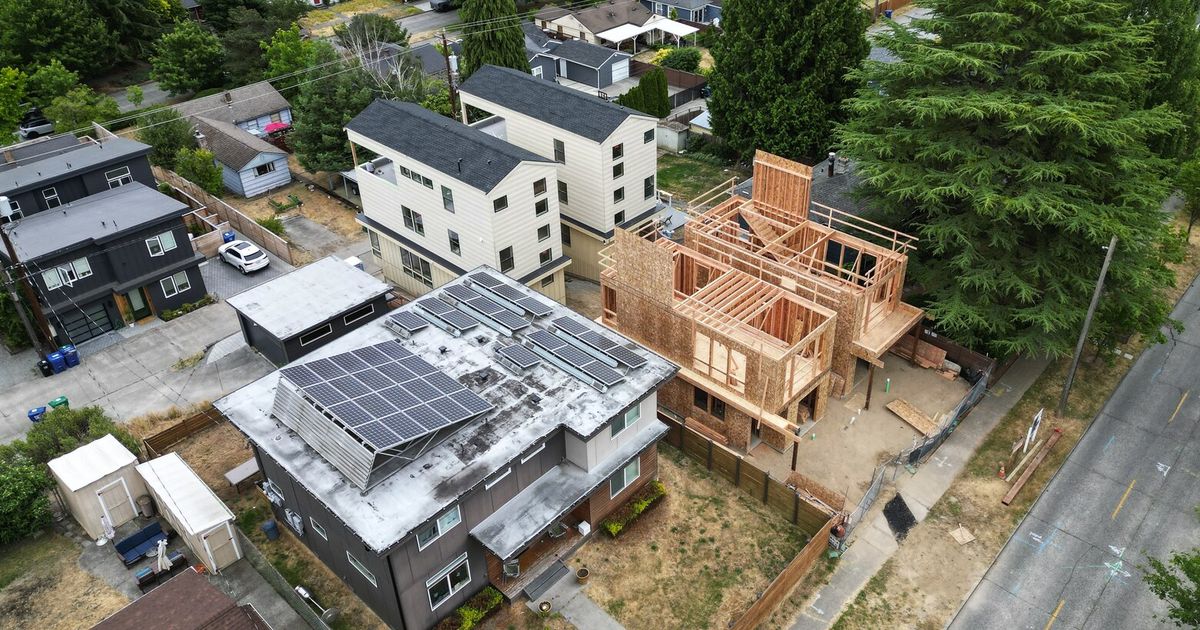
Earlier this year, I received a solicitation from a developer that laid bare what the Legislature and the Seattle City Council had done to residential neighborhoods.
HB 1110, the so-called Middle Housing measure passed in 2023, allowed lots to be subdivided to create greater density. The goal was to encourage more types of housing, which would bring costs down. Or so it was hoped.
At the time, sponsor Rep. Jessica Bateman, D-Olympia, said: “HB 1110 will legalize more housing, in more neighborhoods, that’s affordable to working people.”
My letter from the developer described the impacts a little differently: “We now have a very generous zoning code, thanks to the state’s desire for density and their landmark legislation — HB 1110. Where once you could only build one, you can build four or more separate homes that can now be sold individually …. As you can imagine, this has changed the math for us dramatically.”
Yes, I can imagine. And so can thousands of other Seattleites who regularly receive letters, texts and emails from developers thirsting for properties. The Seattle City Council, which added pro-developer enticements on top of what the state allowed under HB 1110, recently congratulated itself for passing an ordinance making it possible to opt-out of such hard-sell tactics that stemmed directly from the free-for-all it created.
The early results of HB 1110 are in, and they are not good — for affordability, the environment or Seattle’s once-vaunted quality of life.
Construction permits filed with the city since an interim middle housing ordinance went into effect in July 2025 show that four freestanding houses on a single lot is the predominant type of what Seattle City Hall calls middle housing.
Instead of being affordable, building separate homes on a lot is the most expensive and resource-intensive alternative possible. Middle housing — defined as smaller housing for the middle class — it is not.
And look at what’s been happening in the neighborhoods. We’re talking trees, street atmosphere, parking and views — all impacted by new three-story houses that look like giant milk cartons lording over the rest of the neighborhood.
Land-use laws are complicated and difficult to get right. The Seattle City Council can take another shot. Thankfully, there are some good ideas that can better address affordability and livability than what is currently on the books.
For change to happen, residents must understand the transformation in their neighborhoods and take part in forming a future that is greener, more affordable and more in tune with traditional Seattle values.
Let’s take a few steps back.
The average lot size in Seattle is about 5,000 square feet. Single-family zoning effectively ended in 2019, when the council allowed up to three units on a lot, if at least two shared a roof. That meant a house converted into a duplex with a backyard cottage, but there was a lot of fudging.
After HB 1110 got through the Legislature, the Seattle City Council passed interim and then final rules that expanded the allowable density to four homes — six if the property was near transit or two were offered to buyers with lower incomes.
But council went much further than just the number of units on a lot.
By unanimous votes, councilmembers reduced setbacks in front — the area between the house and street, what most people call the yard — from 20 feet to 10 feet. If there’s an alley, backyards disappeared entirely. Council also allowed development to stretch across 50% of a lot instead of 35%. Building height increased from 30 to 32 feet, higher in some circumstances. And Seattle greatly increased what’s called Floor Area Ratio, which determines how many total square feet a developer is allowed to build on a particular lot.
The result so far?
Older homes purchased and then razed. Entire lots bulldozed and scraped of every living thing. Although the language of HB 1110 promised buildings that are “compatible in scale, form, and character with single-family houses …,” the result so far has been architectural gigantism: Tall, bulky homes that take up every allowable inch of land and often sell for more than a million dollars.
Seattle Residents for Thoughtful Growth, a group formed to monitor the city’s comprehensive plan, tracked permits filed with the city’s Department of Construction & Inspections. Between July 1, 2025, and June 30, 2026, it found 65 sites with permits filed to build four freestanding houses. There were 52 sites with two duplexes, and 30 sites with a duplex and two freestanding houses.
Neighbors have noticed the impacts.
So far this year, an average of 176 trees have been cut down each month related to construction, according to city permits. Given the Wild West nature of tree removal, it’s likely a vast undercount.
In the permit file of a four-standalone home development in West Seattle, an anonymous commenter wrote earlier this year: “Fitting four units onto a single-family lot demands maximum use of every square inch. Existing trees and landscaping, which provide shade, absorb stormwater, reduce urban heat, and support local wildlife, would almost certainly be cleared. Simply put, this neighborhood deserves better.”
As part of that site, nine trees and a Bigleaf maple with a 64-inch diameter trunk were cut down. The maple, which was described in the permit as “stately,” likely wouldn’t have survived construction, noted the developer-hired arborist who recommended its removal.
I warned about urban clear-cutting making way for unaffordable housing in January last year when I looked at zoning rules applied to a few Seattle neighborhoods, including South Park. Today, that kind of zoning is everywhere, and development has focused in West Seattle and parts of North Seattle.
Lawmakers thought everyone would benefit. But it’s only the favored few who can afford the million dollar-plus cost of such new housing. The notion that prices would drop for the rest of us is illusionary.
Is there a better way?
Tracy Burman thinks so.
Burman is a former data analyst who teamed up with Sol Baron, a retired developer, to form Seattle Residents for Thoughtful Growth. Along with Pete Anderson, a former construction executive, and Carl Pirscher, an architect, they are promoting a program to stop Seattle’s teardown redevelopments and create more attainable, middle-income housing by reusing existing houses to build more units.
Here’s their concept: Take an existing house and split up each floor. Add a kitchen and bath in the rear on each level, and you have two, three or four new units. Construction is fast, they say, because the existing foundation and structure remains.
“You’re reusing the well-built houses we already have,” Burman told me. “And you’re still getting four units out of the lot.”
“It’s a different way of working, and it’s producing different-sized housing. But it has the natural benefits of being anti-displacement, saving the tree canopy, leaving the streetscape of the neighborhood intact, and producing affordable housing.”
To make this happen, city development standards must change to mandate smaller spaces, which would be cheaper for homebuyers.
But given the price of land, would anyone build smaller, more affordable units in Seattle? Are we left with the choice between mega houses crammed on a single lot, or no middle housing at all?
That’s the question Burman hopes to answer with a third way.
Setbacks, height restrictions, floor space ratios — all these may make many voter’s eyes glaze over.
But consider this: Next fall, seven Seattle City Council positions are up for grabs. Middle housing — real middle housing — ought to be part of the campaign.
Unless something changes, the Seattle of the future will look very different from the city of the present, and likely even less affordable.
