

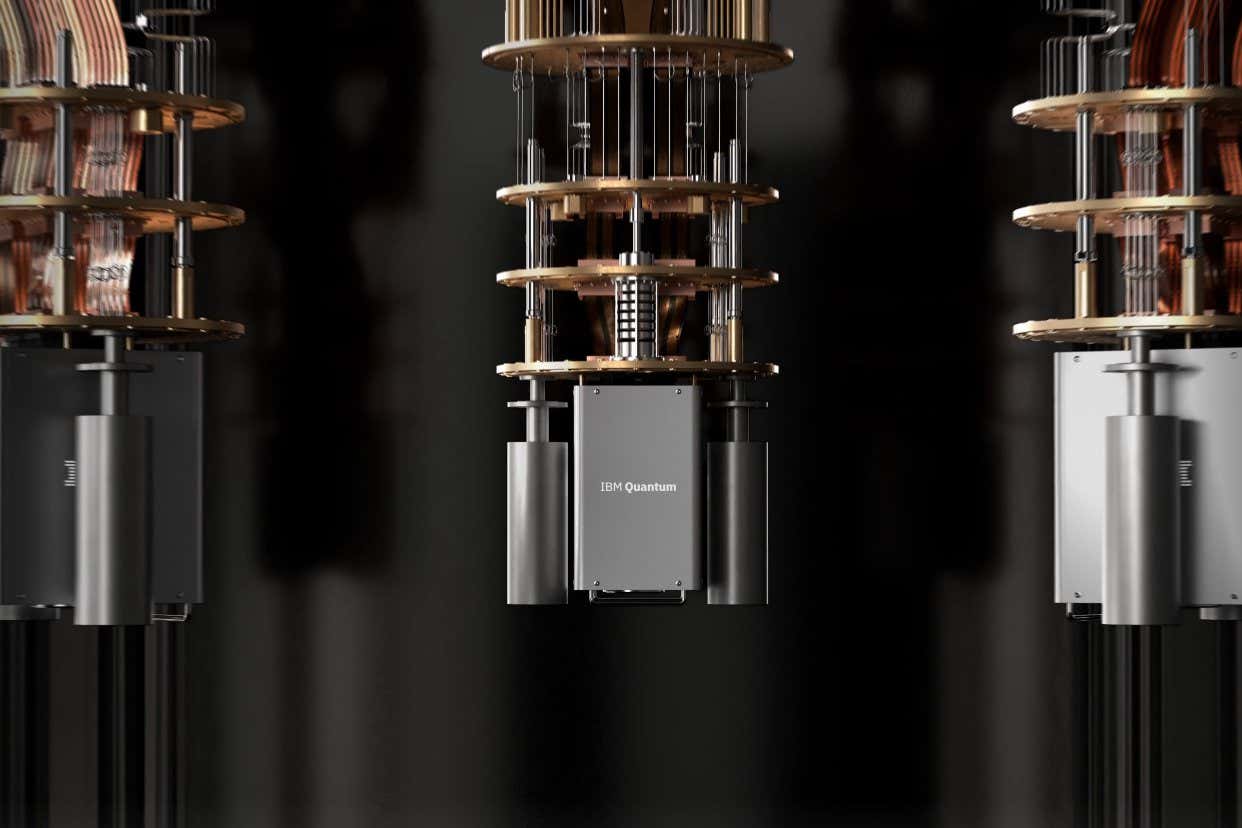
A rendering of IBM’s proposed quantum supercomputer
IBM
In less than five years, we will have access to an error-free quantum supercomputer – so says IBM. The firm has presented a roadmap for building this machine, called Starling, slated to be available to researchers across academia and industry in 2029.
“These are science dreams that became engineering,” says Jay Gambetta at IBM. He says that he and his colleagues have now developed all the pieces needed to make Starling work, and this makes them confident about their ambitious timeline. The new device will be housed in a data centre in New York, and Gambetta says that it could be useful to manufacturers of new chemicals and materials.
IBM has already made a whole fleet of quantum computers, but the path towards a truly useful device isn’t straightforward – nor is it devoid of competition. Errors continue to spoil many attempts to use quantum effects to solve problems that the best conventional supercomputers cannot.
Because of this, building quantum computers that correct their own errors – that are “fault-tolerant” – is key. So is making these devices bigger, and thus more powerful. There is no consensus on the best approach for addressing either challenge, so research teams are pursuing a variety of strategies.
All quantum computers rely on quantum bits, or qubits, but some teams make these building blocks from particles of light, others from extremely cold atoms, and in the case of Starling, IBM will use another variant – superconducting qubits. To make it unprecedentedly large and fault tolerant, IBM is betting on two innovations.
First, Starling will deploy new connections between its qubits, including those far away from each other. Each qubit will be embedded into a chip, and the researchers have developed new hardware for connecting these components within a single chip, and for connecting different chips together. This will allow them to make Starling bigger and capable of running more complex programs, than its predecessors.
Gambetta says that Starling will be capable of 100 million quantum operations using tens of thousands of qubits – today’s largest quantum computers have about 1000 physical qubits. In this case, the qubits will be grouped into about 200 “logical qubits”. Within each of these, multiple qubits work together as a single computing unit that is resilient to errors. The record number of logical qubits is 50 and currently belongs to the quantum computing company Quantinuum.
IBM will also use a new recipe for combining physical qubits into logical qubits called LDPC code, which is a notable deviation from the way logical qubits have previously been created in other superconducting quantum computers. Gambetta says that using LDPC was once seen as a “pipe dream”, but his team has now developed crucial details for implementing it.
The benefit of this somewhat unconventional approach is that each logical qubit created with the LDPC recipe requires fewer physical qubits than competing methods. As a result, error correction can be achieved sooner, with smaller and easier-to-build devices.
“IBM has been quite good at setting an ambitious roadmap for many years now and achieving some great things,” says Stephen Bartlett at the University of Sydney in Australia. “They’ve done a bunch of innovations and improvements over the past five-plus years, but this is a real step change.” He says that both the new hardware that will connect distant qubits and new logical qubit codes are a departure from the well-performing devices that IBM has made previously – and they will need to be tested extensively. “It’s looking promising, but it is really taking a bit of a leap of faith,” says Bartlett.
Matthew Otten at the University of Wisconsin-Madison says that the LDPC code has only been seriously developed in the past few years, and IBM’s roadmap fills in all the blanks on how it could work in practice. This is important as it can help researchers identify possible bottlenecks and practical trade-offs, he says. For instance, he says that Starling may run more slowly than existing superconducting quantum computers.
At its planned size, the device could solve problems relevant for sectors such as the pharmaceutical industry. Here, a simulation of a small molecule or a protein on a quantum computer like Starling could replace an expensive and taxing experimental step in the drug development process, says Otten.
IBM isn’t the only player in the quantum computing industry that is publicly racing towards its next breakthrough. For instance, Quantinuum also has plans for a fault-tolerant utility-scale machine in 2029, and PsiQuantum plans to build a quantum supercomputer by 2027. “I am a big believer in competition,” says Gambetta.
Topics:
