

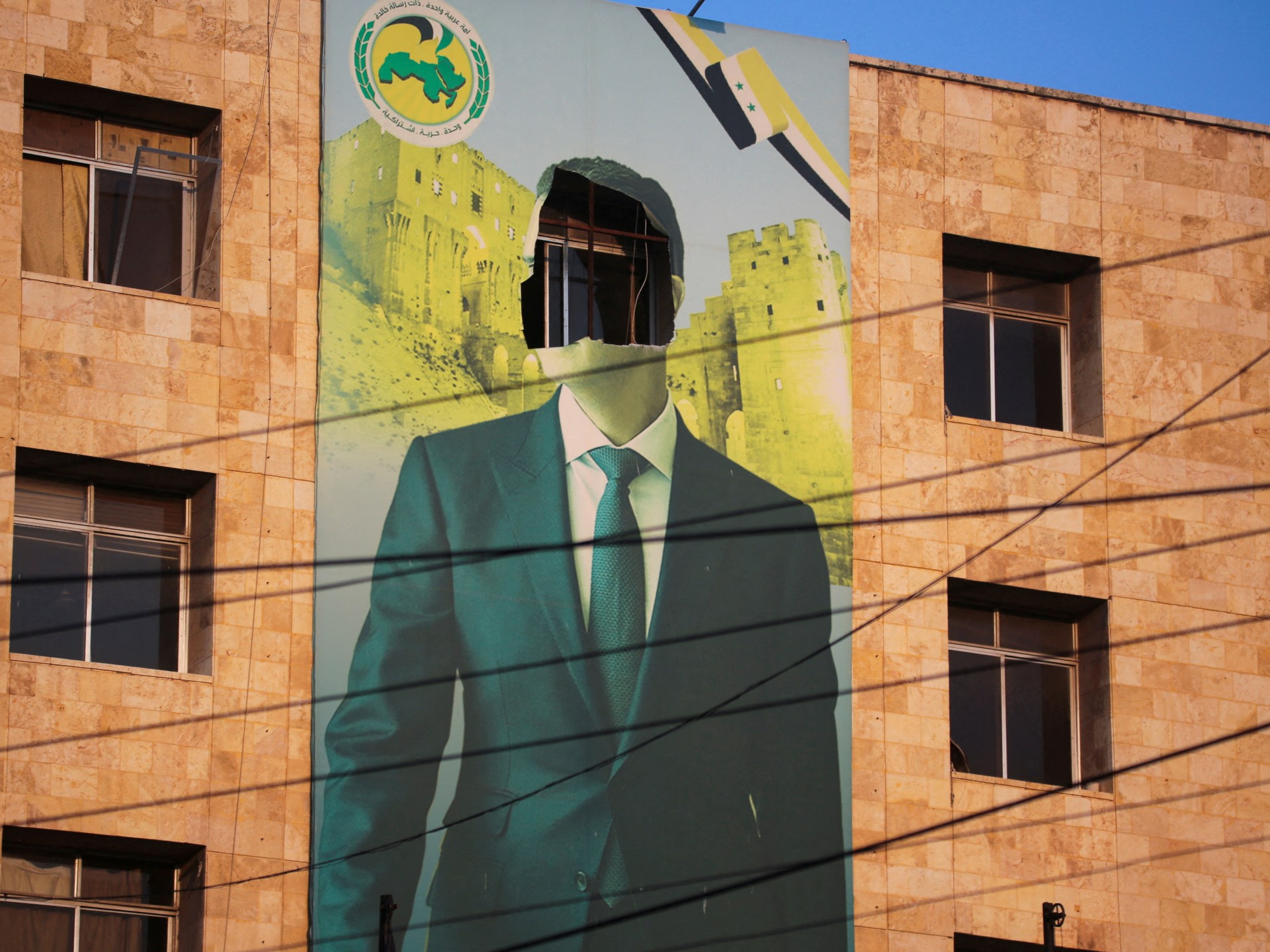
On November 27, a coalition of armed opposition groups, led by Hayat Tahrir al-Sham (HTS) began an offensive against government-held positions in Aleppo and Idlib provinces in the northwest of Syria. Less than two weeks later, they rolled into Damascus as President Bashar al-Assad and his family flew out in an unknown direction.
The disintegration of the Syrian regime’s army was spectacularly quick. It brings to mind similar collapses in Afghanistan – when the Taliban captured Kabul from the Afghan government following the withdrawal of the US force – and in Iraq, when ISIL (ISIS) invaded in 2014 and took Mosul, the second-largest Iraqi city, within days.
The successes of HTS, the Taliban and ISIL (ISIS) were due as much to their mobilisation and internal cohesion – or “asabiyya” as Arab historian Ibn Khaldun would call it – as to their opponents’ failures. Networks of patronage and corruption dominated Syria’s army just like they did Iraq’s and Afghanistan’s, making it unstable and ineffective without support from foreign forces.
That, in addition to al-Assad’s faltering governance, lack of legitimacy and regime unpopularity ensured the Syrian military’s inability to withstand the advance of well-organised armed groups.
Patronage and low morale
For years, the Syrian opposition suffered from fragmentation and infighting, losing ground to the Syrian regime. After 2020, the conflict was largely considered “frozen”, which allowed the opposition, especially HTS, to consolidate and regroup. Despite many years of setbacks, it did not lose the hope and the drive to fight the Syrian regime.
This ensured a sense of internal solidarity, which Ibn Khaldun identified back in the 14th century as the key element that made a tribal force strong enough to take on whole kingdoms. He made this conclusion while observing the advance of Mongol leader Timur, who captured not just vast swaths of land in Central Asia, but also parts of India, Persia, Iraq, and Anatolia.
In 1400, his forces sacked Aleppo and then launched a lightning offensive, taking Hama and Homs. Eventually, Damascus capitulated to Timur without a battle in December 1400, with the unpopular Mamluk Sultan fleeing the city in shock.
In the case of the Syrian opposition, their morale was boosted not only by internal solidarity, but also by the idea that they are fighting for national liberation.
By contrast, the Syrian military was suffering from low morale. Its ranks were mostly conscripts, some of whom were forced into service after arrest and torture.
The 130,000-strong Syrian troops thus stood little chance against the 30,00 rebel fighters who advanced. The army disintegrated just like the 300,000-strong Afghan army did when it faced a Taliban force of 60,000 fighters and just like the 30,000-strong Iraqi force did when 1,500 ISIL (ISIS) fighters attacked Mosul.
In reality, large numbers hide structural deficiencies. The Syrian army – like the Iraqi and Afghan ones – was mired in corruption and had a significant problem with “ghost soldiers”. This phenomenon refers to rosters inflated by fictitious names so that officers collect additional paychecks.
This practice emerged because the military served as a patronage network where officer posts were awarded based on loyalty rather than military acumen. These officers would then use their positions to extract wealth for themselves, either through these inflated rosters or the racketeering of the civilian population.
The fall of a corrupt dynasty
When Egypt signed a peace treaty with Israel in 1979, then Syrian President Hafez al-Assad – Bashar’s father – gave up on Arab military alliances and unilaterally developed a massive military force.
The Soviet Union supplied it with a fleet of tanks, artillery, and aircraft, as well as ballistic Scud missiles to deter what it perceived as its main enemy in the region – Israel. Syria also developed a chemical weapons programme to match the Israeli nuclear one.
However, these weapons were never used in a conventional war against the Israeli military. This enormous military power was instead unleashed against Syria’s population – first under Hafez’s rule during the Hama uprising and then under Bashar’s rule during the Syrian revolution in 2011.
Weapons designed to inflict serious damage on the Israeli military were turned against Syrian civilians. Al-Assad even launched his long-range ballistic Scud missiles on Syrian cities.
When the massacre of Syrian people by the military caused a massive desertion drive which cost it half of its officers and soldiers, the al-Assad regime sought to import foreign forces to fight on its behalf.
Lebanese fighters from Hezbollah and Russian fighters from the mercenary Wagner Group were joined by various pro-Iran armed groups and eventually some regular Russian forces.
While these foreign forces managed to push back rebel forces and secure the al-Assad regime, the latter made the fatal mistake of believing it could reign forever by brute force. It did close to nothing to try to regain legitimacy by offering good governance to its people. It provided few services and almost no security, as the Syrian economy continued its freefall and standards of living plummeted.
This negligence was also reflected in how the regime treated army ranks. As of 2023, soldiers were receiving bonuses of 10,000 Syrian lira or $0.75. Three days before his fall, al-Assad made a last-ditch effort to boost morale by raising salaries in the military by 50 percent. But this proved to have no effect whatsoever.
What remained of the Syrian military after it waged a decade-long war against its own people no longer appeared willing to wage another decade-long war in 2024. With foreign forces no longer around to fight on al-Assad’s behalf, Syrian troops withdrew from city after city until rebels took over Damascus. The army disappeared into thin air as its soldiers threw out their military uniforms in dustbins and put on civilian clothes.
As Ibn Khaldun observed some 700 years ago, corruption can kill asabiyya and bring the hasty downfall of whole dynasties. Clearly the al-Assads had not learned much from the history of their own country.
The views expressed in this article are the author’s own and do not necessarily reflect Al Jazeera’s editorial stance.
