

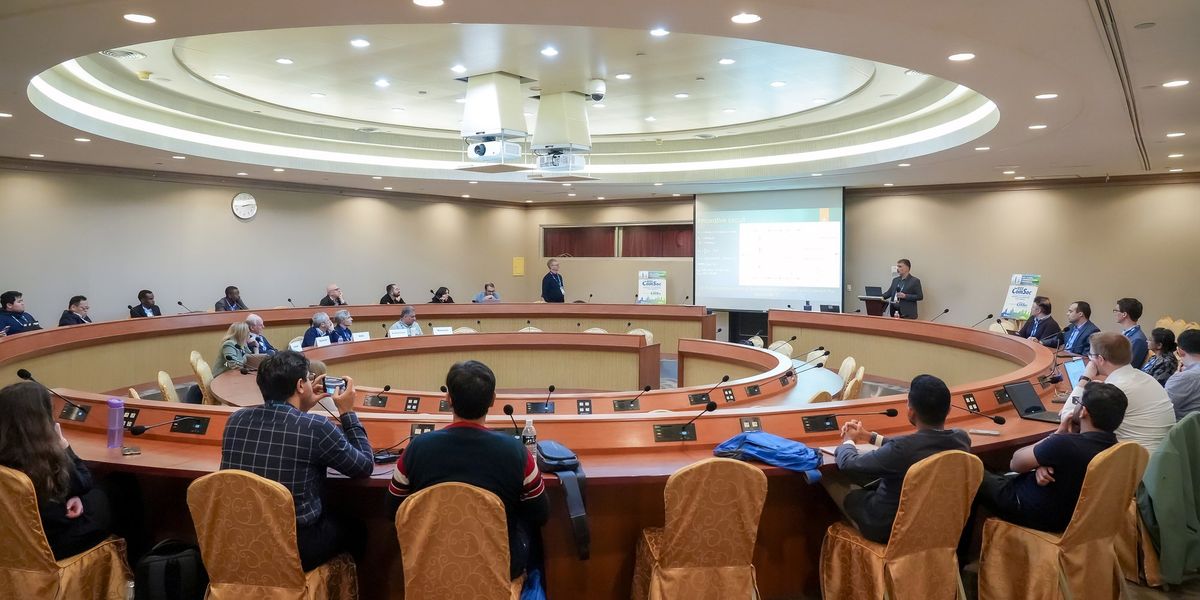
The IEEE Communications Society (ComSoc)’s Research Collaboration Pitch Session initiative is proving to be a catalyst for meaningful engagement between academic researchers and industry innovators. Launched last year, the program connects promising researchers with industry leaders who can offer them funding, mentorship, and connections to bring interesting ideas closer to real-world deployment.
Rather than relying on chance encounters at conferences, the pitch sessions create a focused environment. Five academic presenters share their work with five industry representatives, known as “innovation scouts”: senior leaders primarily chosen from ComSoc’s Corporate Program partner companies such as Ericsson, Intel, Keysight, and Nokia. The curated format ensures that each idea receives dedicated attention from professionals who are seeking new concepts aligned with their organization’s priorities.
The initiative was launched in November at the IEEE Middle East Conference on Communications and Networking (MECOM) in Cairo and appeared in December at the IEEE Global Communications Conference (GLOBECOM) in Taipei, Taiwan.
AI-driven communication network
One of the most compelling outcomes came from the inaugural session in Cairo. Angela Waithaka, a student member and biomedical engineering student at Kenyatta University, in Nairobi, Kenya, presented her “AI-Driven Predictive Communication Networks for Enhanced Performance in Resource-Constrained Environments” paper. You can view her presentation along with others on IEEE.tv.
Waithaka’s research tackles a critical challenge: Next-generation communication systems increasingly rely on artificial intelligence and machine learning, yet most existing architectures consume abundant computational and energy resources, which are not always present in developing regions.
Waithaka proposed lightweight, adaptive AI/machine learning models capable of delivering predictive, reliable communication performance even under tight resource constraints.
Her vision resonated with Ruiqi “Richie” Liu, a master researcher at ZTE in China. ZTE is a global leader in integrated information and communication technology solutions. Liu says he recognized the relevance Waithaka’s proposal had to his company’s work with the International Telecommunication Union. He invited her to establish an ITU account so she could participate in the organization’s meetings discussing global telecommunications standardization projects—which would elevate her work to an international stage.
Simplifying data center protocols
The momentum continued at GLOBECOM. Among the presenters was Nirmala Shenoy, a professor at the Rochester Institute of Technology, in New York. Shenoy, an IEEE member, spoke on the topic of simplifying data center network protocols. She highlighted the growing complexity of the critical networks, which underpin cloud services, enterprise IT, and emerging AI workloads.
Shenoy’s focus on reducing protocol complexity while maintaining scalability, resilience, and low latency caught the attention of an innovation scout from Nokia, who heads its eXtended Reality Lab in Madrid. He found the key person at Nokia for Shenoy to connect with to discuss her research, and it led her to record a video for the company detailing her approach and its potential applications.
A model for accelerating innovation
The early success stories demonstrate the power of intentional, structured engagement. By bringing researchers and industry leaders together in a format designed for discovery, ComSoc is helping accelerate innovation and expand opportunities for collaboration. The pitch sessions are not merely conference events; they are becoming a bridge between academic creativity and industry implementation.
This year sessions will be held during the IEEE International Conference on Communications in Glasgow from 24 to 28 May, and more are scheduled during the IEEE International Mediterranean Conference on Communications and Networking in Sardinia from 6 to 9 July, and at GLOBECOM in Macau from 7 to 11 December.
As the program continues to grow, it could become a signature ComSoc initiative, one that strengthens the research ecosystem, supports emerging talent, and ensures that promising ideas find pathways to real-world impact.
From Your Site Articles
Related Articles Around the Web
