

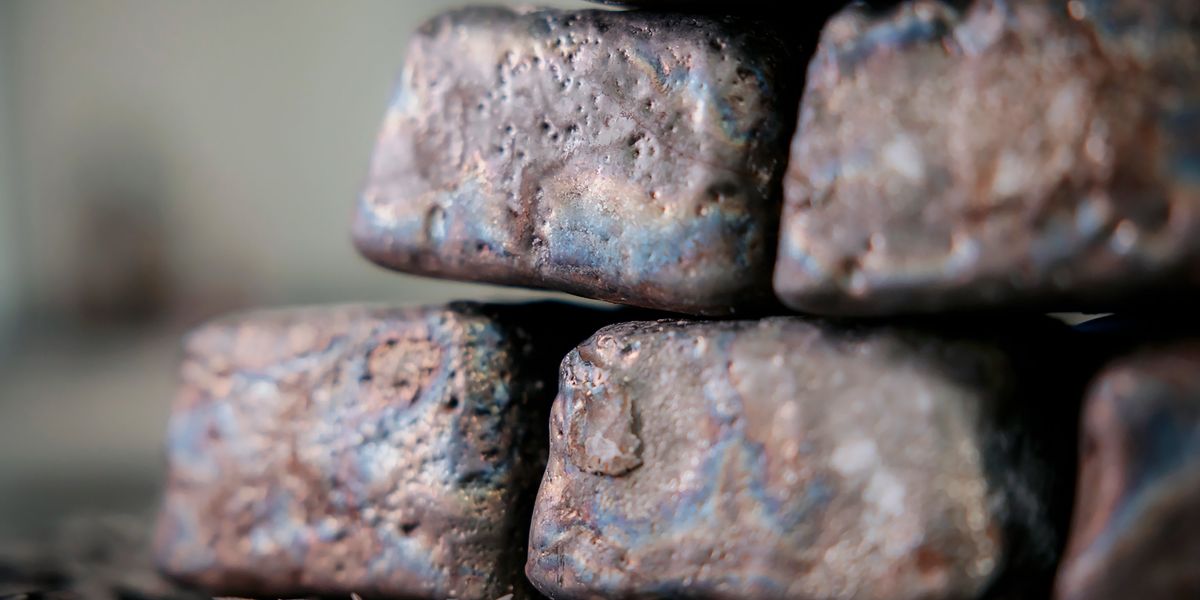
Rarely a week went by in 2025 without some newsworthy development related to rare earth elements, magnets, and electric motors. IEEE Spectrum was on top of the big ones, starting with the production of industrial quantities of the rare-earth oxides of neodymium and praseodymium at the Mountain Pass mine and processing facilities in California’s Mojave desert.
Between 1965 and the mid 1980s, the Mountain Pass mine produced as much as 70 percent of the world’s annual supply of rare earths, which are used in nearly all powerful permanent magnets. But following a string of reversals and environmental mishaps, the facilities began going into a decline in the 1990s and 2000s. At the same time, Chinese producers, which were much less confined by environmental regulations, began their astonishingly rapid ascendence.
Today, China controls between about 85 and 99 percent of the global market for key rare earth oxides and metals, on which huge and vital tech-based industries depend. The United States and its allies find themselves at China’s mercy for certain rare earths, including ones that are essential for motors, semiconductors, electroluminescent compounds, optoelectronics, and catalysis. They’re in critical components of countless military systems, such as ones in aircraft, submarines, weapons, and night-vision gear.
For these reasons, the resumption of mass production of rare earths at Mountain Pass, which was greatly scaled up during 2025, was a major development in geopolitics. The total output of the mine and its associated processing facilities, where the rare earth ore is turned into industrially useful oxides, is small, however, compared to China’s output.
The Trump administration invested a lot of time during 2025 trying to set up deals to establish rare-earth supply chains that do not depend on China. This effort started puzzlingly, with some high-profile arm twisting of Ukraine, whose deposits are dismissed by mining experts. And also with overtures about annexing Greenland, a district of Denmark whose rare-earth deposits are enormous but, like Ukraine’s, are not attractive from a mining standpoint. As the year wore on, the administration eventually settled on a strategy similar to that of the Biden administration, which emphasized investing in domestic production and working with allies, such as Australia, to strengthen and expand existing mining, refining, and magnet-making operations outside of the United States.
Mostly overlooked by the administration so far has been Canada (also one of Trump’s annexation targets). Canada has some exceptionally large reserves of rare earth elements, and it operates one of only about four sizable rare-earth-oxide refining plants outside of Asia. That Canadian plant, owned by Toronto-based Neo Performance Materials, is in Sillamäe, Estonia.
Here are eight of 2025’s most popular Spectrum articles on rare earth elements, magnets, and motors, ranked by the amount of time people spent reading them.
Jabin Botsford/The Washington Post/Getty Images
The Trump administration’s first public move in its long-awaited rare-earths strategy was a head-scratcher. At a White House press conference on 28 February, 2025, where observers were expecting to hear about a Ukraine-U.S. deal involving critical minerals, including rare earths, Trump instead got into a heated argument with Ukrainian president Volodymyr Zelenskyy. When the deal was finally signed, two months later, it made no sense to mining and rare-earths experts. Ukraine’s four substantial rare-earth deposits, they noted, were all in or near areas of active conflict with Russia. And two of them are a type of ore for which there are no existing processing technologies.
 Michael Tessler/MP Materials
In 2024, the Mountain Pass mine and refining plant, in the northeastern Mojave Desert, became the only producer of rare-earth oxides anywhere in the Americas after it began producing neodymium and praseodymium oxides. The mine and plant had been essentially inactive since the early 2000s, but were rebuilt and rehabilitated starting in 2017 by a new company, MP Materials. In July 2025, MP Materials announced that the U.S. Department of Defense (now the Department of War) was investing $400 million to take a 15 percent stake in MP, and also guaranteeing a price “floor” of US $110 per kilogram for certain rare earth oxides. That price was roughly twice what China was charging at the time for those oxides.
 Business Wire
Early in 2025, there was a flurry of announcements from companies touting plans to manufacture rare-earth magnets in the United States. The most interesting of these was from MP Materials, which operates the Mountain Pass mine and processing plants in California. MP announced it had begun producing neodymium-iron-boron magnets on a “trial” basis, at a plant in Texas that it would eventually scale up to 2,000 to 3,000 tonnes per year.
In mid-July, MP Materials announced a $500 million agreement with Apple to begin supplying NdFeB magnets to the computer giant, starting in 2027. Apple uses magnets in the speakers and haptic (vibrating) components of its phones and tablets, as well as in charging connectors such as its MagSafe cable.
 Randy Pollock
The mathematics of using chemical rockets for space travel is grim. They’re inefficient, slow, and require enormous amounts of fuel. They’re not really up to the task of colonizing Mars, let alone visiting the outer planets. So researchers have long investigated alternative means of propulsion, some involving the use of intense magnetic fields to accelerate and direct ions to produce thrust. At Victoria University in Wellington, New Zealand, researchers have demonstrated one such system, which is based on applied-field magnetoplasmadynamic thrusters. Their twist is using high-temperature superconducting tape to greatly reduce the power required to energize the electromagnets to achieve a given magnetic-field strength. Hēki, a technology demonstration comprised of the novel superconducting components of the system, minus the thruster itself, was launched to the International Space Station in September. It was installed on the exterior of the station and has been operated continuously since then, said Betina Pavri, senior principal engineer at the Robinson Research Institute at Victoria University, in an email exchange in late November.
 Hinetics
The electrification of passenger aircraft faces several very steep technological challenges, one of which is the need for motors with extremely high specific power. Of the various ways of achieving that, one of the most interesting is through the use of high-temperature superconducting (HTS) materials in the coils of the motor. That’s the approach of startup Hinetics, which was spun out of the University of Illinois Urbana-Champaign and has received funding from the Advanced Research Projects Agency–Energy (ARPA-E). In its motors, designed with passenger aviation in mind, Hinetics is using HTS tape originally designed for winding the high-power electromagnets used in experimental Tokamak fusion reactors. Based on the performance of prototypes, the company believes it will soon achieve a specific power of 40 kW/kg, much higher than that of the radial-flux motors that now dominate commercial applications in vehicles and industrial machinery.

For years, Airbus has had a high-profile corporate goal of building a large, zero-emission, single-aisle passenger airliner. The centerpiece of that effort was a project to build an ultraefficient, high-specific-power motor with superconducting coils. The motor would be powered by fuel cells running on liquid hydrogen. It’s a breathtakingly ambitious initiative, called ZEROe, and it’s far ahead of anything Airbus’s rival Boeing is doing. As recently as late March, 2025, at a symposium for the press, Airbus’s CEO, Guillaume Faury, reaffirmed the company’s support for the blue-sky project. But he also cautioned that Airbus doesn’t see hydrogen-powered planes making substantial inroads into the passenger aviation market before the 2040s, which was interpreted as meaning before the late 2040s.
 Donut Lab
In-wheel hub motors are one of the perennial grails of the electric-vehicle industry. They’d unleash remarkable opportunities, including torque-vectoring: the ability to finely adjust the power and torque at each wheel to deliver ultra responsive handling. But fundamental problems have long precluded their widespread use. One of these is the need to deal with unsprung weight, which refers (in this case) to the mass of the wheels, which are not supported by the vehicle’s suspension and can therefore bounce around on rough terrain and make it really hard to provide a smooth ride. With its latest, highest-power motor, however, Donut Lab claimed a weight of just 40 kg, and a power rating of 650 kW, figures that it claimed rendered the unsprung-weight problem “insignificant.”
 Hannibal Hanschke/Reuters/Redux
During 2025, Greenland, another resource-rich, sparsely populated country, was repeatedly identified as an annexation target by President Trump and other members of his administration. In an interview on 9 January, 2025, Michael Waltz, then Trump’s national security advisor, explicitly linked Trump’s interest in Greenland to critical minerals, including rare earths. However, mining Greenland’s rare earths on an industrial scale would require surmounting staggering challenges. To explain them in detail, we called on Flemming Getreuer Christiansen, a Danish mining and geology consultant with expertise in research and exploration projects in Greenland.
From Your Site Articles
Related Articles Around the Web
