

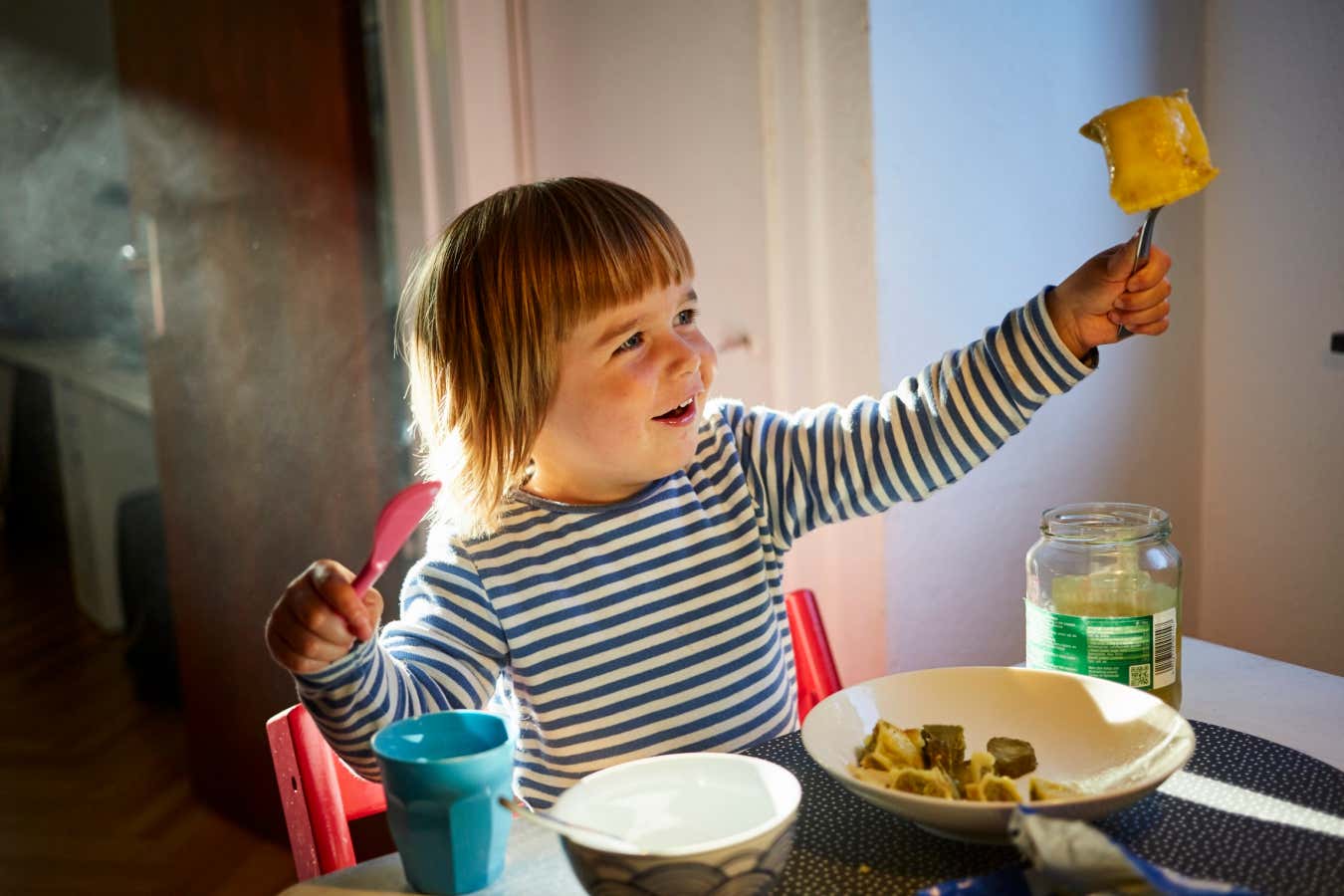
Parents can take steps to encourage their children to develop positive eating habits
plainpicture/artwall
Nancy Bostock is increasingly worried about the messaging children and parents are receiving around food. A paediatrician at Cambridgeshire and Peterborough NHS Foundation Trust, Bostock has worked in a children’s weight-management clinic and a children’s inpatient mental health unit, and co-led the development of a food strategy for the new Cambridge Children’s Hospital, making her uniquely positioned at the intersection of paediatric physical and mental health.
“I worry that parents are overwhelmed with advice from so many different places and so may end up doing things that aren’t necessarily helpful for their child,” she says. Bostock spoke to New Scientist to share six simple, science-backed approaches to help children develop a healthy relationship with food.
1. Notice the social and emotional aspects of food
Food, parenting and anxiety have an interlinked relationship. Sometimes this can develop early on. In some families I’ve met, the first few weeks after birth have contributed to anxiety around food. Parents feel pressured to breastfeed. I mean, breastfeeding is really good for your baby, but a mum being able to cope is also very important. Common difficulties that babies have in their early days and weeks – low blood sugar, jaundice and weight loss (which is normal to a certain degree in the first few days of life) – may feed into parental guilt about their ability to provide nourishment for their baby.
This anxiety may result in an over-focus on food for some parents, where they become very anxious about their children eating enough. This can lead to parents focusing much more on what and how much their children are eating than on the relationship they have with food. Remember that the vast majority of children will eat when they are hungry and drink when they are thirsty.
I have met many parents that worry their children don’t drink enough. However, if your child is well, you don’t need to check their water bottle or nag them to drink – their body will do that for them.
Being mindful about the social aspects of eating in your own family is also important. Just reflecting on what the experience of mealtimes is like for your child can be helpful. Do you all eat together? Are mealtimes relaxed, or joyful? Is there happy conversation? Try to see food as a social and joyful thing.
2. Don’t say, “You can’t have pudding until you’ve finished your food”
Allowing your child to manage their own appetite will help them get attuned to their bodies and manage their intake better as adults. Try to limit parental intervention. Instead, sell the concept that food is nourishing for your body and gives you energy, your body knows what it needs – try to take out the noise around it.
Behavioural approaches, such as saying, “You can’t have pudding until you’ve finished dinner”, teach your child to potentially eat beyond what they need to get the sweet food. And if you offer them a very sweet, filling pudding every day, they may learn to eat less of the nutritious food to leave space for the less-nutritious food. It also gives the message that they aren’t expected to enjoy the savoury food. Our desire for sweet, highly calorific food made sense in our evolutionary history, but now that we are surrounded by high-calorie foods, it is difficult to override those tendencies. Fat and sugar are so rewarding for us that even if your child isn’t hungry, they may well eat it.
Instead, offer dinner and then, if they want it, some fruit.
3. Avoid restricting your child’s diet unnecessarily
There is a lot of advice about what we should and shouldn’t be feeding our children. Some parents may seek advice from nutritionists or behavioural experts to support them with managing their child’s behaviour, or for other perceived health benefits.
They may receive recommendations about restricting certain foods without a medical basis – for example, implementing a gluten-free diet when the child does not have coeliac disease. Much of this advice can ultimately be unhelpful, or even unsafe. A 2019 review showed that a gluten-free diet in children who don’t have coeliac disease is associated with detrimental effects, such as a loss of dietary fibre and mineral and vitamin deficiencies, for example. And from a psychological perspective, for children to have certain foods completely “banned” will give them the experience that some foods are “unsafe”.
Research suggests that to improve health and life expectancy, it is more important to think about what we are not eating than what we are, and focusing on ensuring that children are offered food that includes plenty of fibre, fruit and vegetables, nuts and seeds and whole grains is more important than cutting out certain food groups entirely.
4. Don’t let your children use food as a way of managing their environment
Parents worry their children aren’t eating enough or may be anxious about how their child may behave if they are perceived to have not eaten enough. Children very quickly learn whether their parents really care about whether they have eaten or not, and so may try to use food as a bargaining chip.
They may try emotional blackmail: “If you don’t let me have ice cream now, I will be really sad, and it means you don’t love me.” Or maybe they’ll cry or stamp their feet. This behaviour can quickly escalate, and if the parent gives in, the child learns that this particular behaviour works and will repeat it next time. But it is possible to take the power out of the behaviour, and out of food, by saying, “Eating is for you, for your body, to give you energy, and this is what is on offer today. If you’re not hungry, you don’t have to eat it. If you really don’t like it, there’s fruit and yoghurt.”
5. Understand that picky eating is normal
It is developmentally normal for children to go through a very picky-eating phase and restrict their eating. Studies estimate that between 8 and 54 per cent of children are identified as picky eaters during their preschool years. The theory around this is that it is important for children to learn what is and isn’t safe to eat, and so, for example, some 2-year-olds may prefer to eat food off their parents’ plate, as they know it’s safe.
This is the age when it would be easy to start only giving them their safe foods, but you need to make sure that it isn’t you who is restricting their food. A good approach is to offer something that you know they are comfortable with, and a new food with no expectation or pressure to eat it. Research shows that children need to have around 15 positive experiences with a food before they accept it into the range of food they will eat.
Of course, there are certain foods that people can have a sensitivity to, like cow’s milk or raw tomatoes, so they might choose not to have it. But what’s been lost in our attempts to give children more autonomy is an understanding that children are not small adults. They are developing and learning to live in our society. So they also need to learn to eat things they don’t love because that’s necessary for health, for environmental sustainability, functioning in society and expanding their range of experiences in life. Just keep offering varied foods and understand that a child doesn’t have to love a food to be able to tolerate it and eat it.
6. Think about what behaviour you’re modelling – consciously or unconsciously
Children take their cues about what they think about the world, their attitudes and beliefs, from parents. So do consider carefully what you’re modelling around food. If you look at your tummy and say (or even think) that “this is disgusting”, talk about losing weight or make derogatory comments about people being overweight – children will take all this in. There is evidence that children’s views align with parental unconscious bias rather than with parents’ articulated views. So one of the most important things you can do to support your children developing a positive relationship with food – and their bodies – is to model it yourself.
As told to Helen Thomson
If your child’s diet has become extremely restrictive, or if they are not growing or gaining weight appropriately, please consult your general practitioner.
Topics:
