

Political cartooning in Kenya has never been without its risks. Cartoonists have faced state-engineered dismissal and censorship, lawsuits from irate politicians unhappy with their portrayal, and even the occasional phoned-in threat. However, until this week, they had never had to endure arbitrary detention.
Even during the worst days of the 24-year Daniel arap Moi dictatorship, the “Nyayo Error” which ravaged the country from 1978 to 2002, cartoonists were not directly targeted by the state. Newspaper publishers saw their presses trashed, and editors and writers – including satirists such as Wahome Mutahi – were detained for lengthy periods without trial. Cartoonists were however spared the regime’s worst excesses.
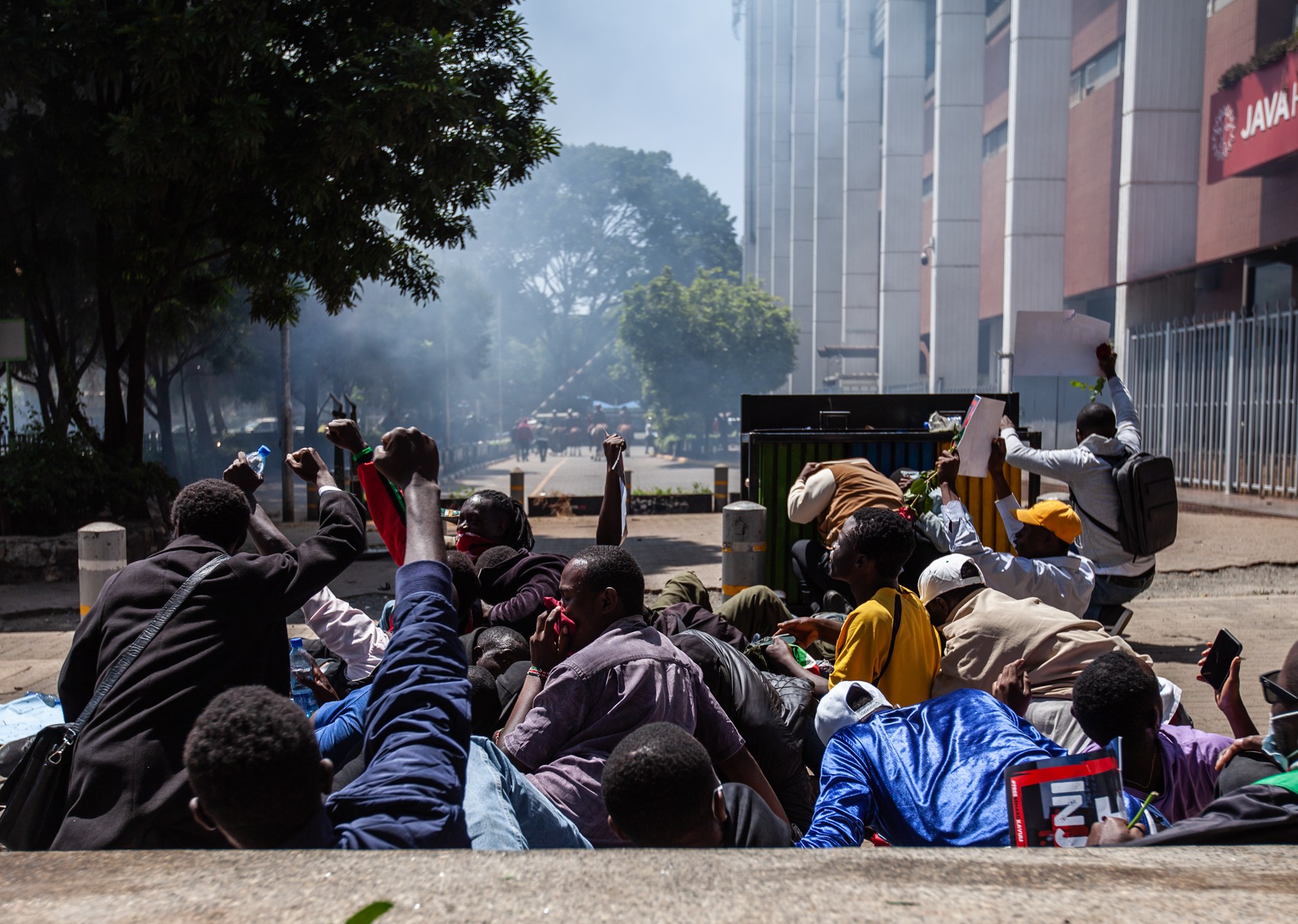
That changed with the abduction of Gideon Kibet, better known as Kibet Bull, a young cartoonist who has become an internet sensation for his bold use of silhouettes to ridicule the administration of President William Ruto, which has increasingly taken an authoritarian turn after its legitimacy was thrown into doubt by countrywide youth-led street protests.
The regime responded with a brutal crackdown that killed dozens and a campaign of abductions of prominent activists which has continued to this day. According to the Kenya National Human Rights Commission, in the past seven months, at least 82 people have been taken and nearly a third of them remain unaccounted for. Kibet and his brother, Ronnie Kiplagat, went missing in the capital, Nairobi, on Christmas Eve after they met opposition legislator Okiya Omtatah.
That the police are behind the duo’s disappearance is partly confirmed by reports that officers had previously broken into his home in Nakuru, about 150km (93 miles) from the capital, in a vain attempt to nab him there. Also, police have been implicated in previous abductions, including the kidnapping of veteran journalist, Macharia Gaitho, who was snatched from the precincts of a police station where he had sought refuge.
By going after Kibet, the Ruto regime has demonstrated its fragility. According to one theory, cartooning depends on the political system. While in totalitarian regimes the artist is forced to praise the system and denounce its enemies and in democratic ones the cartoonist is a watchdog, keeping power-holders honest and accountable, in authoritarian regimes some dissent is allowed, and when the regimes become brittle, cartoonists mercilessly expose their rigid foolishness.
For six decades, Kenya has been an aspiring democracy, with the people constantly having to push back against the authoritarian tendencies of their rulers. Ruto, who was elected with barely a third of the vote in 2022, has been especially insecure about his position, initially trying to craft a place for himself on the international stage to cover for his lack of domestic legitimacy. The midyear protests, which forced him to withdraw unpopular tax measures, reshuffle his cabinet, and launched a youth movement focused on deposing him, also supercharged his authoritarian tendencies, which had been nurtured by none other than Moi himself.
Through his cartoons, Kibet Bull has been mercilessly exposing Ruto’s rigid foolishness, attracting the attention and wrath of the regime, as well as winning the admiration of millions of Kenyans both online and offline. He now joins dozens of young people who have been disappeared by the Ruto regime, some of whom have reported being tortured and others who have been killed. That the abductions are the work of state agents is not seriously in doubt and has attracted condemnation from a large cross-section of Kenyan society as well as human rights groups.
In recent days, Ruto has vowed to end the abductions which many Kenyans have interpreted as an admission of complicity. In his New Year’s message to the country, he acknowledged “instances of excessive and extrajudicial actions by members of the security services”, but seemed to suggest that the real problem was not police behaving badly, but rather citizens advancing “radical, individualistic, and self-centred interpretations of rights and freedoms”.
Ruto, who has in the past shown disdain for the teaching of history in Kenyan schools, arguing that Kenyans needed to focus on more “marketable” disciplines, would actually be well served by reading up on Kenya’s recent past. In the course of the last seven decades, Kenya’s rulers – from the British colonialists to his predecessors as president, including fellow crimes against humanity indictee at the International Criminal Court, Uhuru Kenyatta – have all learned the same painful lesson: a lack of legitimacy is lethal to their regimes and their brutality will not save them.
Ruto is by far the weakest of the lot and he knows it. Barely halfway through his term, he is already plotting to change the rules on the handover of power to give himself more control of the process, even though the next elections are more than two-and-a-half years away. As he flails about, he has had several major government reshuffles and even engineered the impeachment, removal and replacement of his deputy. Having successfully run a populist campaign for the presidency against the “dynasties” – the political families that have dominated Kenya’s politics since independence – he has been reduced to swallowing his words and courting their support.
But it is this same weakness, insecurity, fear and desperation that makes Ruto so dangerous. It is this that makes him target the young people whose only crime is to demand the better life he promised them. It is this that makes his regime tremble at ridicule and see online cartoons as an existential threat. And it is this that makes him a threat to the nation and its constitutional order – one that all Kenyans must be alive to.
The views expressed in this article are the author’s own and do not necessarily reflect Al Jazeera’s editorial stance.
