

This story was supported by a grant from the Pulitzer Center and published in partnership with Mongabay and Project Multatuli.
TRANSCRIPT
[CLIP: Forest sounds]
On supporting science journalism
If you’re enjoying this article, consider supporting our award-winning journalism by subscribing. By purchasing a subscription you are helping to ensure the future of impactful stories about the discoveries and ideas shaping our world today.
[Title]
SOUND GUARDIANS
Abidin: My name is Abidin. I’ve lived in Pemaluan since I was born. I’ve never moved. This is the land of my ancestors from long ago. We are people who love farming in the mountains. I feel at peace being here because the atmosphere is calm, safe. [But] after the construction of the new capital city…life has slowly started to change.
[Text]
Jakarta is the world’s fastest-sinking city.
Because of sea-level rise, excess groundwater pumping and other factors, experts estimate that one third of the city could be underwater by 2050.
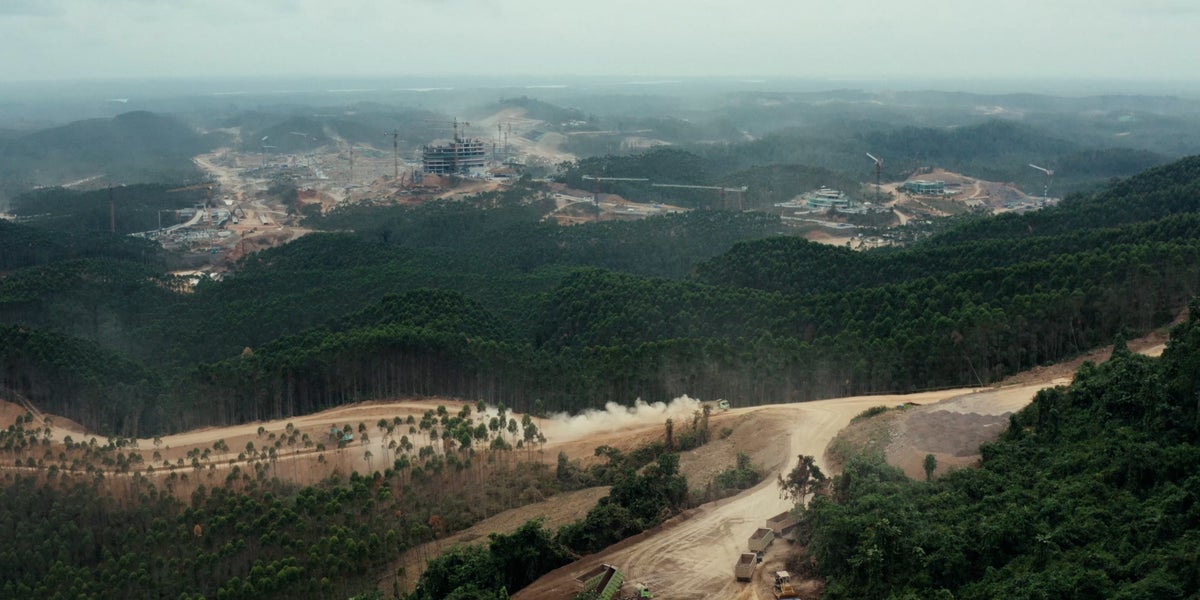
In response, Indonesia is building a new capital city on the island of Borneo.
The city is projected to be completed by 2045. It will house a fraction of Jakarta’s population — mostly government workers.
Joko Widodo: Indonesia, as a great nation, must dare to take steps. We must be brave to have a big agenda, and this is for the advancement of our country, for the progress of the nation.
Nusantara Marketing Video: The new capital city of Nusantara is a grand collective endeavor for the progress of the Indonesian nation. The forests of Nusantara serve as a hub where residents and visitors can experience Indonesia’s rich biodiversity. This green city serves as a meeting point between Indonesia’s history and its aspirations for the future. A smart forest city.
Wendy Erb: When we heard that Indonesia was moving the capital to Kalimantan, and I’ve been working in Kalimantan for ten years now, I knew immediately that building a new capital city there has the potential to have a huge impact on forests and animals there.
We’re interested in documenting what’s here before all this big change happens. And we’re trying to do that all through sound work. Sound is a unique kind of data. It becomes, in some ways, a time capsule of a place.
We have recorders on top of mountains. We have recorders in mangrove areas. We have recorders right next to caves.
We ended up sampling 20 different sites, and then from there we could do comparisons over time as we recorded across 18 months, as the capital’s being built, as this environmental change is happening, as this social change is happening, economic growth is happening. And could we see places where wildlife [was] being displaced?
Maybe those are places where more investment could be made in conservation efforts. The question is: Can we tune our ears? Can we pay attention? Can we notice when the natural world is feeling a little sick?
It’s a giant squirrel! They sound like bubblegum lasers.
Abidin: In Pemaluan, the most distinct sound is the sound of monkeys or gibbons. Back then, our ancestors used their sound as a sign. Usually, gibbons, at dawn, just before morning, they would call. If they call at … around 9 or 10 in the morning, and everything feels eerily quiet, that’s usually a sign … indicating that someone will pass away in the village.
In the past, the most dominant sound came from the white-breasted waterhen. Then, hornbills, with their loud calls. The most iconic one is the great argus, the great argus is indeed a favorite of the Balik people. [Now] we can hear other sounds. Our people say that usually the chainsaw is the loudest.
Personally, I’m very scared because we have lost our tradition, our ancestral traditions from the past. For example, the great argus, even my child doesn’t know that. So, with these wildlife recording devices, we are preserving the knowledge of our ancestors. Then, from us, if possible, we’ll pass it down to our children and grandchildren.
Researcher 1: Swiftlets.
Researcher 2: Swiftlets.
Researcher 1: Don’t know their name because swiftlets like to eat.
Erb: Another driving goal of our research is in the process of generating that knowledge. The local people are playing a central role in collecting the data, help us define the research problems, identify the research sites, understand the history of this landscape, and most importantly, the relationships between people and forest, people and place.
Abidin: This is besawan in our local language.
In an emergency, we can … take the main stalk and prepare it as a side dish. But only in emergencies,like when there’s no food in the forest.
Erb: But does it taste good?
Abidin: Of course, if it’s cooked.
Erb: OK, OK.
Erb: I think the science will be better off for it. And I think the local people will most importantly benefit from being a part of defining the problems and defining the solutions.
Abidin: Our ancestors once predicted something. The prophecy was like this. They said, “It’s OK. “Those who were once behind, one day will be ahead.” It’s like the flow of a river. For so long, when the capital city was still in Jakarta, the flow from all of Indonesia converged there. This is the reversal. Our village, so to speak, has become bustling.
Erb: What is your biggest fear when you see all this and imagine the future?
Abidin: It’s the future generations, the children and grandchildren. What I fear is what their fate will be later. In terms of education, they are far behind compared to our brothers and sisters from Sumatra, from Java. Especially in city life, you have to be smart, right? Meanwhile, they, so to speak, are still relying on the lifestyle of the past.
What can we do in the city? I myself can’t live in the city. I don’t understand what I can do. If we become scavengers in our own hometown, it’s better to just die.
Erb: As we started the research project, it looked like something, but it wasn’t a city. Now it’s like, there’s apartment buildings, and there’s a Swiss-Belhotel, and there’s a palace. And, maybe this work, like, we can’t actually stop anything from happening, and sometimes that feels really sad and hard to sit with. Because maybe you’re like, we could do something, things could be different. But maybe they can’t, or maybe, like, it’s also not really our place to do that.
Although we recognize that within our small team and our limited expertise we don’t have the ability to capture and preserve every aspect of their culture and their knowledge, there’s still a ton that we can do through this kind of sound work, where we’re really thinking about the voices – whether that’s the voices of the forest, or whether that’s the voices of the community members who feel like nobody’s listening to them. I think what’s at stake is people losing their connectedness.
Abidin: My hopes for my children, when they’re my age, is that they don’t forget the culture of our tribe.
I’ll keep trying to teach them not to let our own language disappear. I can teach my children the sounds of animals in the forest. Even though there are changes now, I still feel that this is my home.
[Text]
Abidin, Wendy and other partners are currently co-creating a book about Balik biocultural heritage.
They are also developing a platform for the communities to access and use the sound recordings.
In 2025 Indonesia’s new president slashed the budget for the new capital city, leading to uncertainty about its future.
Still, construction is ongoing.
This story was supported by a grant from the Pulitzer Center and published in partnership with Mongabay and Project Multatuli.
