

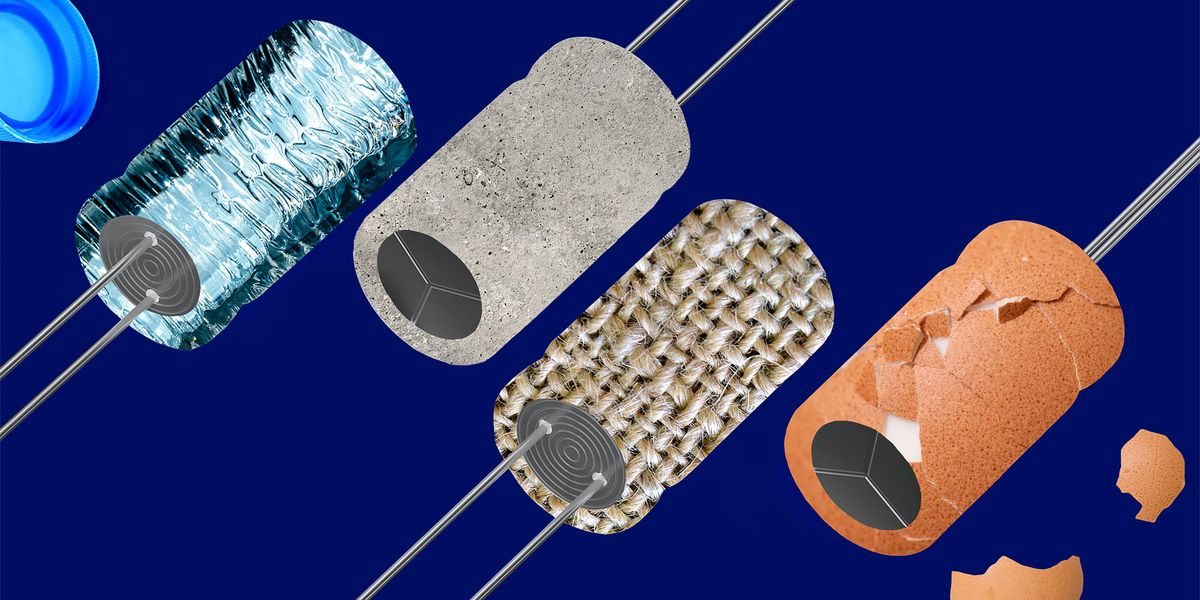
What do water bottles, eggs, hemp, and cement have in common? They can be engineered into strange, but functional, energy-storage devices called supercapacitors.
As their name suggests, supercapacitors are like capacitors with greater capacity. Similar to batteries, they can store a lot of energy, but they can also charge or discharge quickly, similar to a capacitor. They’re usually found where a lot of power is needed quickly and for a limited time, like as a nearly instantaneous backup electricity for a factory or data center.
Typically, supercapacitors are made up of two activated carbon or graphene electrodes, electrolytes to introduce ions to the system, and a porous sheet of polymer or glass fiber to physically separate the electrodes. When a supercapacitor is fully charged, all of the positive ions gather on one side of the separating sheet, while all of the negative ions are on the other. When it’s discharged, the ions are randomly distributed, and it can switch between these states much faster than batteries can.
Some scientists believe that supercapacitors could become more super. They think there’s potential to make these devices more sustainably, at lower-cost, and maybe even better performing if they’re built from better materials.
And maybe they’re right. Last month, a group from Michigan Technological University reported making supercapacitors from plastic water bottles that had a higher capacitance than commercial ones.
Does this finding mean recycled plastic supercapacitors will soon be everywhere? The history of similar supercapacitor sustainability experiments suggests not.
About 15 years ago, it seemed like supercapacitors were going to be in high demand. Then, because of huge investments in lithium-ion technology, batteries became tough competition, explains Yury Gogotsi, who studies materials for energy-storage devices at Drexel University, in Philadelphia. “They became so much cheaper and so much faster in delivering energy that for supercapacitors, the range of application became more limited,” he says. “Basically, the trend went from making them cheaper and available to making them perform where lithium-ion batteries cannot.”
Still, some researchers remain hopeful that environmentally friendly devices have a place in the market. Yun Hang Hu, a materials scientist on the Michigan Technological University team, sees “a promising path to commercialization [for the water-bottle-derived supercapacitor] once collection and processing challenges are addressed,” he says.
Here’s how scientists make supercapacitors with strange, unexpected materials:
Water Bottles
It turns out your old Poland Spring bottle could one day store energy instead of water. Last month in the journal Energy & Fuels, the Michigan Technological University team published a new method for converting polyethylene terephthalate (PET), the material that makes up single-use plastic water bottles, into both electrodes and separators.
As odd as it may seem, this process is “a practical blueprint for circular energy storage that can ride the existing PET supply chain,” says Hu.
To make the electrodes, the researchers first shredded bottles into 2-millimeter grains and then added powdered calcium hydroxide. They heated the mixture to 700 °C in a vacuum for 3 hours and were left with an electrically conductive carbon powder. After removing residual calcium and activating the carbon (increasing its surface area), they could shape the powder into a thin layer and use it as an electrode.
The process to produce the separators was much less intensive—the team cut bottles into squares about the size of a U.S. quarter or a 1-euro coin and used hot needles to poke holes in them. They optimized the pattern of the holes for the passage of current using specialized software. PET is a good material for a separator because of its “excellent mechanical strength, high thermal stability, and excellent insulation,” Hu says.
Filled with an electrolyte solution, the resulting supercapacitor not only demonstrated potential for eco- and finance-friendly material usage, but also slightly outperformed traditional materials on one metric. The PET device had a capacitance of 197.2 farads per gram, while an analogous device with a glass-fiber separator had a capacitance of 190.3 farads per gram.
Eggs
Wait, don’t make your breakfast sandwich just yet! You could engineer a supercapacitor from one of your ingredients instead. In 2019, a University of Virginia team showed that electrodes, electrolytes, and separators could all be made from parts of a single object—an egg.
First, the group purchased grocery store chicken eggs and sorted their parts into eggshells, eggshell membranes, and the whites and yolks.
They ground the shells into a powder and mixed them with the egg whites and yolks. The slurry was freeze-dried and brought up to 950 °C for an hour to decompose. After a cleaning process to remove calcium, the team performed heat and potassium treatments to activate the remaining carbon. They then smoothed the egg-derived activated carbon into a film to be used as electrodes. Finally, by mixing egg whites and yolks with potassium hydroxide and letting it dry for several hours, they formed a kind of gel electrolyte.
To make separators, the group simply cleaned the eggshell membranes. Because the membranes naturally have interlaced micrometer-size fibers, their inherent structures allow for ions to move across them just as manufactured separators would.
Interestingly, the resulting fully egg-based supercapacitor was flexible, with its capacitance staying steady even when the device was twisted or bent. After 5,000 cycles, the supercapacitor retained 80 percent of its original capacitance—low compared to commercial supercapacitors, but fairly on par for others made from natural materials.
Hemp
Some people may like cannabis for more medicinal purposes, but it has potential in energy storage, too. In 2024, a group from Ondokuz Mayıs University in Türkiye used pomegranate hemp plants to produce activated carbon for an electrode.
They started by drying stems of the hemp plants in a 110 °C oven for a day and then ground the stems into a powder. Next, they added sulfuric acid and heat to create a biochar, and, finally, activated the char by saturating it with potassium hydroxide and heating it again.
After 2,000 cycles, the supercapacitor with hemp-derived electrodes still retained 98 percent of its original capacitance, which is, astoundingly, in range of those made from nonbiological materials. The carbon itself had an energy density of 65 watt-hours per kilogram, also in line with commercial supercapacitors.
Cement
It may have a hold over the construction industry, but is cement coming for the energy sector, too? In 2023, a group from MIT shared how they designed electrodes from water, nearly pure carbon, and cement. Using these materials, they say, creates a “synergy” between the hydrophilic cement and hydrophobic carbon that aids the electrodes’ ability to hold layers of ions when the supercapacitor is charged.
To test the hypothesis, the team built eight electrodes using slightly different proportions of the three ingredients, different types of carbon, and different electrode thicknesses. The electrodes were saturated with potassium chloride—an electrolyte—and capacitance measurements began.
Impressively, the cement supercapacitors were able to maintain capacitance with little loss even after 10,000 cycles. The researchers also calculated that one of their supercapacitors could store around 10 kilowatt-hours—enough to serve about one third of an average American’s daily energy use—though the number is only theoretical.
From Your Site Articles
Related Articles Around the Web
