

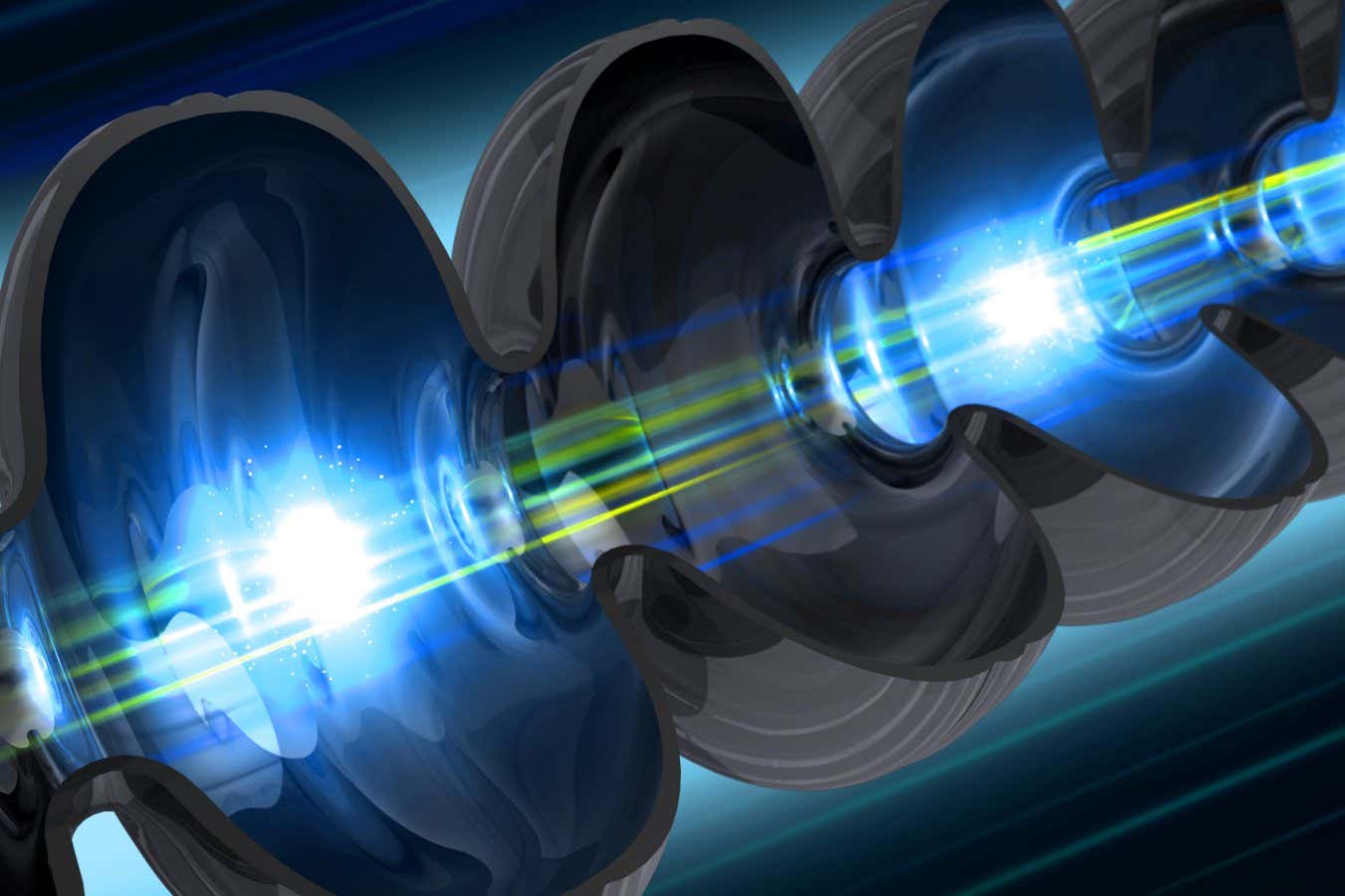
An illustration of an electron beam traveling through a niobium cavity, a key component of SLAC’s LCLS-II X-ray laser
SLAC National Accelerator Laboratory
The Klystron Gallery, a concrete hallway studded with evenly spaced metal cylinders, is long enough to extend past my line of sight. But as I stand inside it, I know that something even more spectacular hides beneath my feet.
Below the Klystron Gallery is a gigantic metal tube that extends for 3.2 kilometres: the Linac Coherent Light Source II (LCLS-II). This machine, located at the SLAC National Accelerator Laboratory in California, generates X-ray pulses more powerful than those produced at any other facility in the world, and I am visiting it because it recently broke one of its own records. Soon, however, its most powerful components will shut down for an upgrade. Once it is turned back on, possibly as early as 2027, its X-rays will have more than double the energy.
“It will be like going from a twinkle to a lightbulb,” says James Cryan at SLAC.
Describing LCLS-II as a mere twinkle is a massive understatement. In 2024, it produced the most powerful X-ray pulse ever recorded. It lasted just 440 billionths of a billionth of a second, but carried almost a terawatt of power, which far surpasses the average yearly output of a nuclear power plant. What’s more, in 2025, LCLS-II generated 93,000 X-ray pulses in one second – a record for an X-ray laser.
Cryan says that this latter record paves the way for researchers to get an unprecedented look into the behaviour of particles inside molecules after they absorb energy. It’s comparable to turning a black-and-white film of their behaviour into a sharper one teeming with colour. Between this accomplishment and the upcoming upgrade, LCLS-II stands a chance of radically improving our understanding of the subatomic behaviour of light-sensitive systems, whether they be photosynthesising plants, or candidates for better solar cells.
LCLS-II achieves all of this by accelerating electrons until they approach the speed of light – the ultimate cosmic speed limit. The cylindrical devices that I saw, which are the klystrons that give the Klystron Gallery its name, are responsible for producing the microwaves that achieve this acceleration. Once sufficiently fast, the electrons pass through rows of thousands of magnets whose poles are carefully arranged to make the speeding electrons wiggle. This, in turn, produces X-ray pulses. Like medical X-rays, these pulses can then be used to image the inside of materials.
On the day of my visit, I tour one of the several experimental halls where the X-rays complete their journey by crashing into molecules. I peek at some of the chambers where a molecule and an X-ray meet. They are like something out of a futuristic submarine: thick metal cylinders with round glass windows, all of which are carefully bolted together so as not to let in any stray molecules of air that could interfere with the experiment.
Cryan and his colleagues ran an experiment the night before my visit, investigating the motion of protons inside molecules. Imaging methods other than X-rays struggle to accurately determine how protons move, yet accurate details of the process are important for solar cell development, he says.
What will happen to such investigations once LCLS-II completes its “High Energy” upgrade to become LCLS-II-HE? The ability to study the behaviour of particles and charges within molecules will increase significantly, says Cryan. Getting there, however, will be no easy task.

CERN and Mont Blanc, dark and frozen matter: Switzerland and France
Prepare to have your mind blown by CERN, Europe’s particle physics centre, where researchers operate the famous Large Hadron Collider, nestled near the charming Swiss lakeside city of Geneva.
John Schmerge at SLAC says that the more energetic the electron beam becomes, the more the team must worry about even just a few particles going astray. He says he once saw an imperfectly controlled beam burn a hole in an instrument at a different facility, so there is little room for error. SLAC’s Yuantao Ding says that all the new parts the team will be installing during the upgrade have been designed to withstand the new, higher power of the facility, but that it will be crucial to ramp the power up step-by-step and verify that everything is working as intended. “We will be turning on the beam and carefully watching what happens,” he says.
He and his colleagues will spend most of 2026 making a big engineering push to get all the parts in place, which will then set them up for this incremental process throughout the following year or two. If all goes according to plan, researchers worldwide will be able to use LCLS-II-HE by 2030. Conversations between researchers who use the X-rays, like Cryan, and those who control it, like Schmerge and Ding, will also play a big role. “Ultimately, it is a big tool, and people will learn how to use it well,” says Schmerge. “We will be constantly tweaking it.”
Topics:
