

Unlock the Editor’s Digest for free
Roula Khalaf, Editor of the FT, selects her favourite stories in this weekly newsletter.
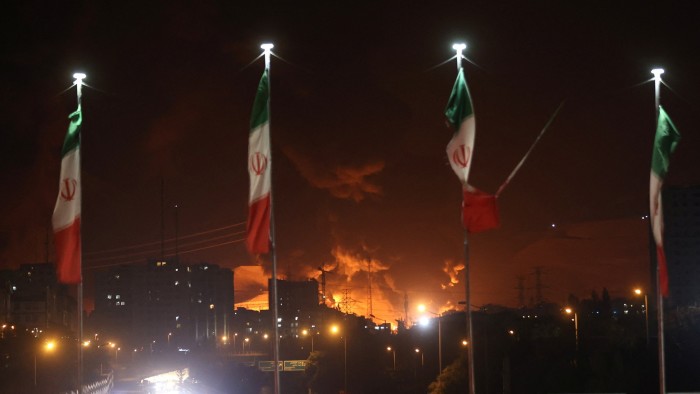
Observers might be forgiven for thinking that financial markets don’t care much about geopolitical shocks. The world’s largest economy is threatening to put itself behind a tariff wall. War rages on in Europe. And since June 13 a fresh Middle East conflict has broken out. Yet, the S&P 500 remains near record highs. It has been resilient this week even as the US considered joining Israel’s war on Iran. Brent crude prices are up, but only to a tame $77 per barrel. Have investors lost touch with reality? A look at historical market reactions to global events suggests not.
Using data going back to the second world war, Deutsche Bank finds that, on average, the S&P 500 tends to fall by around 6 per cent in the three weeks following a geopolitical shock, only to recover fully three weeks later. In other words, if history is any guide, there is still time for the market reaction to the Israel-Iran conflict to evolve.
Each shock also manifests itself in different ways. Adolf Hitler’s annexation of Czechoslovakia in 1939 triggered a 20 per cent crash in the main US equity index. That took over a month to bottom out. The 9/11 attacks sparked a sell-off of over 10 per cent in just six days that recovered in three weeks. The 1973 oil embargo by Arab countries following the Yom Kippur war sparked an inflation crisis from which developed markets took years to recover. Europe’s high dependence on Russian gas meant its industries were hampered by high costs for a long period after Vladimir Putin invaded Ukraine in February 2022. Germany’s Dax index continued trending downwards until October that year.
What can we learn from these events? The market reaction typically comes in two parts. First, the shock buffets investor confidence, stoking a flight to safety. Second, depending on the event’s economic significance and persistence, it eventually seeps into earnings, investment plans, prices and jobs, which then leads traders to price in a changed economic outlook.
Right now, confronted by both the tariff and Middle East shocks, investors are trying to ascertain their effects on the real economy. The sharp initial sell-off triggered by Donald Trump’s “liberation day” duties was only staved off by a 90-day pause in its enforcement. That deadline is up on July 8, with little clarity over what happens next.
As for the Israel-Iran war, the more restrained immediate reaction, at least relative to historical energy shocks, makes sense. Oil is less significant in powering the global economy than it was in the 1970s. Supply is also less concentrated. Iran’s oil exports account for less than 2 per cent of global demand, and in 2020, the US became an annual net exporter of total petroleum for the first time since at least 1949.
This has focused investors’ minds on what matters most for the global economy from the crisis. The greatest risk is an escalation, potentially with the US entering the conflict, that leads to the closure of the Strait of Hormuz, through which a fifth of the world’s daily oil consumption flows. If that were to happen, analysts reckon oil could push above $120 a barrel. A temporary price shock could then turn into more sustained inflation, with knock-on implications for central banks.
This leaves traders carefully watching developments on both tariffs and the Middle East war, recalibrating probabilities for worst-case scenarios in real time. Only when uncertainty clears up can investors properly reassess their forecasts for economic fundamentals, which underpin asset valuations. For now, however, July 9 remains a big unknown. And, though President Trump appeared on Thursday to be allowing time for negotiation with Iran, as he warned earlier, “nobody knows what I’m going to do”. Despite recent appearances, geopolitics does matter for markets — as soon as it affects the real economy. Today may prove to be the relative calm before the storm.
