

Revenge on referees
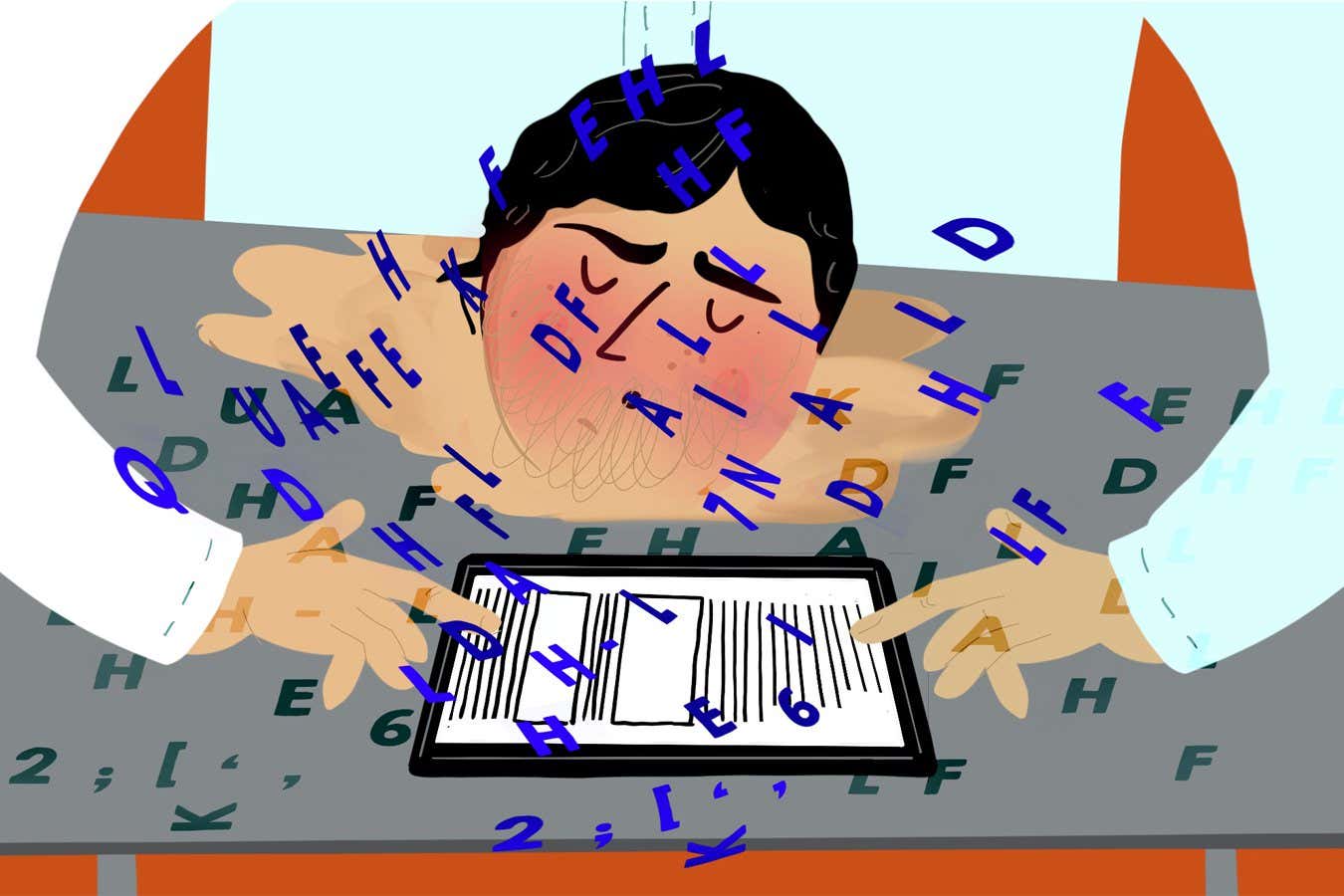
Our news colleagues Jacob Aron and Michael Le Page have drawn Feedback’s attention to a post on social media site BlueSky, which highlighted a scientific paper in awed tones.
The study in question was recently published in the International Journal of Hydrogen Energy. There are seven authors. It is about the ways hydrogen atoms can infiltrate certain metal alloys and make them brittle. It focuses on calculating exactly where the hydrogen atoms place themselves in the crystal structure of the metal, in order to understand the mechanism of this embrittlement.
At this point, you may be wondering what this piece of research is doing in Feedback. Well, the introduction concludes with the following paragraph: “As strongly requested by the reviewers, here we cite some references [[35], [36], [37], [38], [39], [40], [41], [42], [43], [44], [45], [46], [47]] although they are completely irrelevant to the present work.”
For anyone who hasn’t worked in academia, the best way we can explain this is that the authors are being gloriously petty. Their article has been examined by anonymous peer reviewers, who (among other suggestions) have urged them to cite the 13 older studies in the list. The authors, left with no choice but to insert the supposedly irrelevant studies, have refused to incorporate them into their actual text, but instead included them while simultaneously drawing attention to their irrelevance.
Or, as BlueSky user @Dave nʎ=2dsinɵ :protein: put it: “Absolute shots fired”. By the way, kudos to @Dave nʎ=2dsinɵ :protein: for having a username that pushed New Scientist‘s font to its limits and sent Feedback to a search engine. The little equation in the middle is, we discovered, Bragg’s law, which describes how crystal lattices scatter incoming waves.
Anyway, once Feedback had stopped having flashbacks to our brief time in academia, in which this kind of thing happened to us but we didn’t have the nerve to kick back in print, we did our due diligence and looked up all 13 references.
All are concerned with alloys and other composite materials, but none of them seems to be about hydrogen embrittlement. Most are so technical that Feedback was rather defeated in our attempt to fully comprehend them: any readers more familiar with composite materials are welcome to weigh in at the usual address. Still, even with our poor understanding, none of the references seems directly relevant.
However, Feedback did notice something curious. Again and again, the same authors appear in the 13 studies’ author lists – and one author was involved in all of them.
Feedback doesn’t want to put on a tinfoil hat, especially if it has been embrittled by hydrogen. But we wonder if we might have identified the anonymous peer reviewer. Our question now is: how did this get into print? Did the editors not notice the prank – or did they allow it for reasons of their own? Enquiring minds want to know.
A fishy tale
Speaking of taking ideas from colleagues, assistant news editor Sam Wong flagged an intriguing study in Water Resources Research. This journal is not, we confess, one of Feedback’s daily reads, but we seem to have been missing out.
The study is about the biblical miracle of loaves and fishes, in which Jesus apparently fed 5000 people using five loaves and two fish. The authors propose a naturalistic explanation: a seiche or standing wave. The idea is that waves blowing over a lake sometimes create a standing wave, causing deep water to rise to the surface. In Lake Kinneret, the Sea of Galilee from the Bible, this deep water is low in oxygen – so if it rises to the surface, it can cause fish to asphyxiate en masse.
The authors document two such events in Lake Kinneret in 2012. They also note that they seem to be quite rare: there hasn’t been one since 2012. That means most people may not have been aware of the possibility, especially if they had travelled to listen to a charismatic speaker and lacked local knowledge.
Feedback is adding this to the long list of scientific explanations for apparent supernatural events, like the manna from heaven being crystallised honeydew from scale insects and the tendency of infrasound to cause spooky sensations that can be interpreted as hauntings. We have also removed our tinfoil hat, as we worry it might act as a conductor for a divine lightning bolt.
Moon of Uranus
News reaches us from the front of this issue that Voyager 2’s visit to Uranus in 1986 came when the planet wasn’t its usual self, thanks to a gust of solar wind. As a result, many of our ideas about Uranus will have to be rethought – and some believe it is even possible there is life on one or more of its moons.
Life on Uranus, you say? Actually, life on Uranus’s moon? We hope it isn’t Klingons. Or as writer Tess Stenson put it: NASA, “get your ass to Uranus”.
Feedback spent more time than we should trying to think of puns, but our slate has been wiped clean. Some bright spark, conscious of jokes about the planet’s name, decided to name all Uranus’s moons after Shakespeare characters, choosing respectable names like Rosalind and Oberon. This does mean we can rule out life on one of the moons: Juliet is definitely lifeless, there was a play about it. Meanwhile, astronomers urgently need to find some more satellites so Uranus can be orbited by Bottom.
Got a story for Feedback?
Send it to feedback@newscientist.com or New Scientist, 9 Derry Street, London, W8 5HY
Consideration of items sent in the post will be delayed
You can send stories to Feedback by email at feedback@newscientist.com. Please include your home address. This week’s and past Feedbacks can be seen on our website.
