

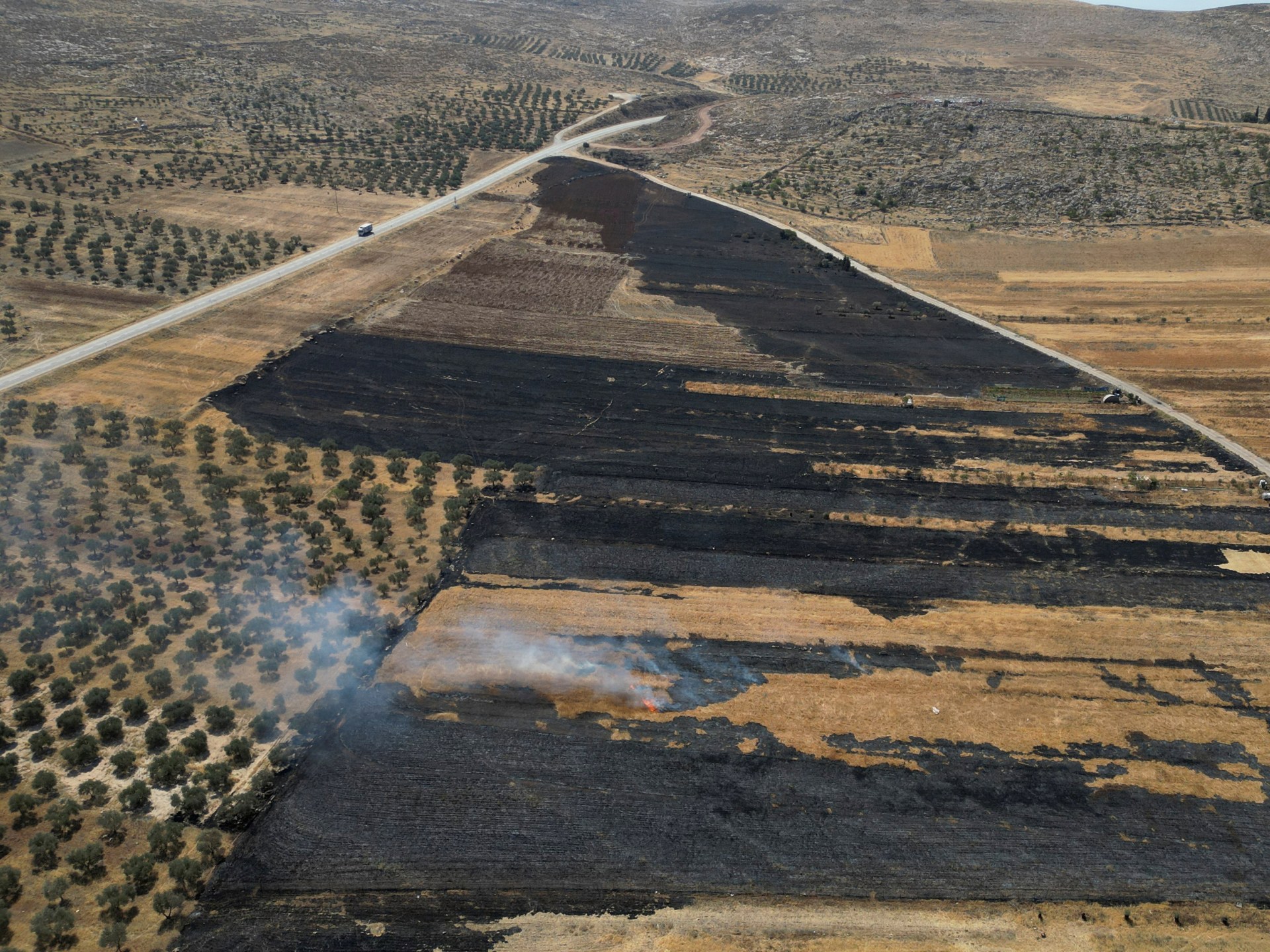
My brother recently sent me a copy of an Israeli military order that was found by farmers on our land and nearby plots in the occupied West Bank. The document, accompanied by a map, states that the land is being seized for military purposes.
It does not specify how long the land will be held and offers the landowners and users only seven days from an upcoming field visit – coordinated between the Israelis and the Palestinian Authority (PA) liaison office – to file an objection with the Israeli army’s legal adviser. This field visit typically serves to demarcate the boundaries of the confiscated land.
From our family’s past experience, confiscation under the guise of “security reasons” often precedes the establishment of a colonial settlement. This happened in 1973 when our family received a similar military order for land along the Jerusalem-Hebron Road. Within a week, a military post was established. Months later, a civilian settlement, Elazar, was erected in the same location.
What’s shocking this time is that this new order has barely made headlines despite the size of the land being slated for confiscation. According to the military order, it amounts to 5,758 dunums, or more than 5.7sq km (2.2sq miles). The confiscation is not arbitrary. At the centre of this particular area is the outpost of Sde Boaz, which was illegally established on private Palestinian land in 2002. The residents – about 50 families – are not fringe extremists. They’re middle-class professionals, including doctors, engineers and accountants.
This confiscation is one of many that have taken place in the past 21 months. Under the shadow of the genocidal war in Gaza, Israel has accelerated its annexation drive in the West Bank. The objective is to formally annex parts of what the Oslo Peace Accords designated as Area B, which is 21 percent of the West Bank, and the whole of Area C, which constitutes 60 percent of the West Bank and includes the whole of the Jordan Valley and Jerusalem countryside as well as other areas.
Most Palestinian farmland and pastures fall within this area as do a large number of Israel’s illegal settlements. My town, al-Khader (St George), owns more than 22,000 dunums (22sq km/8.5sq miles) of land, of which more than 20,500 (20.5sq km/7.9sq miles) are classified as Area C, 500 (half a square kilometre/0.2sq miles) as Area B, and less than 1,000 dunums (1sq km/0.4sq miles) as Area A.
Israeli settlers play an active role in advancing this annexation plan. This is not limited to seizing strategic hilltops but also includes systematic violence against Palestinians. The settler attacks on Palestinian property, the torture and killings of Palestinians are all part of an organised campaign intended to uproot Palestinians from Areas B and C to facilitate annexation. This strategy aligns with what Israeli policymakers refer to as “voluntary transfer”, a euphemism for ethnically cleansing Palestinians from their homeland.
All of this is illegal, according to international law, and goes against repeated resolutions by the United Nations and a 2024 ruling of the International Court of Justice. So who will stop Israel?
The PA, which nominally administers Area A in the occupied West Bank, will certainly not. Since its establishment as part of the Oslo peace process, the PA has not only failed to resist Israeli moves towards annexation, but it has also arguably facilitated them by working with Israel to stem out armed and even peaceful resistance that does not support its political agenda.
The international community is also unlikely to take decisive action. For decades, Western governments, in particular, have offered rhetorical condemnations while simultaneously providing security and economic support to Israel. These same actors who have failed to stop the ongoing genocide in Gaza are unlikely to object if Israel formalises its de facto annexation.
This was most recently evident during a diplomatic visit to Taybeh, a Palestinian village located northeast of Jerusalem and Ramallah. The visit, which included more than 20 diplomats from around the world, including European and American representatives, came in response to repeated attacks by Jewish settlers, who burned parts of the village’s land, including property belonging to the local church. That was all these countries were willing to do – send representatives to the area for a couple of hours to utter a few words of condemnation. Beyond that, it is business as usual in their relations with Israel.
What remains then is the resilience and agency of the Palestinian people and their principled political movements. In the current context, the mere presence of Palestinians on their land is an act of resistance.
To sustain this presence and strengthen their struggle, Palestinians must continue to mobilise global progressive and freedom-oriented movements to support their cause – not only in solidarity but also as part of a broader global fight against the far-right, racist, anti-justice forces that support Israel and simultaneously threaten civil rights and social justice in their own countries.
Solidarity activities at the global level should be strategic and impactful. They should focus on disrupting all components of the supply chain that benefit the Israeli occupation in general and settler colonialism in particular. This means citizens around the world in different sectors of society can contribute to the struggle for Palestine as both producers and consumers by heeding the call to boycott and divest from Israel.
Direct actions from the working class are crucial. Workers can integrate the Palestinian cause into their demands for better working conditions. For instance, public strikes in solidarity with Palestine, such as those organised by rail workers in European countries, might pressure governments to reconsider their support for Israel.
Similarly, port workers could strike to disrupt shipping linked to Israel, pushing governments to reassess their positions. Employees in high-tech industries can play a critical role in supporting Palestinians by demanding their companies align products, services and partnerships with international law, refusing to support technologies complicit in the Israeli occupation or settler violence. If companies refuse, workers can escalate to protest action, such as disrupting supply chains and whistleblowing.
In addition to expanding and strengthening Boycott, Divestment, Sanctions (BDS) activities, there are other solidarity actions that could be carried out. In Palestine, individuals and groups can organise to accompany Palestinian farmers to their lands, serving as witnesses to settler and soldier attacks while helping to protect communities.
They can also help Palestinian farmers and other communities by assisting them in selling their products. This challenges the dominant business model that exploits small-scale producers. I can attest to the importance of such initiatives as I have begun facilitating the connection of local Palestinian producers with the European market through the Palestine General Cooperatives Union and Cooperatives UK.
With governments abrogating their legal obligations to stop genocide and colonisation, grassroots mobilisation for impactful actions is the only way to disrupt Israeli colonial activities. An active global movement can force Israeli citizens to confront and relinquish the racist, apartheid, and colonialist foundations of their society, prompting them to seek real change.
The views expressed in this article are the author’s own and do not necessarily reflect Al Jazeera’s editorial stance.
