

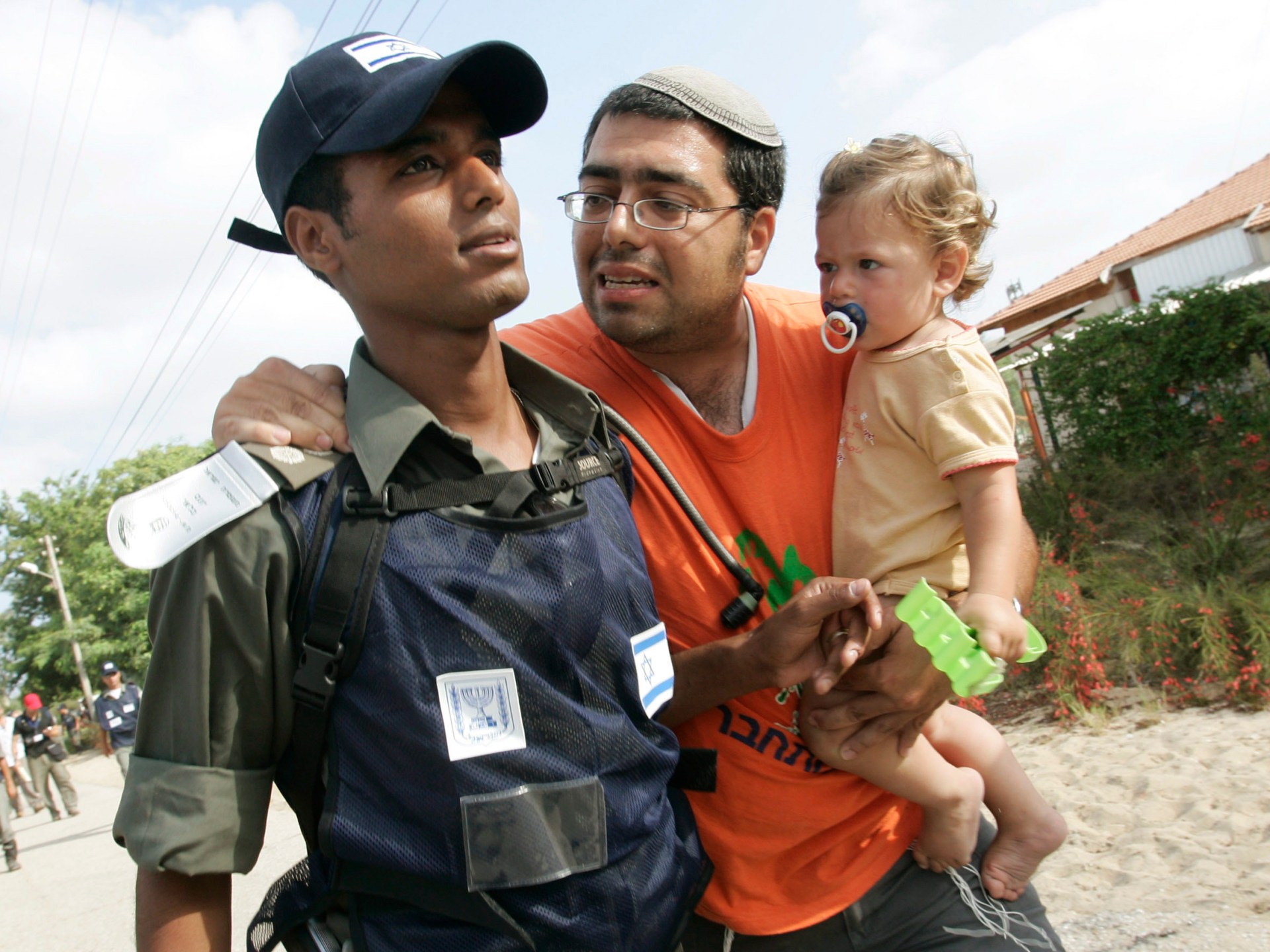
In August 2005, the Israeli government officially withdrew from the Gaza Strip, the Palestinian coastal enclave it had occupied continuously since 1967. Apart from pulling back its armed forces, it had to undertake the dismantlement of 21 illegal settlements housing 8,000 Jewish settlers.
Israeli troops were deployed to begin the process, which pulled at the heartstrings of international media outlets like The New York Times. The paper reported on the sobbing settlers affected by Israel’s “historic pullout from the Gaza Strip”, some of whom had to be carried “screaming from their homes in scenes that moved a number of the soldiers to tears”.
To be sure, there is nothing quite so tragic as illegal colonisers being uprooted from one section of land that does not belong to them and transferred to another section of land that does not belong to them. It bears mentioning that a majority of the Palestinian population of the Gaza Strip are themselves refugees from Israel’s blood-drenched conquest of Palestine in 1948, which killed 15,000 Palestinians, expelled three-quarters of a million more, and destroyed over 500 Palestinian villages.
Since 2005, the myth of a unilateral Israeli “withdrawal” from Gaza has stubbornly persisted – and has been repeatedly invoked as alleged evidence of Israel’s noble willingness to occasionally play by the rules.
And yet objectively speaking, what happened in August of that year was not much of a “withdrawal” at all, given that the Israeli military continued to control Gaza’s borders while subjecting the territory to a punishing blockade and periodic wanton bombardment.
Israeli officials themselves made no effort to hide what they were really up to. In 2004, while the plan was still being discussed in the Knesset, Dov Weisglass, a senior adviser to then-Israeli Prime Minister Ariel Sharon, stated point-blank: “The disengagement is actually formaldehyde. It supplies the amount of formaldehyde that is necessary so there will not be a political process with the Palestinians.”
By “freezing” the political process, Weisglass went on to explain, “you prevent the establishment of a Palestinian state, and you prevent a discussion on the refugees, the borders and Jerusalem”. Thanks to “disengagement”, then, the whole issue of Palestinian statehood had been “removed indefinitely from our agenda” – and all with the “blessing” of the president of the United States of America “and the ratification of both houses of Congress”.
Since the so-called “withdrawal” from Gaza did not entail ceasing to make life hell for the Palestinian inhabitants of the territory, Israel remained ever-engaged on that front. On September 28, 2005 – the month following the drama of the sobbing settlers and soldiers – the late Dr Eyad El-Sarraj, founder of the Gaza Community Mental Health Programme, wrote on the Electronic Intifada website: “During the last few days, Gaza was awakened from its dreams of liberation with horrible explosions which have shattered our skies, shaken our buildings, broken our windows, and threw the place into panic.”
These were the effects of Israeli aircraft executing sonic booms in the skies over Gaza, a method El-Sarraj noted “was never used before the disengagement, so as not to alarm or hurt the Israeli settlers and their children”. And that was just the start of the “disengaging”.
In 2006, Israel launched Operation Summer Rains in the Gaza Strip, which scholars Noam Chomsky and Ilan Pappe would subsequently characterise as being thus far the “most brutal attack on Gaza since 1967”. This, of course, was before Gaza was awakened from its dreams of liberation with an all-out Israeli genocide, which has now killed nearly 53,000 Palestinians since October 2023.
But there was plenty of brutality in between, from Israel’s Operation Cast Lead – which kicked off in December 2008 and killed 1,400 Palestinians in a matter of 22 days – to Operation Protective Edge, which slaughtered 2,251 people over 50 days in 2014.
Along with periodic bouts of mass killing, the fluctuating Israeli blockade of the Gaza Strip posed additional existential challenges. In 2010, for example, the BBC listed some of the household items that had at different times been blocked from entering Gaza, including “light bulbs, candles, matches, books, musical instruments, crayons, clothing, shoes, mattresses, sheets, blankets, pasta, tea, coffee, chocolate, nuts, shampoo and conditioner”.
In 2006, Israeli government adviser Weisglass – the same character who revealed the “formaldehyde” approach to disengagement – also took it upon himself to charmingly clarify the logic behind Israel’s restrictions on food imports into the Gaza Strip: “The idea is to put the Palestinians on a diet, but not to make them die of hunger.”
Now that Israel is literally starving Palestinians to death in Gaza with the full complicity of the United States, it seems the “idea” has undergone some revisions. Meanwhile, recent news reports citing unnamed Israeli officials indicate that Israel is also currently plotting the “conquest” and full military occupation of the Gaza Strip.
Two decades on from Israel’s withdrawal-that-wasn’t from Gaza, it’s safe to surmise that “disengagement” paved the way for conquest. And this time around, there’s no disengagement plan.
The views expressed in this article are the author’s own and do not necessarily reflect Al Jazeera’s editorial stance.
