

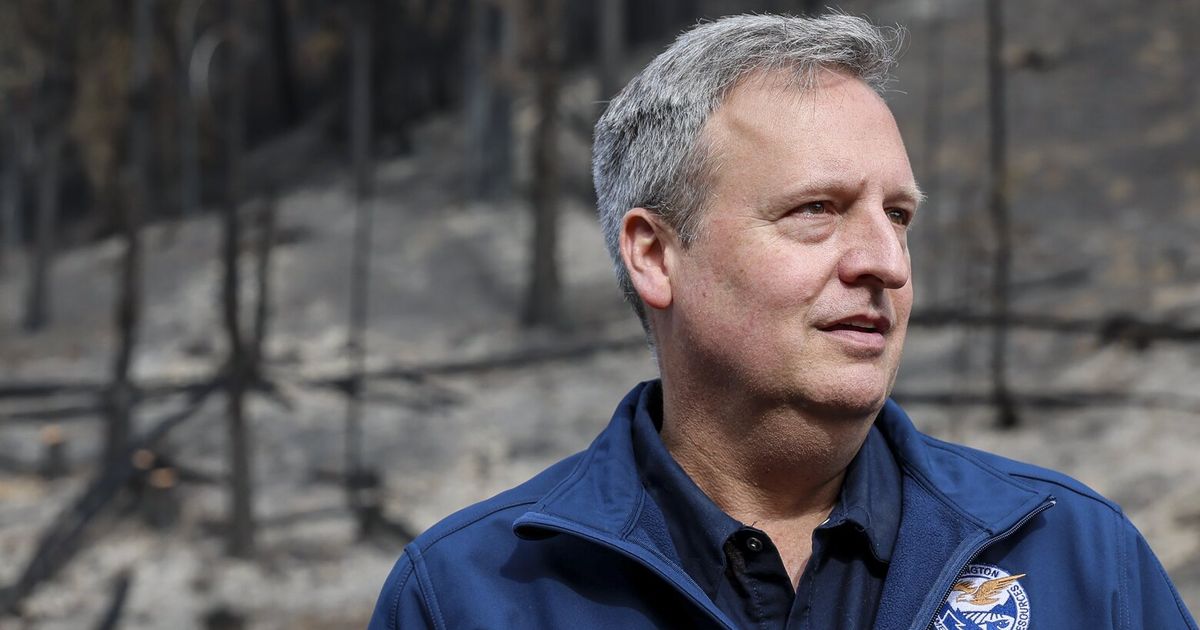
State lands Commissioner Dave Upthegrove often uses an emergency room analogy to describe his agency’s efforts to squelch forest fires. No matter the situation, the Department of Natural Resources will treat its patient — most every inch of the Evergreen State — until the blaze is out.
“And then we send the bill to the Legislature,” Upthegrove said in a news media panel Feb. 19.
That gets expensive, fast. Fire season last year cost Washington state taxpayers at least $287 — which doesn’t include the lives placed at risk by flames and copiously smoky skies.
There’s a better way. Extending Upthegrove’s analogy, his agency can apply some preventative medicine to help thwart future wildfire. One example: Forest practices such as thinning tree canopies and clearing vegetation can reduce the fuels that feed wildfires. That work buys firefighters precious time to contain the worst blazes.
Lawmakers this session made a wise course correction by reinstating $60 million to a state budget that funds that work. But state Department of Natural Resources leaders this year struggled publicly to prove their case before legislative budget writers. They must commit to greater transparency on how these vital funds are spent.
A quick review: In 2021, lawmakers approved unanimously a plan by then-DNR Commissioner Hilary Franz for $125 million every two years. That funded a three-pronged strategy to safeguard the state.
First, DNR beefed up its initial aerial attack, with more than 40 aircraft pre-positioned around Washington to respond more rapidly to the flames. Second, the agency drew up plans to more actively manage lands to reduce the risk for the worst catastrophic blazes and make forests healthier. Finally, DNR partnered with the most at-risk communities to pursue neighborhood-by-neighborhood solutions. The simple act of clearing landscaping within 5 feet of a home, for example, can be the difference that prevents an inferno.
But the Legislature in 2025 cut this biannual funding in half.
As the editorial board has noted many times before, confronting 21st-century wildfire is a choice between taking preemptive action to better protect communities and forestlands, or suffering through unmitigated conflagrations. Lawmakers deserve credit for making the right choice and extending DNR’s ability to do the work.
This year, lawmakers tapped the Climate Commitment Act’s carbon auction proceeds to fund the wildfire work. The auctions generate money from the state’s largest carbon polluters. As climate change both causes more fire and those fires generate toxic emissions of their own, the funds are a logical and appropriate use.
However, DNR’s case to restore those funds this year didn’t appear to be clear-cut for lawmakers. In a terse exchange before the state Senate’s Ways and Means Committee in late January, its chairwoman, Sen. June Robinson, D-Everett, pressed DNR State Forester George Geissler about whether the agency had a comprehensive plan to show lawmakers how the money would be spent.
Geissler replied they did not but that the agency didn’t feel it was necessary — though he said attaining the wildfire support was DNR’s “highest priority,” before the Legislature.
“It seems like if it’s your highest priority, there would’ve been a plan put forward so we know what we’re funding,” Robinson said.
Upthegrove told the editorial board the exchange prompted his agency to provide a “rigorous level of detail” for the money. That should’ve been the attitude from the get-go and must remain so in the years ahead.
Legislators ultimately inserted a requirement into the state budget that DNR report quarterly to the state Office of Financial Management the “costs and accomplishments” of wildfire funding.
The 2021 wildfire law’s funding ends in 2029. Lawmakers will need to find a sustainable new source to continue wildfire mitigation work in the future. A bill this year sponsored by Rep. Shaun Scott, D-Seattle, closed a tax exemption for large banks and diverted those new funds to the wildfire cause. That’s a start. But it will likely only raise a fraction of the funds necessary to do the work.
DNR’s mission must be to use every dollar as strategically as possible to safeguard the state in a dangerous era of climate change — and show proof of their work to lawmakers along the way.
So far, the agency has made the case on the ground: More than 1,800 fires started in the 2025 season, the third highest in DNR’s history. But nearly 95% of those starts were kept to under 10 acres, thanks to those legislative investments.
Fire in Washington’s forests is inevitable. The Legislature can fund a Department of Natural Resources that merely reacts to the flames as they happen, or they can continue to take a multifaceted approach that better meets the threat head on. Lawmakers must continue to choose the latter.
