Close Menu
    National News Brief
    Wednesday, May 6
    • Home
    • Business
    • Lifestyle
    • Science
    • Technology
    • International
    • Arts & Entertainment
    • Sports
    National News Brief
    Home»Technology

    Life-changing eye implant helps blind patients read again

    Team_NationalNewsBriefBy Team_NationalNewsBriefOctober 21, 2025 Technology No Comments5 Mins Read
    Share
    Facebook Twitter LinkedIn Pinterest Email


    Fergus WalshMedical editor

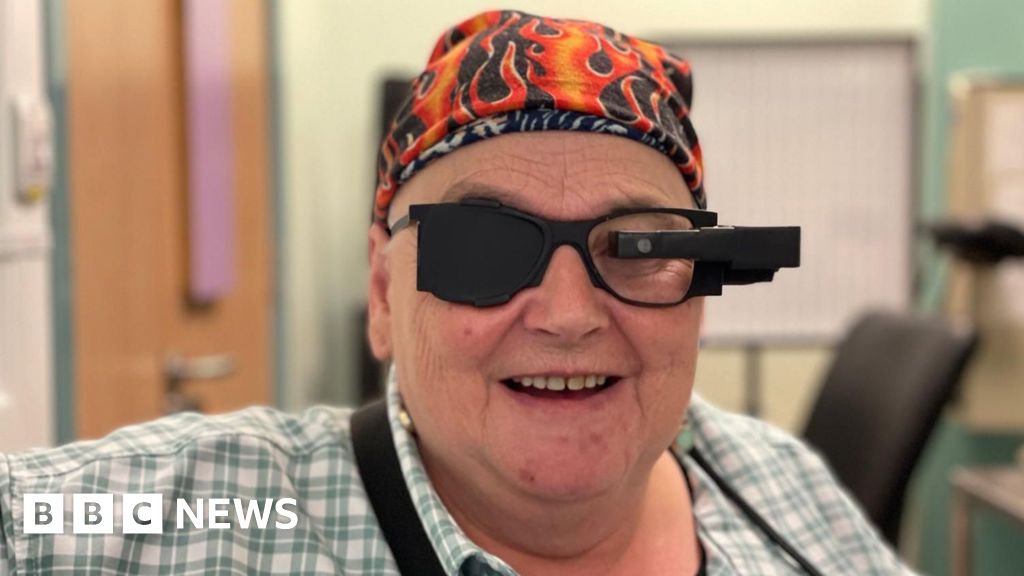
    Sheila Irvine, who is registered blind, punches the air with joy at being able to read again

    A group of blind patients can now read again after being fitted with a life-changing implant at the back of the eye.

    A surgeon who inserted the microchips in five patients at Moorfields Eye Hospital in London says the results of the international trial are “astounding”.

    Sheila Irvine, 70, who is registered blind, told the BBC it was “out of this world” to be able to read and do crosswords again. “It’s beautiful, wonderful. It gives me such pleasure.”

    The technology offers hope to people with an advanced form of dry age-related macular degeneration (AMD), called geographic atrophy (GA), which affects more than 250,000 people in the UK and five million worldwide.

    In those with the condition – which is more common in older people – cells in a tiny area of the retina at the back of the eye gradually become damaged and die, resulting in blurred or distorted central vision. Colour and fine detail are often lost.

    The new procedure involves inserting a tiny 2mm-square photovoltaic microchip, with the thickness of a human hair, under the retina.

    Patients then put on glasses with a built-in video camera. The camera sends an infrared beam of video images to the implant at the back of the eye, which sends them on to a small pocket processor to be enhanced and made clearer.

    The images are then sent back to the patient’s brain, via the implant and optic nerve, giving them some vision again.

    The patients spent months learning how to interpret the images.

    Mahi Muqit, consultant ophthalmic surgeon at Moorfields Eye Hospital in London, who led the UK arm of the trial, told the BBC it was “pioneering and life-changing technology”.

    “This is the first implant that’s been demonstrated to give patients meaningful vision that they can use in their daily life, such as reading, writing.

    “I think this is a major advance,” he said.

    How the implant technology works
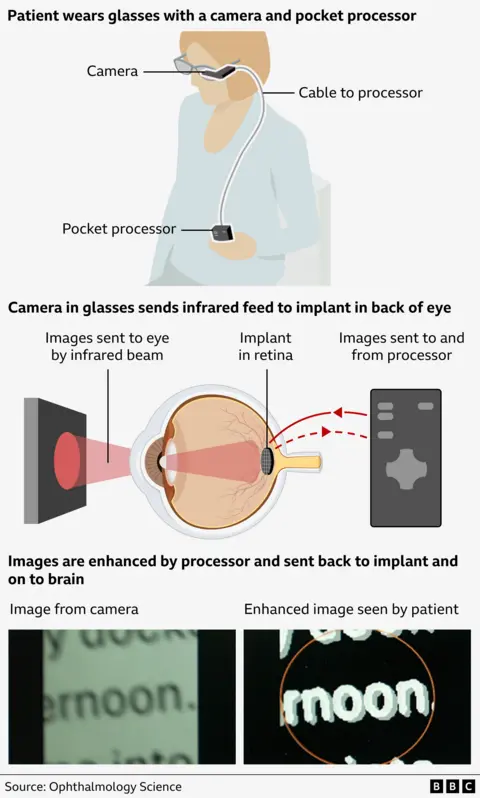
    The graphic shows how the technology works. There is an illustration of a patient with the implant wearing glasses with a built-in video camera and holding a processor connected by wire to the glasses.
Below, another graphic shows how the camera sends images to the implant at the back of the eye, via infrared beam. A close-up of the eye shows the implant receiving those infrared images and then sending them on to a black hand-held processor. Red arrows highlight that the images are sent to the processor, enhanced and then sent back to the implant and on to the brain.
A third graphic illustrates the way the images are enhanced. On the left is an image from the camera showing part of a word. The letters 'ernoon' are coloured black on a white background and appear slightly blurred. On the right is an enhanced image seen by the patient where the letters (now white) are bold and stand out against a black background.

    For the research, published in the New England Journal of Medicine, 38 patients with geographic atrophy in five European countries took part in the trial of the Prima implant, which is made by California biotech Science Corporation.

    Of 32 patients given the implant, 27 were able to read again using their central vision. After a year, this equated to an improvement of 25 letters, or five lines, on an eye chart.

    For Sheila, from Wiltshire, the improvement is even more dramatic. Without the implant, she is completely unable to read.

    But when we filmed Sheila reading an eye chart at Moorfields Hospital, she did not make a single error. After completing it, she punched the air and cheered.

    ‘I am one happy bunny’

    Sheila Irvine faces the camera standing next to a blue sign with white writing saying Welcome to Moorfields, the London hospital where she had the procedure. She is smiling and is wearing a checked shirt and red headscarf.

    Sheila says she rushes her chores every day in order to sit down and put on the special glasses

    The task took huge concentration. Sheila had to put a pillow under her chin in order to steady the feed from the camera, which can focus on just one or two letters at a time. At some points she needed the device switched to magnification mode, especially to distinguish between the letters C and O.

    Sheila began losing her central vision more than 30 years ago, due to loss of cells in the retina. She describes her vision as like having two black discs in each eye.

    Sheila gets around using a white cane because her very limited peripheral vision is completely blurred. She is unable to read even the largest street signs when outdoors.

    When she had to give up her driving licence, she says she cried.

    But after having an implant fitted around three years ago, she is delighted by her progress, as is the medical team at Moorfields.

    “I am able to read my post, books, and do crosswords and Sudoku,” she says.

    When asked if she ever thought she’d read again, Sheila replied: “Not on your nelly!”

    “It is amazing. I am one happy bunny,” she adds.

    “Technology is moving so fast, it’s amazing that I am part of it.”
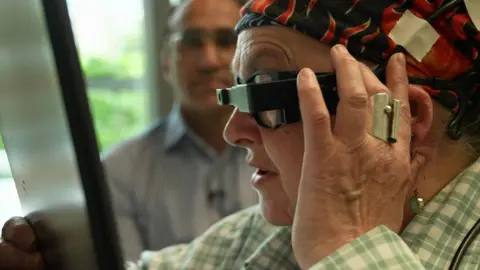
    Sheila is wearing the special glasses, reading from a tablet a few centimetres from her face - she is side-on, holding one hand to the side of her face and concentrating hard. Watching behind her, slightly blurred, is consultant ophthalmic surgeon Mahi Muqit, from Moorfields Eye Hospital.

    Sheila concentrates hard in order to read

    Sheila doesn’t wear the device when outdoors. In part, this is because it requires great concentration – her head has to be held very still in order to read. She also does not want to become over-reliant on the device.

    Instead, she says she “rushes her chores” at home each day before sitting down and putting on the special glasses.

    The Prima implant is not yet licensed so is not available outside of clinical trials, and it’s unclear how much it may eventually cost.

    Nonetheless, Mahi Muqit said he hoped it would be available to some NHS patients “within a few years.”

    It’s possible the technology could be used to help people with other eye conditions in the future.

    Dr Peter Bloomfield, director of research at Macular Society, says the results are “encouraging” and “fantastic news” for those who currently have no treatment options.

    “Artificial vision may offer a lot of hope to many, particularly after previous disappointments in the world of dry AMD treatment.

    “We are now watching closely to see if the Prima implant will be approved for use here in the UK, and crucially whether it could be made available on the NHS.”

    The trials are not expected to help those with conditions where the optic nerve, which sends signals from the retina to the brain, is not functioning.


    Source link

    Team_NationalNewsBrief
    • Website

    Keep Reading

    How Users Quietly Shape Assistive Technology

    Tech Life – Could this tech help millions of us sleep better?

    Soft Photonic Switch Could Drive All‑Optical Logic

    The BCI User Experience: Living With Brain Implants

    OpenAI Engineer Helps Companies Boost Sales

    IEEE Smart Village Is Helping Electrify Rural Cameroon

    Add A Comment

    Comments are closed.

    Editors Picks

    Uber CEO Wants to Partner With Tesla, Musk on Autonomous Vehicles

    February 15, 2025

    How studying babies’ minds is prompting us to rethink consciousness

    February 12, 2025

    Jennifer Aniston Goes Instagram Official With Love Guru Boyfriend

    November 3, 2025

    BREAKING NEWS: Beijing intensifies its transnational repression: relatives of former Canadian candidate Joe Tay detained in Hong Kong after Carney meets with Trump.

    May 10, 2025

    Uncle Sam wants you … to rat on parks that reflect true U.S. history

    July 17, 2025
    Categories
    • Arts & Entertainment
    • Business
    • International
    • Latest News
    • Lifestyle
    • Opinions
    • Politics
    • Science
    • Sports
    • Technology
    • Top Stories
    • Trending News
    • World Economy
    About us

    Welcome to National News Brief, your one-stop destination for staying informed on the latest developments from around the globe. Our mission is to provide readers with up-to-the-minute coverage across a wide range of topics, ensuring you never miss out on the stories that matter most.

    At National News Brief, we cover World News, delivering accurate and insightful reports on global events and issues shaping the future. Our Tech News section keeps you informed about cutting-edge technologies, trends in AI, and innovations transforming industries. Stay ahead of the curve with updates on the World Economy, including financial markets, economic policies, and international trade.

    Editors Picks

    Ryan Reynolds Reportedly Pushed Blake Lively Toward Settlement

    May 6, 2026

    Washington media gala suspect slapped with additional charge for shooting officer

    May 6, 2026

    Trump pauses US operation in Strait of Hormuz in push for deal with Iran | US-Israel war on Iran News

    May 6, 2026

    Cardinals must stay far away from QB Aaron Rodgers amid rumors

    May 6, 2026
    Categories
    • Arts & Entertainment
    • Business
    • International
    • Latest News
    • Lifestyle
    • Opinions
    • Politics
    • Science
    • Sports
    • Technology
    • Top Stories
    • Trending News
    • World Economy
    • Privacy Policy
    • Disclaimer
    • Terms and Conditions
    • About us
    • Contact us
    Copyright © 2024 Nationalnewsbrief.com All Rights Reserved.

    Type above and press Enter to search. Press Esc to cancel.