

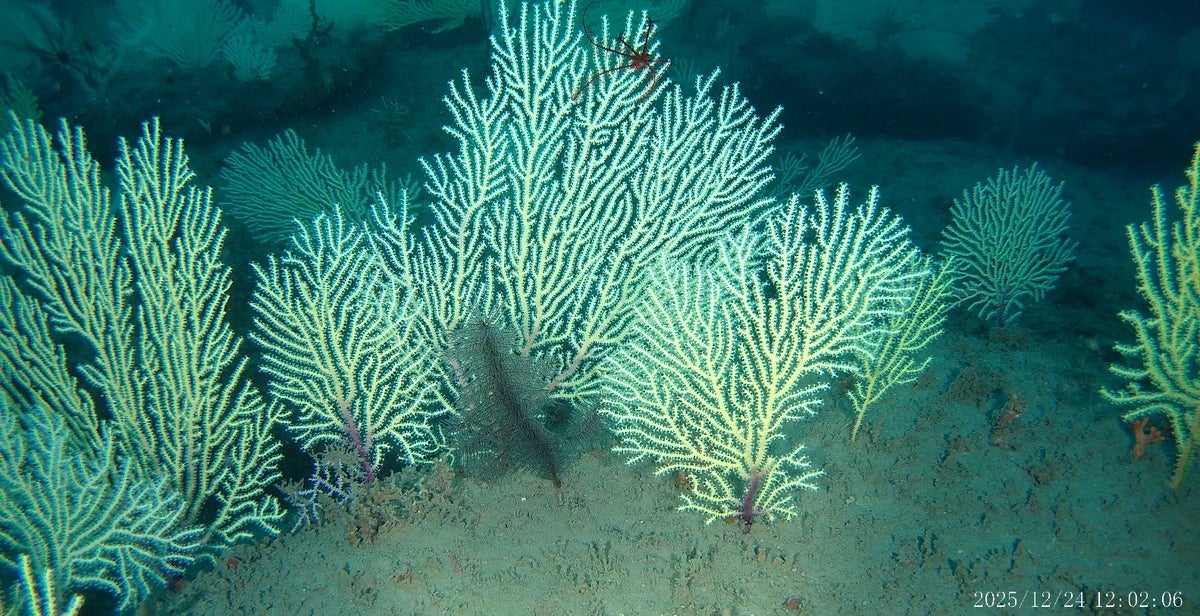
Some 60 years ago scientists documented a coral reef off the coast of Benin in West Africa that they presumed was already dead. But now researchers have rediscovered the coral reef and found it to be a thriving deep-water community.
The reef was first flagged when fishing surveys conducted in the 1960s detected a possible coral formation more than 50 meters beneath the surface. Because of its depth and the limited technology available at the time, scientists concluded the reef was probably a lost cause and didn’t investigate further.
That changed when a team led by Gérard Zinzindohoué of the Benin Fisheries and Oceanological Research Institute recently returned to the area with high-resolution sonar, an underwater drone and the National Geographic Exploration Technology Lab’s Deep Sea Camera System.
On supporting science journalism
If you’re enjoying this article, consider supporting our award-winning journalism by subscribing. By purchasing a subscription you are helping to ensure the future of impactful stories about the discoveries and ideas shaping our world today.
“I was guided by the hope that sometimes nature can surprise us, and what you don’t intend to see is what can actually happen—it surprised me as well,” Zinzindohoué says.
“The first thing that gave us hope was our first deployment of the sonar. We were seeing nothing but sand and sediment, and suddenly we could see some rocky structure,” he adds. “Through the signature, we thought we might be in front of something that could be a coral reef barrier.”
Underwater imagery confirmed the sonar’s signal: a living coral ecosystem in the ocean’s “twilight zone.” Such so-called mesophotic reefs thrive in dimly lit water, so they are deeper than the shallow tropical reefs most people are familiar with. Rather than forming a single continuous barrier, the reef off Benin consists of scattered coral patches growing on rocky outcrops. “A mesophotic coral ecosystem is a type of coral habitat formed deeper than the usual shallow coral reef, in a zone where light is much more limited,” Zinzindohoué says. “Unlike a typical shallow reef, it does not always form a single continuous reef structure. Instead it can appear as patchy or scattered coral communities spread across the seafloor.”
The rediscovery, published on July 19 in Frontiers in Marine Science, marks the first confirmed living mesophotic coral ecosystem on the Gulf of Guinea’s continental shelf. It’s unclear, however, if the reef has existed continuously since the 1960s detections or if it has waxed and waned over the years.
Zinzindohoué says future expeditions—including direct coral sampling and broader seafloor surveys of the west African coast—will be needed to determine the reef’s full extent and to reconstruct its history.
“Right now, on the coast of West Africa, and particularly in Benin, ocean science and marine research are not well developed,” he says, adding that governments are more focused on other, more urgent societal issues.
“We hope that, through this result, people will start to look at the ocean differently,” Zinzindohoué says, “and that it might inspire others to do more ocean research and focus on the protection and conservation of marine ecosystems.”
It’s Time to Stand Up for Science
If you enjoyed this article, I’d like to ask for your support. Scientific American has served as an advocate for science and industry for 180 years, and right now may be the most critical moment in that two-century history.
I’ve been a Scientific American subscriber since I was 12 years old, and it helped shape the way I look at the world. SciAm always educates and delights me, and inspires a sense of awe for our vast, beautiful universe. I hope it does that for you, too.
If you subscribe to Scientific American, you help ensure that our coverage is centered on meaningful research and discovery; that we have the resources to report on the decisions that threaten labs across the U.S.; and that we support both budding and working scientists at a time when the value of science itself too often goes unrecognized.
In return, you get essential news, captivating podcasts, brilliant infographics, can’t-miss newsletters, must-watch videos, challenging games, and the science world’s best writing and reporting. You can even gift someone a subscription.
There has never been a more important time for us to stand up and show why science matters. I hope you’ll support us in that mission.
