

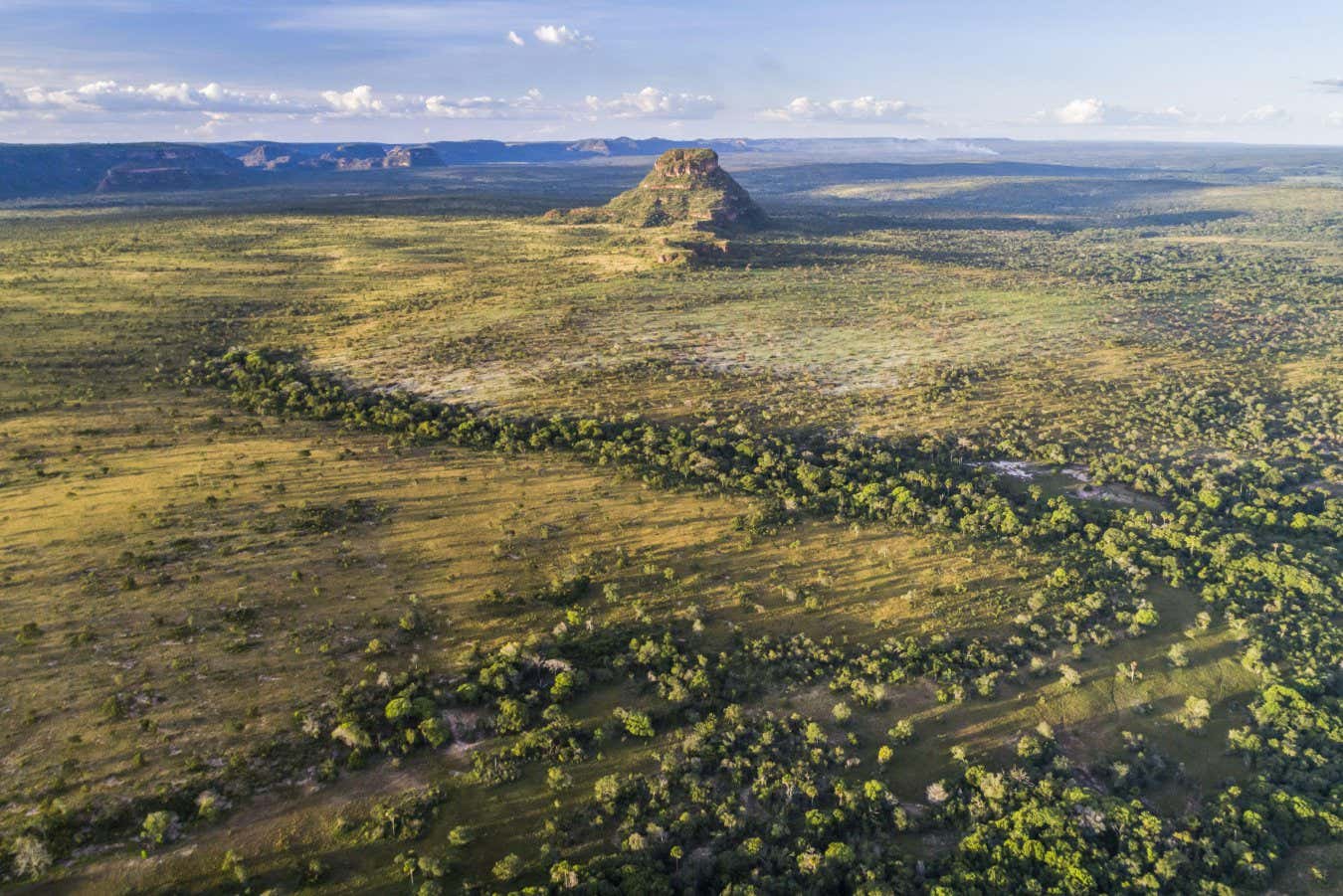
Vegetation like that in the Chapada das Mesas National Park, Brazil, is no longer removing as much CO₂ from the atmosphere
Pulsar Imagens/Alamy
Hot and wet weather in 2024 – the hottest, wettest year on record – caused ecosystems on land to emit nearly as much carbon dioxide as they took out of the atmosphere, according to a preliminary analysis. This is the second year in a row in which the land carbon sink has nearly vanished due to climate-related stressors, and would explain why 2024 saw a record jump in the concentration of CO₂ in the atmosphere.
The findings could also mean that the land carbon sink – which normally removes billions of tonnes of CO₂ from the atmosphere each year and is essential for meeting climate targets – is weakening decades earlier than expected. It remains unclear, however, if the past two years represent a lasting trend.
“Everybody I’ve talked with who is working on this subject is very surprised,” says Guido van der Werf at Wageningen University in the Netherlands. “It was projected to be a weak sink, but now there’s hardly any sink.”
Forests, grasslands and other ecosystems on land take up CO₂ from the atmosphere as they grow. When they decompose or burn, this carbon is returned to the atmosphere. The uptake and release should generally be in balance. But over the past half century or so, these ecosystems have tended to take up more CO₂ than they have released, creating a carbon sink that varies in strength from year to year.
This tilted balance is thought to be due mainly to increased concentrations of CO₂ in the atmosphere fertilising plants, plus other factors like nutrient pollution and reforestation. But it isn’t expected to last forever because the climate consequences of rising CO₂ are catching up with the fertilisation effect. “We know the land carbon sink will diminish, but we don’t know how fast it will diminish,” says Van der Werf.
In 2023, researchers were concerned when the land carbon sink nearly disappeared due to extreme wildfires, heat and drought making ecosystems less productive. These conditions were driven mainly by rising concentrations of greenhouse gases, as well as the emergence of the El Niño pattern in the Pacific ocean, which is generally associated with a weaker sink.
In 2024, the sink was expected to strengthen as El Niño faded and there were fewer wildfires. But an international research team that includes Van der Werf has found that the sink was extremely weak again.
To estimate carbon cycling, the researchers used satellite data on the greenness of the land’s surface – which generally corresponds to plant growth – to calculate the productivity of the planet’s terrestrial ecosystems, and therefore the amount of CO₂ they took up. They then subtracted from this the amount of CO₂ released in wildfires and by decomposition, using measurements of CO₂ in the atmosphere from all over the world to estimate how much was released.
They found the land carbon sink in 2024 nearly disappeared, removing around 2.6 billion tonnes less CO₂ than usual. This was even less than the struggling sink removed during the 2015-2016 El Niño, making it the weakest land carbon sink in over a decade.
Unlike in 2023, however, the researchers found this weakening wasn’t mainly driven by fires and dry weather. Instead, their analysis found hot and wet conditions sped up the rate at which organic matter was decomposing. Ecosystems also saw an increase in productivity – greenness reached record highs – but this was outpaced by the overall amount of CO2 released, a measure called total ecosystem respiration.
“The large decline in land sink is caused by the respiration,” says Guanyu Dong at Nanjing University in China, who led the analysis. “It’s two quite different underlying mechanisms.” While most regions saw a weaker sink, this effect was especially notable in grasslands and shrublands in the tropics, he says.
Van der Werf says these numbers are a first estimate, and other teams teasing apart what happened with the carbon sink could get different results. But this weakening would explain most of the record jump in the concentration of CO₂ in 2024, which was too large to be explained by fossil fuel emissions alone.
The disappearance of the sink for the second year running could also be a sign it is diminishing earlier than expected. “This to me looks like the more pessimistic models may be right,” says Van der Werf. The early loss of the sink would mean concentrations of CO₂ in the air would rise faster than anticipated, and and could contribute to temperatures continuing to rise even after reaching net zero emissions.
“It is certainly possible, and that’s the scary implication of this whole phenomenon,” says Scott Denning at Colorado State University, who wasn’t involved with the research. However, he says it could be that the past two years were a blip, and that the extreme fires and acceleration in decomposition rates will be hard to repeat. “You need to be cautious interpreting even two years of growth as a persistent collapse,” he says.
Topics:
